Marcelo Maragni was born in Sao Paulo, Brazil. According to his mother’s idea, he was ment to be an architect in a quest of changing the world. Instead, he preferred to take possession of his father’s camera and learn another craft on his own.
“One talented photographer has managed to capture these jaw-dropping images that show off the beauty of the surf and the art hidden in the waves. Kenji Croman has a deep passion for bodyboarding and photography and was inspired to combine the two after growing up in Hawaii”. – Caters News. (Photo by Kenji Croman/Caters News)
Two holidaymakers amuse themselves with a porter's trolley whilst waiting for their train at Euston Station, London, 5th August 1939. (Photo by A. J. O'Brien/Fox Photos/Getty Images)
A Chinese tourist wears protective gloves as she holds a baby Siberian tiger as they pose for pictures at the Heilongjiang Siberian Tiger Park on August 16, 2017 in Harbin, northern China. The center is one of two Siberian tiger parks in the Chinese province of Heilongjiang, about 500 kilometers (300 miles) from the border with Russia. It is considered the world's largest for breeding the Siberian, or Amur, tiger which is listed as endangered by the World Wildlife Federation. (Photo by Kevin Frayer/Getty Images)
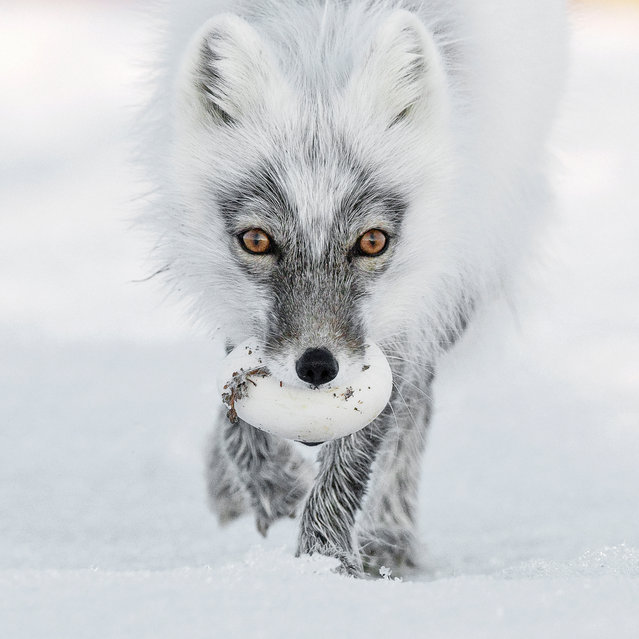
Arctic treasure by Sergey Gorshkov (Russia). An arctic fox carries its egg trophy from a raid on a snow goose nest and heads for a suitable burial spot. Finalist 2017, Animal Portraits. (Photo by Sergey Gorshkov/2017 Wildlife Photographer of the Year)
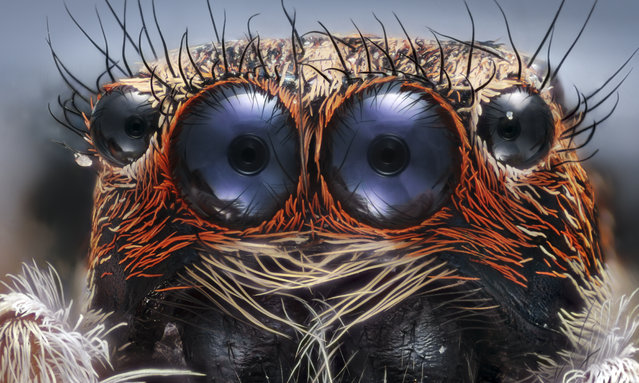
A competition, now in its 43rd year, dedicated to showcasing the beautiful and bizarre as seen under a light microscope attracted over 2,000 entries from 88 countries. Here: Honorable Mention by Emre Can Alagöz, Istanbul, Turkey: The eyes of a jumping spider, magnified 6x. (Photo by Emre Can Alagöz/2017 Nikon Small World Photomicrography Competition)
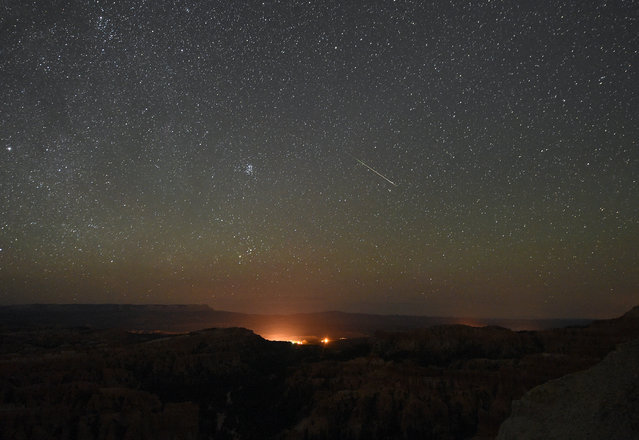
A Perseid meteor streaks across the sky above Inspiration Point early on August 12, 2016 in Bryce Canyon National Park, Utah. The annual display, known as the Perseid shower because the meteors appear to radiate from the constellation Perseus in the northeastern sky, is a result of Earth's orbit passing through debris from the comet Swift-Tuttle. (Photo by Ethan Miller/Getty Images)