Loading...
Done
A view of one of the dioramas contained inside iron boxes as part of the “S.A.C.R.E.D” installation by Chinese artist Ai Weiwei during a media preview at the cathedral in Cuenca, Spain, July 21, 2016. (Photo by Susana Vera/Reuters)

A view of one of the dioramas contained inside iron boxes as part of the “S.A.C.R.E.D” installation by Chinese artist Ai Weiwei during a media preview at the cathedral in Cuenca, Spain, July 21, 2016. Ai Weiwei has reproduced scenes of his incarceration for a new art installation, a series of almost life-size dioramas – encased in steel boxes – showing his life in jail. (Photo by Susana Vera/Reuters)
Details
26 Jul 2016 10:25:00
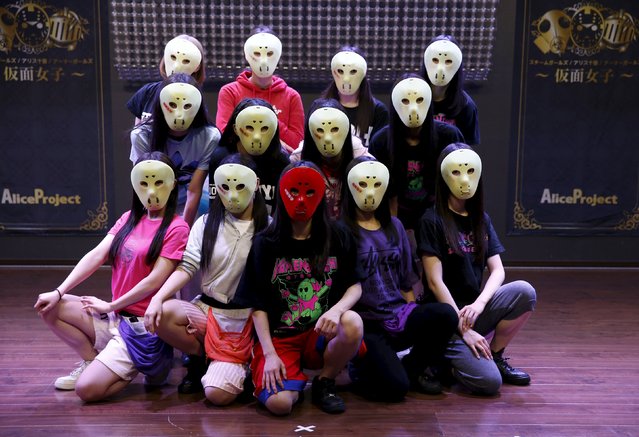
Members of Japanese idol group Kamen Joshi (Masked Girls)  pose for a photo after a rehearsal for a concert at their theatre in Tokyo's Akihabara district, Japan March 17, 2016. For countless girl and pop-idol bands in Japan, standing out from the crowd can be daunting, but one group – “Kamen Joshi” – seems to have found the answer by hiding behind masks. The Tokyo-based all female band has 18 members, split into three groups that perform across Japan and elsewhere in Asia. (Photo by Toru Hanai/Reuters)

Members of Japanese idol group Kamen Joshi (Masked Girls) pose for a photo after a rehearsal for a concert at their theatre in Tokyo's Akihabara district, Japan March 17, 2016. For countless girl and pop-idol bands in Japan, standing out from the crowd can be daunting, but one group – “Kamen Joshi” – seems to have found the answer by hiding behind masks. The Tokyo-based all female band has 18 members, split into three groups that perform across Japan and elsewhere in Asia. (Photo by Toru Hanai/Reuters)
Details
30 Mar 2016 11:04:00


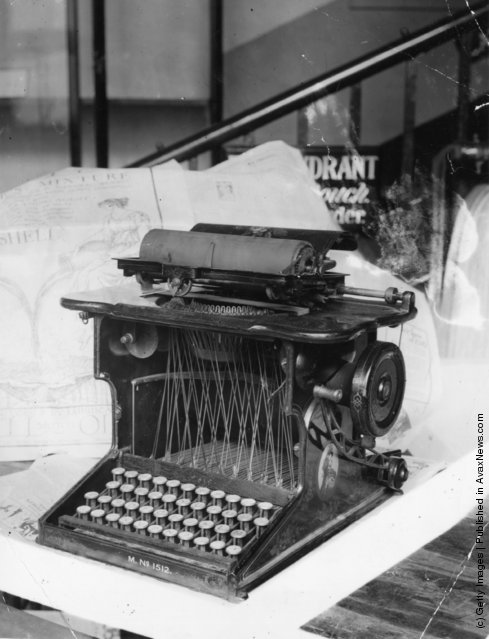
In April 2011 last factory in the world on manufacture of typewriters was closed. The epoch of typewriters has ended...

Photo: A model of a commercial typewriter from 1867. (Photo by Topical Press Agency/Getty Images). June 1923
Details
28 Apr 2011 07:25:00
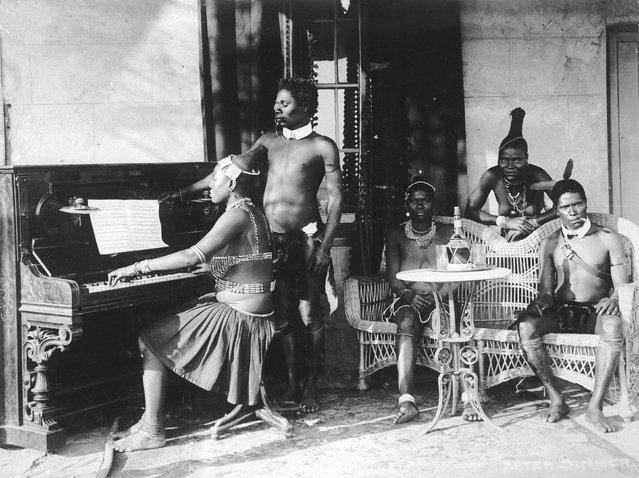
circa 1925:  A Zulu woman playing the piano while a group of others sit and listen.  (Photo by General Photographic Agency/Getty Images)

“The Zulu are the largest South African ethnic group, with an estimated 10–11 million people living mainly in the province of KwaZulu-Natal. Small numbers also live in Zimbabwe, Zambia, and Mozambique. Their language, Zulu, is a Bantu language; more specifically, part of the Nguni subgroup. The Zulu Kingdom played a major role in South African history during the 19th and 20th centuries. Under apartheid, Zulu people were classed as third-class citizens and suffered from state-sanctioned discrimination. They remain today the most numerous ethnic group in South Africa, and now have equal rights along with all other citizens”. – Wikipedia.

Photo: A Zulu woman playing the piano while a group of others sit and listen (to put it briefly, Englishmen scoff over Zulu). South Africa, circa 1925. (Photo by General Photographic Agency)

Details
03 Feb 2014 09:40:00
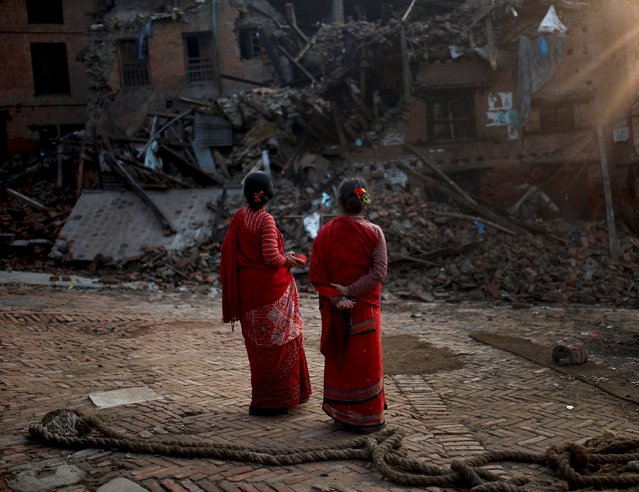
Women look at a collapsed building caused by earthquakes, in  Bhaktapur, Nepal, May 18, 2015. (Photo by Ahmad Masood/Reuters)

Women look at a collapsed building caused by earthquakes, in Bhaktapur, Nepal, May 18, 2015. Nepal is facing billions in reconstruction costs with almost 745,600 buildings and homes damaged or destroyed, including at least 87,700 in the capital, according to Nepal's emergency authority. (Photo by Ahmad Masood/Reuters)
Details
21 May 2015 11:39:00
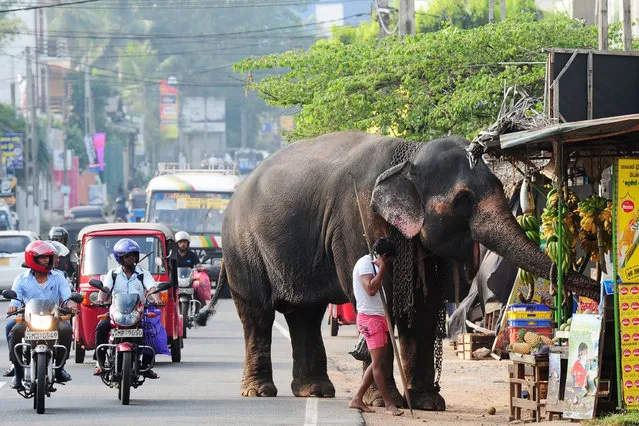
A Sri Lankan elephant, accompanied by his mahout, browse through a roadside fruit stall in Colombo on January 19, 2015. The Sri Lankan elephant is listed as endangered by the International Union for Conservation of Nature (IUCN) as the population has declined by at least 50 percent over the last three generations, with the species threatened by habitat loss, degradation and fragmentation. (Photo by Lakruwan Wanniarachchi/AFP Photo)

A Sri Lankan elephant, accompanied by his mahout, browse through a roadside fruit stall in Colombo on January 19, 2015. The Sri Lankan elephant is listed as endangered by the International Union for Conservation of Nature (IUCN) as the population has declined by at least 50 percent over the last three generations, with the species threatened by habitat loss, degradation and fragmentation. (Photo by Lakruwan Wanniarachchi/AFP Photo)
Details
23 Jan 2015 13:21:00
Members of the U.S. Army 173rd Airborne Brigade stand at attention as a Ukrainian folk dance group performs at the opening ceremony of the “Rapid Trident” NATO military exercises on September 15, 2014 near Yavorov, Ukraine. (Photo by Sean Gallup/Getty Images)

Members of the U.S. Army 173rd Airborne Brigade stand at attention as a Ukrainian folk dance group performs at the opening ceremony of the “Rapid Trident” NATO military exercises on September 15, 2014 near Yavorov, Ukraine. The two-week exercises include participating units from a variety of NATO and NATO-associate countries as well as Ukrainian troops. Meanwhile fighting between pro-Russian separatists and Ukrainian armed foces has flared again in eastern Ukraine in a battle for the control of Donetsk airport despite the tenuous ceasefire. (Photo by Sean Gallup/Getty Images)
Details
17 Sep 2014 12:34:00
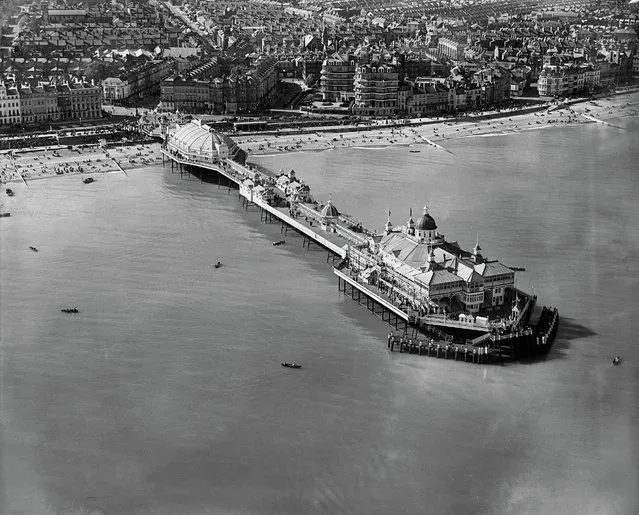
While the lido was described as bringing “modernism to the masses” on the British coast it was just the latest example of a trend that had been developing since Victorian times – transforming seaside towns into resorts for leisure and entertainment. In the latter half of the nineteenth century, the fashion was for local authorities to build great piers stretching from the promenade out into the sea

While the lido was described as bringing “modernism to the masses” on the British coast it was just the latest example of a trend that had been developing since Victorian times – transforming seaside towns into resorts for leisure and entertainment. In the latter half of the nineteenth century, the fashion was for local authorities to build great piers stretching from the promenade out into the sea. The Eastbourne Pier, pictured here in May 1931, was erected between 1866 and 1870 to an ingenious design by Eugenius Birch, which saw the structure sitting on special cups allowing the supporting struts to “move” in bad weather. Arranged on the pier's 1,000-foot length were kiosks, a theatre, a ballroom and a camera obscura. 1931. (Photo by Aerofilms Collection via “A History of Britain From Above”)
Details
25 Feb 2014 12:59:00