Loading...
Done
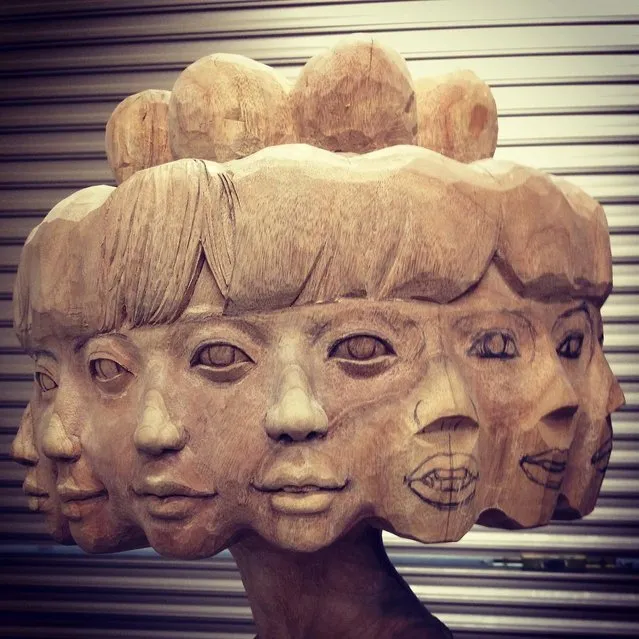
Sculpture By Yoshitoshi Kanemaki

There are many ways to interpret the creations of Yoshitoshi Kanemaki, whose works usually involve sculptures of people where two or more characters have merged into a single being. Possibly, Yoshitoshi Kanemaki is trying to express through his sculptures that everyone’s soul is multifaceted. Good emotions are mixed with the bad, love is mixed with hate, contempt with admiration. How often do you hear that a person loves someone deeply, while doing completely horrendous things, unable to see that he or she is destroying their object of love? Nevertheless, we should be thankful to the nature for all the different emotions that we are able to feel. Unlike animals, who only show simple forms of emotions, such as anger, happiness, and a few others, human soul is much deeper, allowing us to feel a full plethora of emotions. (Photo by Yoshitoshi Kanemaki)
Details
20 Nov 2014 12:26:00
Dead sperm whales are seen washed up on a beach on Texel Island, The Netherlands, January 13, 2016. The five sperm whales that beached on the Dutch lsland of Texel on Tuesday have died overnight, Dutch media reported. It is extremely unusual for so many whales to be in Dutch waters, a spokesman for the Ecomare marine centre told local paper Noordhollands Dagblad. (Photo by Cris Toala Olivares/Reuters)

Dead sperm whales are seen washed up on a beach on Texel Island, The Netherlands, January 13, 2016. The five sperm whales that beached on the Dutch lsland of Texel on Tuesday have died overnight, Dutch media reported. It is extremely unusual for so many whales to be in Dutch waters, a spokesman for the Ecomare marine centre told local paper Noordhollands Dagblad. Efforts to get the whales back into open water on Tuesday evening failed and rescuers finally withdrew from the beach at around midnight. The area of beach where the whales are has been closed to the public, to minimise the distress to the animals. (Photo by Cris Toala Olivares/Reuters)
Details
15 Jan 2016 08:04:00
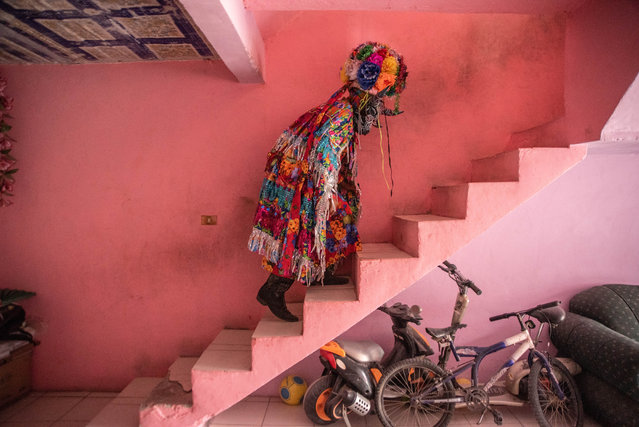
Inhabitants of the community of Coyolillo celebrate their Afro-descendant carnival in Veracruz, Mexico on February 25, 2020. This carnival has more than 100 years of history and is the heritage of the African workers who arrived in that area more than 300 years ago to work in the sugar cane fields. The event is known for the colourful robes, capes and animal masks – of bulls, deer, goats and cows – worn by participants. As such, the carnival is a unique expression of African-Mexican folk art. (Photo by Hector Adolfo Quintanar Perez/ZUMA Wire/Rex Features/Shutterstock)

Inhabitants of the community of Coyolillo celebrate their Afro-descendant carnival in Veracruz, Mexico on February 25, 2020. This carnival has more than 100 years of history and is the heritage of the African workers who arrived in that area more than 300 years ago to work in the sugar cane fields. (Photo by Hector Adolfo Quintanar Perez/ZUMA Wire/Rex Features/Shutterstock)
Details
05 Mar 2020 00:03:00
Women share a joke as they walk to a paddy field in Cikawao village of Majalaya, West Java province, Indonesia, October 12, 2017. (Photo by Reuters/Beawiharta)

A gory fight to the death between snarling dogs and captured wild boars. Gathered around a bamboo-walled arena, Indonesians in this remote part of Java island seem eager to watch the blood-curdling contests, known locally as “adu bagong” (boar fighting). Not surprisingly, animal rights activists are up in arms against the regular spectacle, which began in the 1960s when wild pig numbers in this area in West Java soared and they were hunted to protect crops. Here: Women share a joke as they walk to a paddy field in Cikawao village of Majalaya, West Java province, Indonesia, October 12, 2017. (Photo by Reuters/Beawiharta)
Details
21 Oct 2017 07:46:00
Players in action during the Swamp Soccer Championships 2019 in Hyrynsalmi, Finland, 19 July 2019. The World Championship in swamp football is played annually on Vuorisuo bog in Hyrynsalmi. (Photo by Tomi Hanninen/EPA/EFE)

Players in action during the Swamp Soccer Championships 2019 in Hyrynsalmi, Finland, 19 July 2019. The World Championship in swamp football is played annually on Vuorisuo bog in Hyrynsalmi. (Photo by Tomi Hanninen/EPA/EFE)
Details
21 Jul 2019 00:07:00
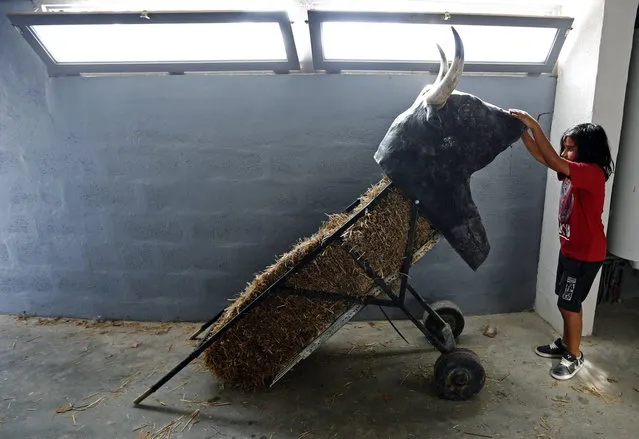
Nino, a ten-year-old toreador apprentice of the French Tauromachy Centre, nicknamed El Nino, touches a practice bull at the bullring of Garons, near Nimes, September 25, 2013. (Photo by Jean-Paul Pelissier/Reuters)

Nino, a ten-year-old toreador apprentice of the French Tauromachy Centre, nicknamed El Nino, touches a practice bull at the bullring of Garons, near Nimes, September 25, 2013. Since 1983, the French Tauromachy Centre in Nimes has trained some 1,000 youths in the art of bullfighting. Twenty of them have gone on to become professional matadors, facing fighting bulls in the arena. Twice a week, students take courses with a matador to learn the movements and gestures of the bullfighter in the ring, but without an animal present. Students train with calves in the surrounding fields during spring, and regularly participate in beginner's bullfights (becerradas) without killing calves. Solal has been taking courses for three years and Nino, for just a year now. Both are normally enrolled in French public schools, but have one thought in mind – bullfighting. They share a passion linked to the city of Nimes, famous for its ferias and bullring. (Photo by Jean-Paul Pelissier/Reuters)
Details
06 Nov 2013 10:12:00
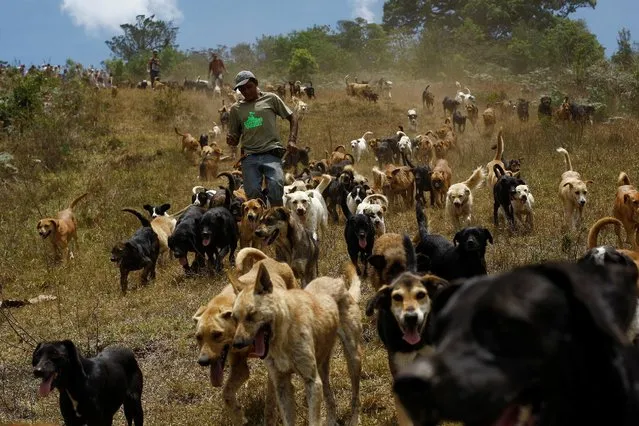
Stray dogs run at dog sanctuary Territorio de Zaguates or “Land of the Strays” in Carrizal de Alajuela, Costa Rica, April 20, 2016. In a lush, sprawling corner of Costa Rica, hundreds of dogs roam freely on a hillside – among the luckiest strays on earth. Fed, groomed and cared for by vets, more than 750 dogs rescued from the streets of Costa Rica inhabit Territorio de Zaguates or “Land of the Strays”, a pooch paradise. The 152-hectare sanctuary in the centre of the Central American country is funded by donations. Around 8,000 dogs have passed through the refuge. There are more than a million stray dogs in Costa Rica, where the government outlawed putting animals down in 2003. (Photo by Juan Carlos Ulate/Reuters)

Stray dogs run at dog sanctuary Territorio de Zaguates or “Land of the Strays” in Carrizal de Alajuela, Costa Rica, April 20, 2016. In a lush, sprawling corner of Costa Rica, hundreds of dogs roam freely on a hillside – among the luckiest strays on earth. Fed, groomed and cared for by vets, more than 750 dogs rescued from the streets of Costa Rica inhabit Territorio de Zaguates or “Land of the Strays”, a pooch paradise. (Photo by Juan Carlos Ulate/Reuters)
Details
30 Apr 2016 09:41:00
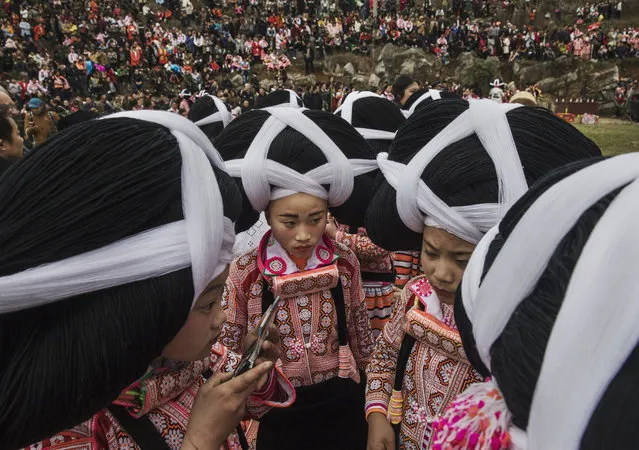
Girls of the Long Horn Miao ethnic minority group wear headdresses as they prepare gather for Tiaohua or Flower Festival as part of the Lunar New Year on February 6, 2017 in Longga village, Guizhou province, southern China. The Long Horn Miao are recognized for their declining practice of wrapping a blend of linen, wool, and the hair of their ancestors around animal horns or a wooden clip to make headdresses. Many young women say they now wear the headdresses only for special occasions and festivals, as the ornaments, which are attached by the horns to their real hair, have proved impractical for modern daily life in a fast changing world. China officially recognizes 56 different ethnic minorities, and statistics show over 7 million Chinese identifying themselves as Miao. But the small Long Horn Miao community counts only around 5000 people living in 12 villages, whose age-old traditions, language, and culture are fading. It is increasingly difficult in a modernizing China, as young people are drawn from remote rural villages to opportunities in bigger cities amongst wide-scale urbanization. Farming and labour remain the mainstays of life for the Long Horn Miao, leaving the area relatively poor in comparison with many parts of China. The government has invested significant amounts into local infrastructure and the tourism industry to try to bolster the local economy. (Photo by Kevin Frayer/Getty Images)

Girls of the Long Horn Miao ethnic minority group wear headdresses as they prepare gather for Tiaohua or Flower Festival as part of the Lunar New Year on February 6, 2017 in Longga village, Guizhou province, southern China. (Photo by Kevin Frayer/Getty Images)
Details
13 Feb 2017 00:01:00