Loading...
Done
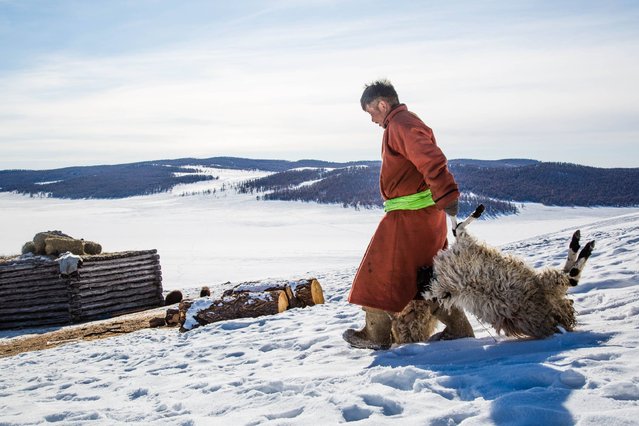
This handout photo taken on February 12, 2017 and released on February 16 by the International Federation of Red Cross and Red Crescent Societies (IFRC) shows Mongolian herder Munkhbat Bazarragchaa (C) dragging two sheep – which recently died due to the weather - to a pile of dead animals behind his “ger” in Khuvsgul province, northern Mongolia. Thousands of Mongolian herders face disastrous livestock losses from dreaded severe weather  known as the “dzud”, the Red Cross said on February 16, 2017 in launching an international emergency aid appeal. (Photo by Mirva Helenius/AFP Photo/IFRC)

This handout photo taken on February 12, 2017 and released on February 16 by the International Federation of Red Cross and Red Crescent Societies (IFRC) shows Mongolian herder Munkhbat Bazarragchaa (C) dragging two sheep – which recently died due to the weather - to a pile of dead animals behind his “ger” in Khuvsgul province, northern Mongolia. Thousands of Mongolian herders face disastrous livestock losses from dreaded severe weather known as the “dzud”, the Red Cross said on February 16, 2017 in launching an international emergency aid appeal. (Photo by Mirva Helenius/AFP Photo/IFRC)
Details
17 Feb 2017 11:40:00
The National Geographic Photo Ark is a travelling exhibition of photographer Joel Sartore’s quest to create a photo archive of biodiversity around the world. So far, Sartore has captured studio portraits of more than 6,000 species – a number that he hopes to double. On 1 July, the ark will open at Melbourne zoo – the first time it has been exhibited in the southern hemisphere. More than 50 portraits will be on display, including many of Australian endangered animals being protected by programs at the zoo itself. These captions have been edited from text supplied by Melbourne zoo. Here: Barking owl. So-named because its call sounds like a barking dog, these birds are native to Australia, Indonesia and Papua New Guinea. In Victoria they are listed as an endangered species, and in 2003 there were estimated to be fewer than 50 breeding pairs. The main threat to the species in Victoria is loss of habitat, especially large trees with hollows in which they can nest and on which many of their prey depend. Apart from a bark, they may utter a chilling scream when they feel threatened. (Photo by Joel Sartore/National Geographic Photo Ark/The Guardian)

The National Geographic Photo Ark is a travelling exhibition of photographer Joel Sartore’s quest to create a photo archive of biodiversity around the world. So far, Sartore has captured studio portraits of more than 6,000 species – a number that he hopes to double. On 1 July, the ark will open at Melbourne zoo – the first time it has been exhibited in the southern hemisphere. More than 50 portraits will be on display, including many of Australian endangered animals being protected by programs at the zoo itself. These captions have been edited from text supplied by Melbourne zoo. Here: Barking owl. (Photo by Joel Sartore/National Geographic Photo Ark/The Guardian)
Details
01 Jul 2017 07:45:00
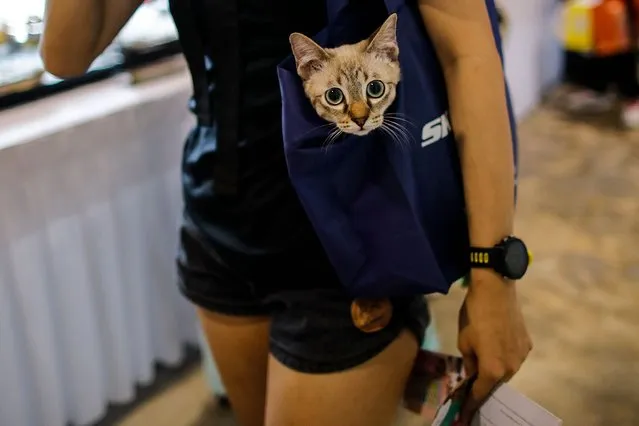
A curious cat ipeeks out of a bag carried by its owner on a tour of the Cat Expo 2022 in Kuala Lumpur, Malaysia, 30 September 2022. The 'Ekspo Kucing', described as Malaysia's Largest Cat Expo runs from 30 September to 02 October 2022 at the Matrade Exhibition and Convention Centre (MECC) in Kuala Lumpur and “will also feature other variety of pets such as rabbits, hamsters, guinea pigs, reptiles and exotic animals”, the MECC said on its website, along with other highlight events such as a Federation Internationale Feline (FIFe) Cat Competition, Cat Adoptions or a “Sugar Glinder Contest”. (Photo by Fazry Ismail/EPA/EFE/Rex Features/Shutterstock)

A curious cat ipeeks out of a bag carried by its owner on a tour of the Cat Expo 2022 in Kuala Lumpur, Malaysia, 30 September 2022. The “Ekspo Kucing”, described as Malaysia's Largest Cat Expo runs from 30 September to 02 October 2022 at the Matrade Exhibition and Convention Centre (MECC) in Kuala Lumpur and “will also feature other variety of pets such as rabbits, hamsters, guinea pigs, reptiles and exotic animals”, the MECC said on its website, along with other highlight events such as a Federation Internationale Feline (FIFe) Cat Competition, Cat Adoptions or a “Sugar Glinder Contest”. (Photo by Fazry Ismail/EPA/EFE/Rex Features/Shutterstock)
Details
28 Oct 2022 05:09:00
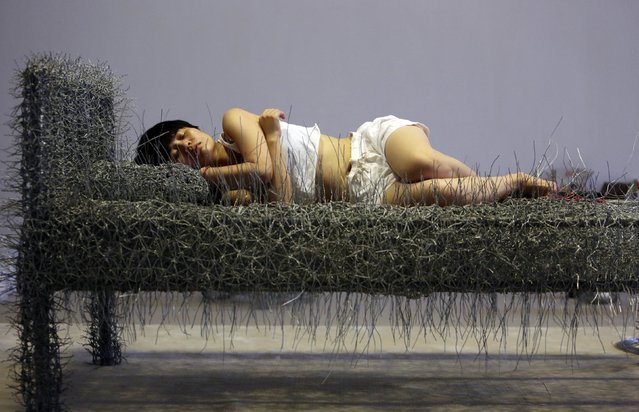
Chinese artist Zhou Jie takes a nap on an unfinished iron wire bed, one of her sculpture works, after lunch at Beijing Now Art Gallery, in Beijing August 11, 2014. Zhou started her art project titled “36 Days” on August 9, in which she would live inside an exhibition hall with an unfinished iron wire bed, some iron wire sculptures in the shape of stuffed animal dolls, a certain amount of food and her mobile phone, for 36 days. (Photo by Jason Lee/Reuters)

Chinese artist Zhou Jie takes a nap on an unfinished iron wire bed, one of her sculpture works, after lunch at Beijing Now Art Gallery, in Beijing August 11, 2014. Zhou started her art project titled “36 Days” on August 9, in which she would live inside an exhibition hall with an unfinished iron wire bed, some iron wire sculptures in the shape of stuffed animal dolls, a certain amount of food and her mobile phone, for 36 days. The entire process is open to visitors and she may also interact with them, according to Zhou. (Photo by Jason Lee/Reuters)
Details
22 Aug 2014 12:04:00
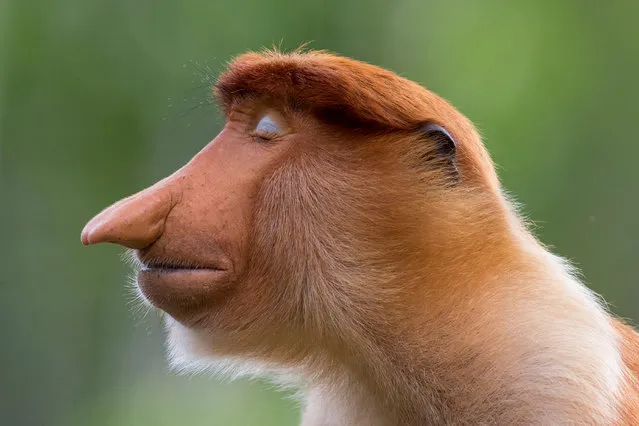
Winner – Animal Portraits: The pose by Mogens Trolle, Denmark. A young male proboscis monkey cocks his head slightly and closes his eyes. Unexpected pale blue eyelids now complement his immaculately groomed auburn hair. He poses for a few seconds as if in meditation. He is a wild visitor to the feeding station at Labuk Bay Proboscis Monkey Sanctuary in Sabah, Borneo – “the most laid-back character”, says Trolle, “quite unlike anything I’ve ever seen on another monkey” – connects us, he hopes, with a fellow primate. (Photo by Mogens Trolle/Wildlife Photographer of the Year 2020)

Winner – Animal Portraits: The pose by Mogens Trolle, Denmark. A young male proboscis monkey cocks his head slightly and closes his eyes. Unexpected pale blue eyelids now complement his immaculately groomed auburn hair. He poses for a few seconds as if in meditation. He is a wild visitor to the feeding station at Labuk Bay Proboscis Monkey Sanctuary in Sabah, Borneo – “the most laid-back character”, says Trolle, “quite unlike anything I’ve ever seen on another monkey” – connects us, he hopes, with a fellow primate. (Photo by Mogens Trolle/Wildlife Photographer of the Year 2020)
Details
16 Oct 2020 00:03:00
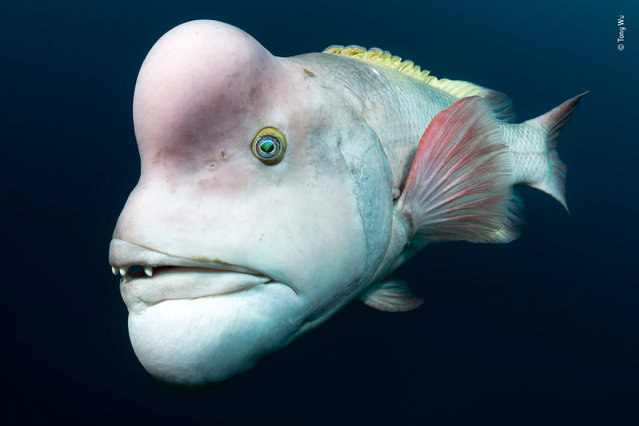
Looking for love by Tony Wu, USA. Highly commended, Animal Portraits. “Accentuating his mature appearance with pastel colours, protruding lips and an outstanding pink forehead, this Asian sheepshead wrasse sets out to impress females and see off rivals, which he will head-butt and bite, near Japan’s remote Sado Island. Individuals start out as females, and when they reach a certain age and size – up to a metre (more than 3 feet) long – can transform into males. Long-lived and slow-growing, the species is intrinsically vulnerable to overfishing”. (Photo by Tony Wu/2018 Wildlife Photographer of the Year)

Looking for love by Tony Wu, USA. Highly commended, Animal Portraits. “Accentuating his mature appearance with pastel colours, protruding lips and an outstanding pink forehead, this Asian sheepshead wrasse sets out to impress females and see off rivals, which he will head-butt and bite, near Japan’s remote Sado Island. Individuals start out as females, and when they reach a certain age and size – up to a metre (more than 3 feet) long – can transform into males. Long-lived and slow-growing, the species is intrinsically vulnerable to overfishing”. (Photo by Tony Wu/2018 Wildlife Photographer of the Year)
Details
03 Sep 2018 08:17:00
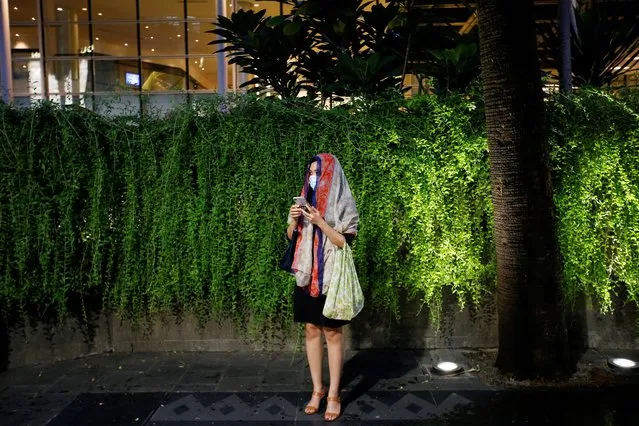
A woman wearing a protective mask stands as she waits for the bus at the sidewalk, after Indonesia confirmed its first cases of coronavirus, in Jakarta, Indonesia, March 4, 2020. (Photo by Willy Kurniawan/Reuters)

A woman wearing a protective mask stands as she waits for the bus at the sidewalk, after Indonesia confirmed its first cases of coronavirus, in Jakarta, Indonesia, March 4, 2020. (Photo by Willy Kurniawan/Reuters)
Details
20 Mar 2020 00:01:00
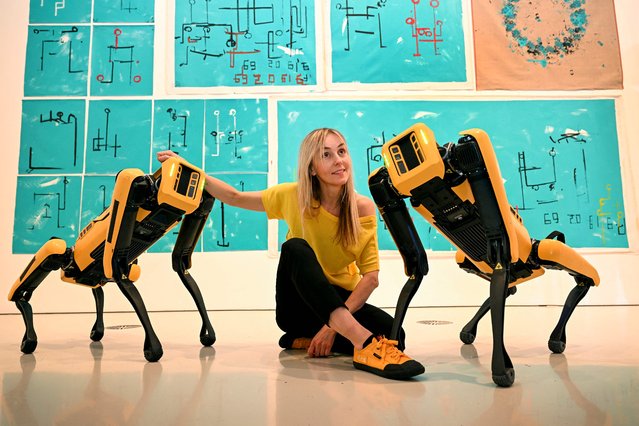
Polish artist Agnieszka Pilat poses with the artwork of her robot painting dogs – Basia Spot and Bunny Spot – who have become artists painting on canvases with their paws, at the launch of the National Gallery of Victoria (NGV) Triennial 2023 in Melbourne on April 5, 2023. Pilat works with the Boston Dynamics dogs, training them to paint autonomously through AI technology individually and collaboratively, and will be part of more than 100 local and international artists, designers and collectives presenting at the exhibition opening in December. (Photo by William West/AFP Photo)

Polish artist Agnieszka Pilat poses with the artwork of her robot painting dogs – Basia Spot and Bunny Spot – who have become artists painting on canvases with their paws, at the launch of the National Gallery of Victoria (NGV) Triennial 2023 in Melbourne on April 5, 2023. Pilat works with the Boston Dynamics dogs, training them to paint autonomously through AI technology individually and collaboratively, and will be part of more than 100 local and international artists, designers and collectives presenting at the exhibition opening in December. (Photo by William West/AFP Photo)
Details
25 May 2023 03:14:00