Loading...
Done
Baby Fennec Fox

“The fennec fox is a small nocturnal fox found in the Sahara of North Africa. Its most distinctive feature is unusually large ears. The name “fennec” comes from the Arabic word for fox, and the species name zerda has a Greek origin that refers to its habitat. The fennec is the smallest species of canid in the world; coat, ears and kidney functions have adapted to a high-temperature, low-water, desert environment. In addition, its hearing is sensitive enough to hear prey moving underground”. – Wikipedia

Photo: A Baby Fennec is seen at Sunshine International Aquarium on June 24, 2009 in Tokyo, Japan. The small nocturnal fox babies were born on May 17 2009. (Photo by Junko Kimura/Getty Images)
Details
16 Sep 2011 12:02:00
Silver Fox By Steffen Sailor

The legendary silver fox is a creature of mystery rarely seen in the wild, and will – literally – run for the hills upon human encounters
Details
21 Oct 2012 05:06:00
Pink Champagne Fox Miko

Meet this Miko, a 4-month fox color "pink champagne". Fox this color were first bred on the Canadian farm, one hundred years ago. They are so rare species that currently exist in the world only two such individuals: one lives in Ontario, and the other is Miko. Such foxes bred in captivity and contain only as pets in Canada.
Details
21 Mar 2014 12:49:00
Actor Danny DeVito attends the 'Dr. Seuss' The Lorax' (Der Lorax) Germany Photocall at Ritz Carlton

Actor Danny DeVito attends the “Dr. Seuss' The Lorax” (Der Lorax) Germany Photocall at Ritz Carlton on March 5, 2012 in Berlin, Germany. (Photo by Andreas Rentz/Getty Images)
Details
06 Mar 2012 13:55:00
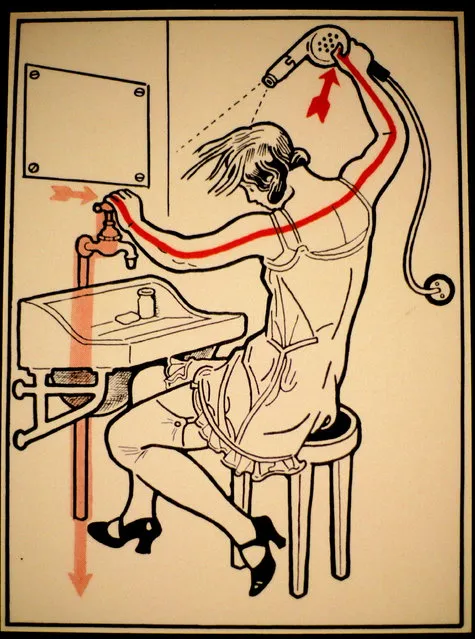
The book “Elektroschutz in 132 Bildern” (Electrical Protection in 132 Pictures) was published in Vienna in the early 1900s by a Viennese physician named Stefan Jellinek (1878-1968, a founder of the Electro-Pathological Museum). The pictures are nice and direct and unambiguous; they teach, graphically, that the surest way to kill yourself with electricity is to form a complete path from source (usually the bright red arrow) to ground (the screened back, pink arrow). Arrowheads provide the path for current flow. (Photo by The Vienna Technical Museum)

The book “Elektroschutz in 132 Bildern” (Electrical Protection in 132 Pictures) was published in Vienna in the early 1900s by a Viennese physician named Stefan Jellinek (1878-1968, a founder of the Electro-Pathological Museum). The pictures are nice and direct and unambiguous; they teach, graphically, that the surest way to kill yourself with electricity is to form a complete path from source (usually the bright red arrow) to ground (the screened back, pink arrow). Arrowheads provide the path for current flow. (Photo by The Vienna Technical Museum)
Details
11 Aug 2014 11:10:00
Crowd reaction outside the court for the Dr Conrad Murray trial verdict

Crowd reaction outside the court for the Dr. Conrad Murray trial verdict on November 7, 2011 in Los Angeles, California. Murray was convicted in the 2009 death of pop singer Michael Jackson from an overdose of the powerful anesthetic propofol. Sentencing will take place November 29. (Photo by Toby Canham/Getty Images)
Details
08 Nov 2011 12:06:00
Urban Fox Project by Photographer Ian Wade

“I have been photographing this group of urban foxes in Bristol for over 12 months; what started off as a chance encounter has become an obsession for me and has changed my feelings and attitudes towards urban foxes forever...”. – Ian Wade. (Photo by Ian Wade)
Details
30 Jun 2013 12:36:00
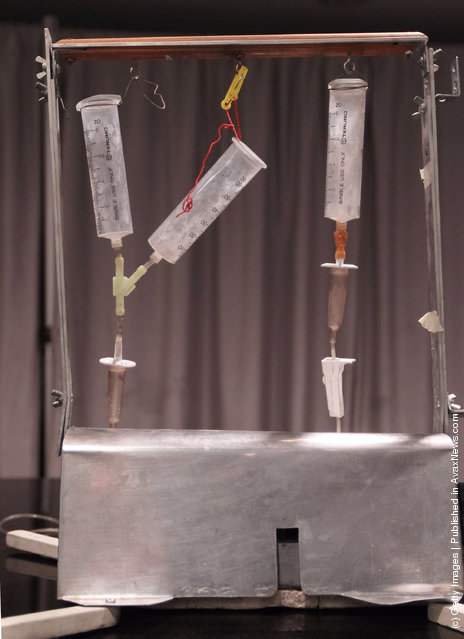
The Thanatron, often referred to as the Death Machine of Dr. Jack Kevorkian

“Jacob «Jack» Kevorkian (May 26, 1928 – June 3, 2011), commonly known as “Dr. Death”, was an American pathologist, euthanasia activist, painter, composer and instrumentalist. He is best known for publicly championing a terminal patient's right to die via physician-assisted suicide; he said he assisted at least 130 patients to that end. He famously said, «dying is not a crime»”. – Wikipedia

Photo: The “Thanatron”, often referred to as the “Death Machine”, is displayed during a press preview of an auction of the personal effects of Dr. Jack Kevorkian at the New York Institute of Technology on October 27, 2011 in New York City. The device was reportedly used by over 100 of Dr. Kevorkian's patients to terminate their lives. (Photo by Mario Tama/Getty Images)
Details
28 Oct 2011 12:26:00