Loading...
Done
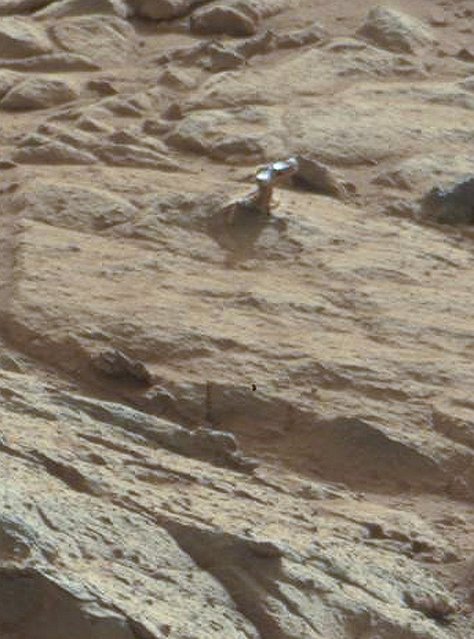
Another Weird Shiny Thing on Mars

“The Curiosity Mars rover has imaged a small metallic-looking protuberance on a rock. Visible (in the image below the green lines point to it), the protuberance appears to have a high albedo and even projects a shadow on the rock below...”
Details
06 Feb 2013 18:41:00
Claire plaiyng the piano in an abandoned Cafe in Luxembourg. (Photo by Alice van Kempen/Caters News)

Meet Claire, the 3-year-old bull terrier travels the world with Dutch photographer Alice van Kempen, 48, and poses for photographs in abandoned buildings. Van Kempen seeks out abandoned places to photograph in pursuit of her passion for urban exploring, bringing along her globetrotting pooch as her trusted companion. Here: Claire plaiyng the piano in an abandoned Cafe in Luxembourg. (Photo by Alice van Kempen/Caters News)
Details
08 Jan 2016 08:03:00
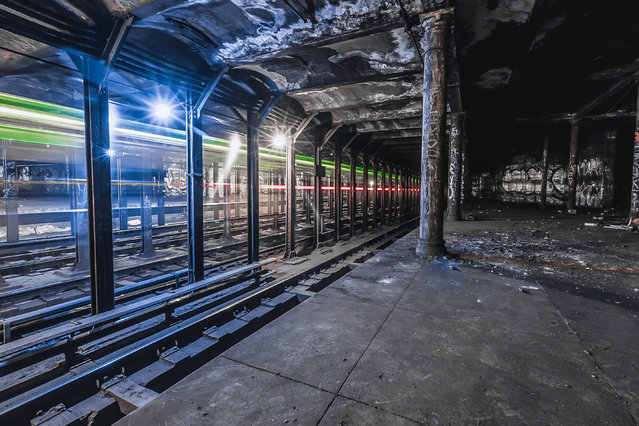
At the dead of night, the photographer – known to his Instagram followers as Dark Cyanide – heads out to look for hidden gems, like abandoned stations, provisions and tunnels. His intriguing images feature vibrant streaks, graffiti, and tight framing – and by adding individuals to some to some of shots, he is also able to depict the incredible scale of some of the tunnels. The photographer, 19, admitted what he and his friends do is highly dangerous, illegal, and he does not recommend others attempt to explore such tunnels. Here: Unnamed subway track in New York City. (Photo by Dark Cyanide/Caters News)

At the dead of night, the photographer – known to his Instagram followers as Dark Cyanide – heads out to look for hidden gems, like abandoned stations, provisions and tunnels. His intriguing images feature vibrant streaks, graffiti, and tight framing – and by adding individuals to some to some of shots, he is also able to depict the incredible scale of some of the tunnels. Here: Unnamed subway track in New York City. (Photo by Dark Cyanide/Caters News)
Details
29 Jan 2016 12:45:00
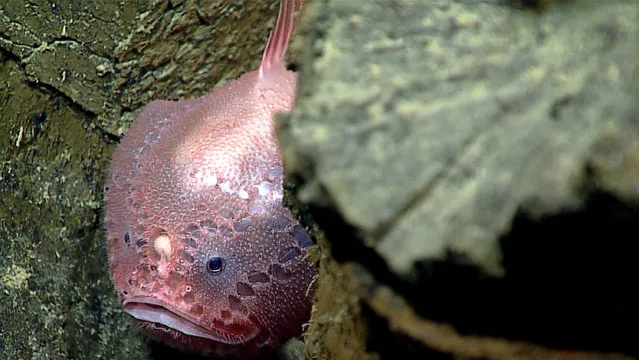
This April 30, 2016 image made available by NOAA shows a deep sea anglerfish living between pillow basalt rock formations, during a deepwater exploration of the Marianas Trench Marine National Monument area in the Pacific Ocean near Guam and Saipan. The ambush predator waits for prey to be attracted by its lure, located between its eyes, and gulps it with its large mouth. (Photo by NOAA Office of Ocean Exploration and Research via AP Photo)

This April 30, 2016 image made available by NOAA shows a deep sea anglerfish living between pillow basalt rock formations, during a deepwater exploration of the Marianas Trench Marine National Monument area in the Pacific Ocean near Guam and Saipan. The ambush predator waits for prey to be attracted by its lure, located between its eyes, and gulps it with its large mouth. (Photo by NOAA Office of Ocean Exploration and Research via AP Photo)
Details
21 Oct 2016 12:30:00
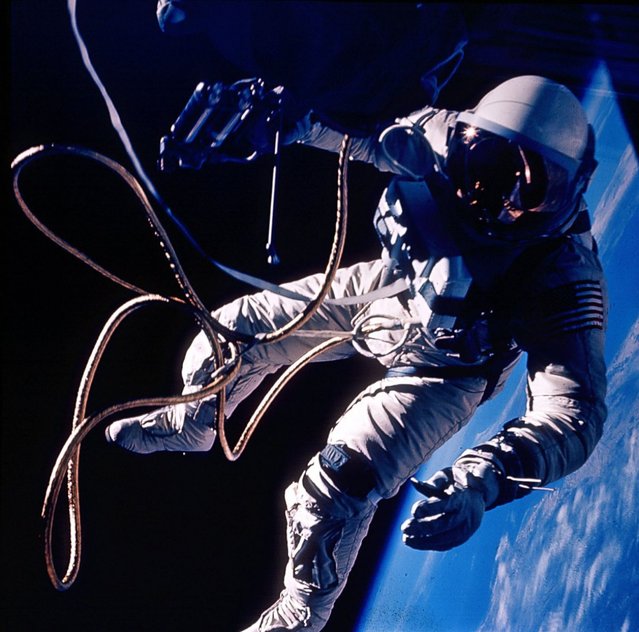
Astronaut Edward H. White II, pilot for the Gemini-Titan 4 (GT-4) spaceflight, floats in the zero-gravity of space during the third revolution of the GT-4 spacecraft on June 3, 1965. White wears a specially designed spacesuit. His face is shaded by a gold-plated visor to protect him from unfiltered rays of the sun. (Photo by NASA)

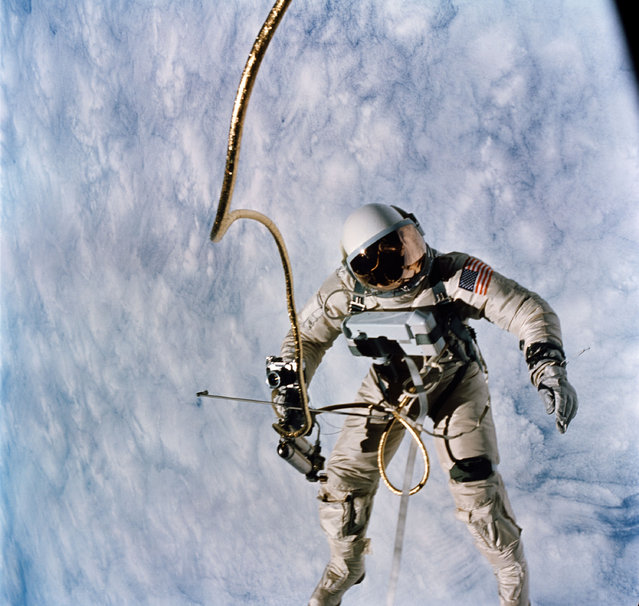
Astronaut Edward H. White II, pilot for the Gemini-Titan 4 (GT-4) spaceflight, floats in the zero-gravity of space during the third revolution of the GT-4 spacecraft on June 3, 1965. White wears a specially designed spacesuit. His face is shaded by a gold-plated visor to protect him from unfiltered rays of the sun. In his right hand he carries a Hand-Held Self-Maneuvering Unit (HHSMU) that gives him control over his movements in space. White also wears an emergency oxygen chest pack; and he carries a camera mounted on the HHSMU for taking pictures of the sky, Earth and the GT-4 spacecraft. He is secured to the spacecraft by a 25-feet umbilical line and a 23-feet tether line. Both lines are wrapped together in gold tape to form one cord. Astronaut James A. McDivitt, command pilot, remained inside the spacecraft during the extravehicular activity (EVA). Astronaut White died in the Apollo/Saturn 204 fire at Cape Kennedy on January 27, 1967. (Photo by NASA)
Details
22 Jul 2014 12:05:00
The First U.S. Spacewalk – Gemini 4 Ed White made the United States' first spacewalk on June 3, 1965 during the Gemini 4 mission. The extra-vehicular activity (EVA) started at 19:45 UT (3:45 p.m. EDT) on the third orbit when White opened his hatch and used the hand-held manuevering oxygen-jet gun to push himself out of the capsule. (Photo by NASA)

The First U.S. Spacewalk – Gemini 4 Ed White made the United States' first spacewalk on June 3, 1965 during the Gemini 4 mission. The extra-vehicular activity (EVA) started at 19:45 UT (3:45 p.m. EDT) on the third orbit when White opened his hatch and used the hand-held manuevering oxygen-jet gun to push himself out of the capsule. (Photo by NASA)
Details
11 Apr 2014 08:40:00
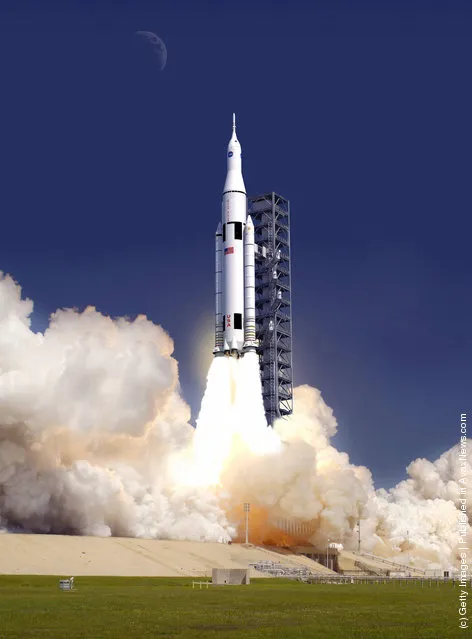
NASA's New Space Launch System

“The Space Launch System, or SLS, is a Shuttle-Derived heavy launch vehicle being designed by NASA, following the cancellation of the Constellation Program, to replace the Space Shuttle after its retirement. The NASA Authorization Act of 2010 envisions the transformation of the Ares I and Ares V vehicle designs into a single launch vehicle usable for both crew and cargo. It is to be upgraded over time with more powerful versions. The proposed SLS is visually similar to the legacy Saturn V booster and in particular the proposed, two-stage, Saturn INT-20”. – Wikipedia

Photo: In this illustration provided by NASA, the design for a new space rocket system, the Space Launch System, is seen. NASA's new rocket design will reportedly cost about $35 billion and be ready to for test launch in 2017. According to NASA, the rocket will be used to carry Orion Multi-Purpose Crew Vehicle as well as cargo and science experiments to earth's orbit, as a backup for the space station and possibly destinations beyond that. (Illustration by NASA via Getty Images)

Details
15 Sep 2011 10:50:00


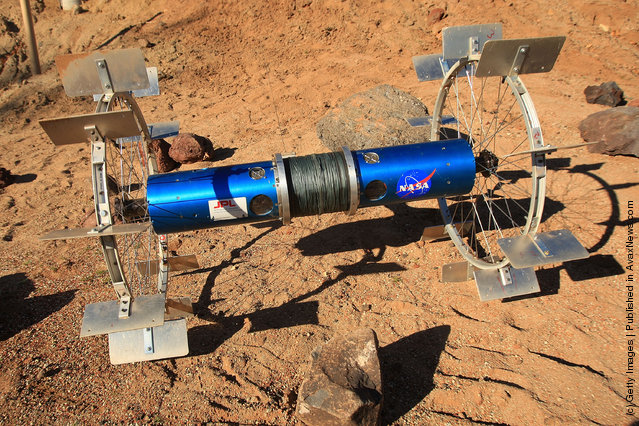
Axel, a research prototype rover for exploring the Moon, Mars and other planets, is remotely driven over rocks as engineers from Jet Propulsion (JPL) and grad students from Caltech (California Institute of Technology) demonstrate its mobile over the steep and rocky grounds of the JPL Mars Yard on January 14, 2009 in Pasadena, California. The rover is capable of descending cliffs or into craters and returning by a cable tethered to its starting point. Development of the Axel rover is a point effort funded by NASA Exploration Systems Mission Directorate (ESMD) and lead by Principal Investigator Issa Newnas and Co-Investigator and Caltech professor of mechanical engineering bio engineering Joel Burdick. (Photo by David McNew/Getty Images)
Details
05 Apr 2011 07:47:00