Loading...
Done
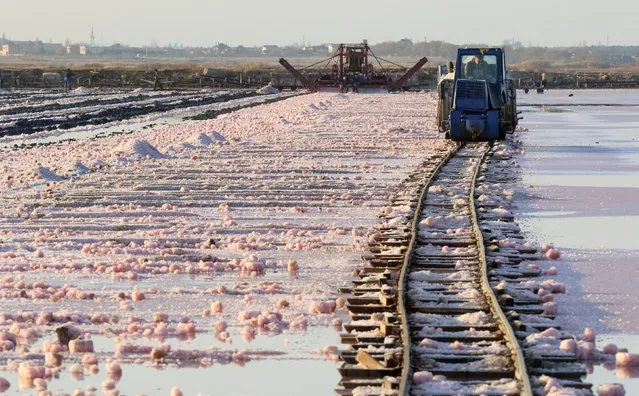
A train drives along a field at a salt production site at the Sasyk-Sivash lake near the city of Yevpatoria, Crimea, November 14, 2017. (Photo by Pavel Rebrov/Reuters)

A train drives along a field at a salt production site at the Sasyk-Sivash lake near the city of Yevpatoria, Crimea, November 14, 2017. A saltwater lagoon known as Lake Sasyk-Sivash on Ukraine's Crimea peninsula is the source of a rare resource: pink salt. The mineral is tinted by tiny algae that produce the pigment beta-carotene. Each autumn, seasonal workers collect thousands of tons of pink salt for processing and export. (Photo by Pavel Rebrov/Reuters)
Details
16 Nov 2017 08:18:00
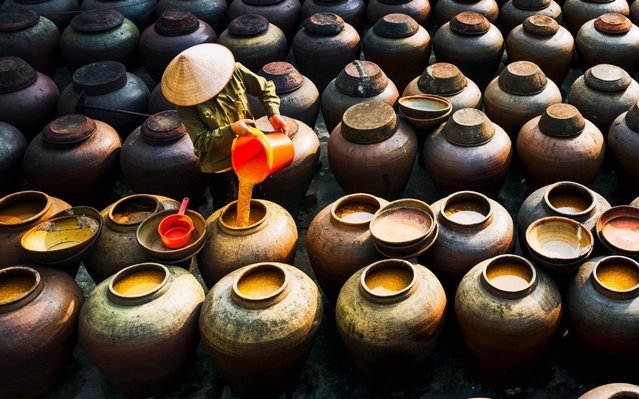
Workers stir hundreds of large ceramic pots as they spend months making a traditional soy sauce on October 14, 2020. Arranged in rows, the containers can hold up to 50 litres of Ban Soy sauce. During the drawn out process the sauce is stirred every two days for two to six months. Ban Yen Nhan village in the Hung Yen Province of Vietnam is famous for its traditional and distinctive method of making the sauce. (Photo by Nguyen Quy/Solent News)

Workers stir hundreds of large ceramic pots as they spend months making a traditional soy sauce on October 14, 2020. Arranged in rows, the containers can hold up to 50 litres of Ban Soy sauce. During the drawn out process the sauce is stirred every two days for two to six months. Ban Yen Nhan village in the Hung Yen Province of Vietnam is famous for its traditional and distinctive method of making the sauce. (Photo by Nguyen Quy/Solent News)
Details
30 Oct 2020 00:05:00
The finished photochromes were produced using at least six different tint stones, although many more were often used. Here: Street food in the Strada del Porto in Naples, Italy, 1899. (Photo by Swiss Camera Museum/The Guardian)

Photochromes are vibrant and nuanced prints hand-coloured from black-and-white negatives. Created using a process pioneered in the 1880s, these images offer a fascinating insight into the world when colour photography was still in its infancy. A Tour of the World in Photochromes is at the Swiss Camera Museum, Vevey, until 21 August. Here: Street food in the Strada del Porto in Naples, Italy, 1899. (Photo by Swiss Camera Museum/The Guardian)
Details
07 Jul 2016 10:56:00
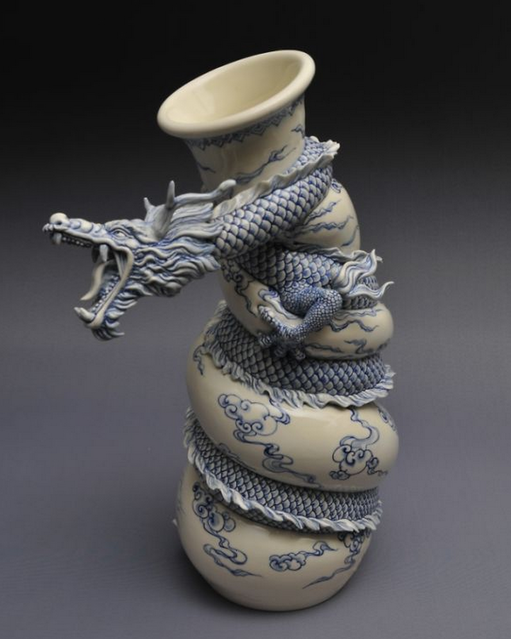
Beautiful Chinese Dragon Vase By Sculptor Johnson Tsang

Artist Johnson Tsang has been posting an amazing series of process photos over on his blog that demonstrate how he makes many of his bizarre ceramic creations. One piece that really stood out is called ‘A Painful Pot’, which is a functional teapot being squeezed by a dragon, its head functioning as the spout.
Details
03 Feb 2014 12:11:00
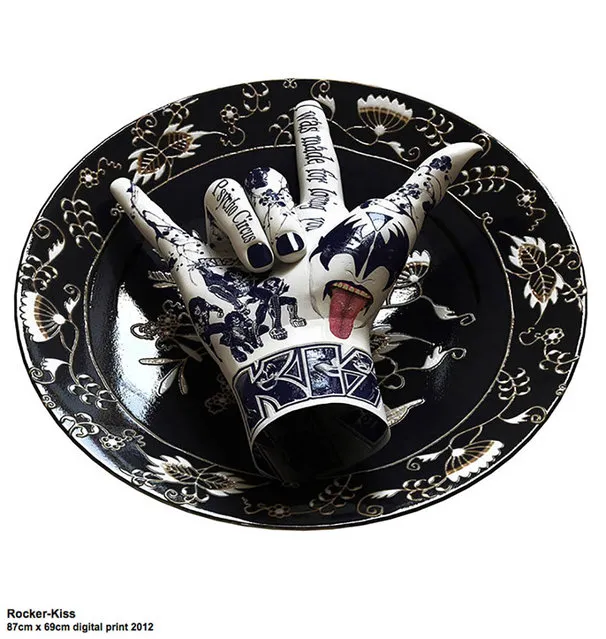
Rocker By Kim Joon
Kim Joon is a Korean artist who specializes in creating images that resemble hollow porcelain human body parts painted in bold patterns from famous ceramic brands including Royal Copenhagen, Herend, and Villeroy & Boch. His latest project is called The Rocker and features a number of pictures of porcelain hands laying on a dish patterned in style of different famous rock bands of the past. The images are so vivid that it makes you think that these hands are actually real and not digitally crafted, though it would be amazing, if someone were to actually make a creation such as this in real life. (Photo by Kim Joon)
Details
18 Dec 2014 14:25:00
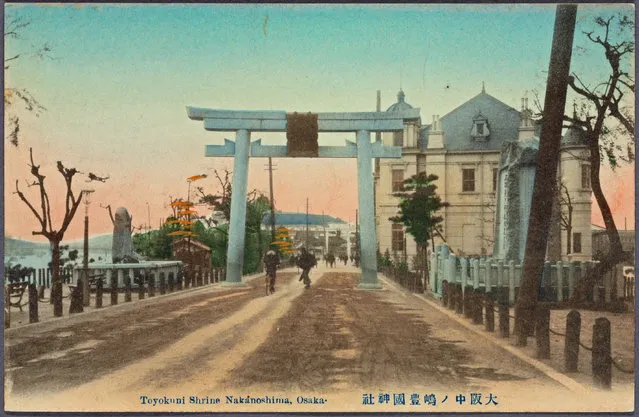
Toyokuni Shrine Nakanoshima, Osaka, Japan. (Photo by New York Public Library/Caters News)

These timeless postcards offer an eye-opening glimpse into life in Japan in the early 20th century. Taken from hand-colored photographs, the postcards showcase the still beauty of the country, depicting a nation on the cusp of modernization. The images feature solemn fishermen, bustling streets, temples and shrines: a country yet to be influenced by Western culture. The tinting effect brings out the rich colors of the natural surroundings, with trees, flowers and cherry blossoms jumping from the original black-and-white images. Here: Toyokuni Shrine Nakanoshima, Osaka, Japan. (Photo by New York Public Library/Caters News)
Details
02 Apr 2016 09:33:00
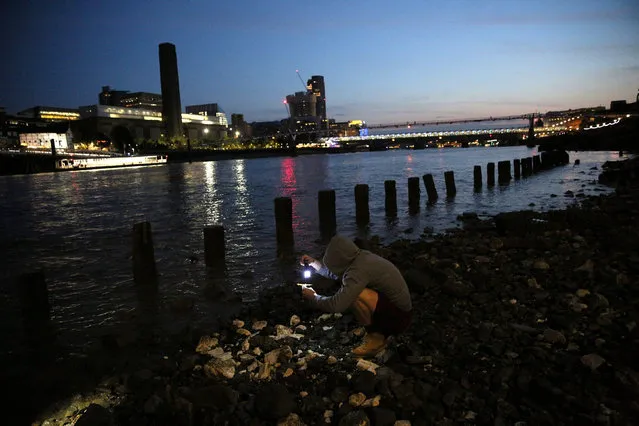
A mudlark uses a torch to look for items on the bank of the River Thames in London, Britain June 06, 2016. Mudlarking is believed to trace its origins to the 18th and 19th century, when scavengers searched the Thames' shores for items to sell. These days, history and archaeology fans are the ones hoping to find old relics such as coins, ceramics, artifacts or everyday items from across centuries. They wait for the low tide and then scour specific areas of exposed shores. "If you're in a field you could be out all day long, with the river you're restricted to about two or three hours," mudlark Nick Stevens said. While many just use the naked eye for their searches, others rely on metal detectors for which a permit from the Port of London Authority is needed. Digging also requires consent. (Photo by Neil Hall/Reuters)

A mudlark uses a torch to look for items on the bank of the River Thames in London, Britain June 06, 2016. Mudlarking is believed to trace its origins to the 18th and 19th century, when scavengers searched the Thames' shores for items to sell. These days, history and archaeology fans are the ones hoping to find old relics such as coins, ceramics, artifacts or everyday items from across centuries. their finds with the Portable Antiquities Scheme. Any item over 300 years old must be recorded. (Photo by Neil Hall/Reuters)
Details
27 Aug 2016 10:43:00
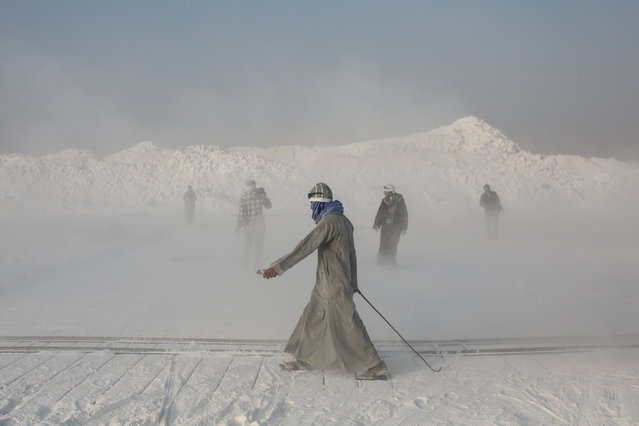
In this Wednesday, March 18, 2015 photo, limestone quarry workers walk through a cloud of dust spewed into the air by rotor blades of the stone-cutting machinery in the desert of Minya, southern Egypt. (Photo by Mosa'ab Elshamy/AP Photo)

In this Wednesday, March 18, 2015 photo, limestone quarry workers walk through a cloud of dust spewed into the air by rotor blades of the stone-cutting machinery in the desert of Minya, southern Egypt. Around 45,000 people, including children, work in an estimated 1,500 quarries, digging out stones that later will be used in construction or powdered to be used by pharmaceutical and ceramic companies. (Photo by Mosa'ab Elshamy/AP Photo)
Details
07 Apr 2015 11:41:00