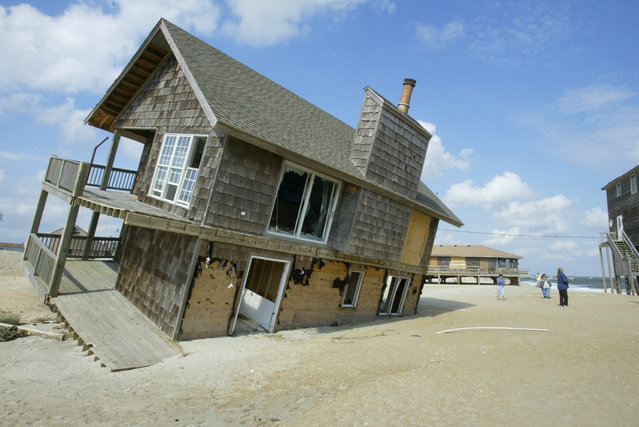
A house that was slammed off its foundation by Hurricane Isabel sits precariously on the beach one month after it hit Rodanthe, North Carolina October 18, 2003. (Photo by Rick Wilking/Reuters)
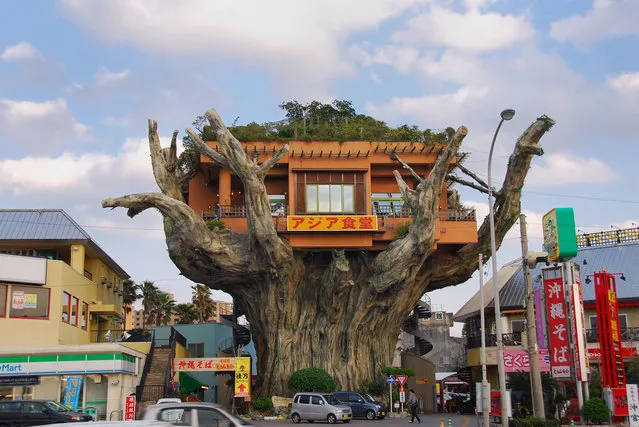
Tree houses, treehouses, or tree forts, are platforms or buildings constructed around, next to or among the trunk or branches of one or more mature trees while above ground level. Tree houses can be used for recreation, work space, habitation, observation or as temporary retreats.
A garbage collector, with his horse and cart, prepares to unload rubbish at the municipal dump in Nezahualcoyotl, on the outskirts of Mexico City, February 18, 2015. Hundreds of horse or donkey-drawn carts will disappear from the streets of a municipality in the state of Mexico, located on the outskirts of Mexico City, and will be replaced by motorized vehicles, local authorities said. (Photo by Henry Romero/Reuters)
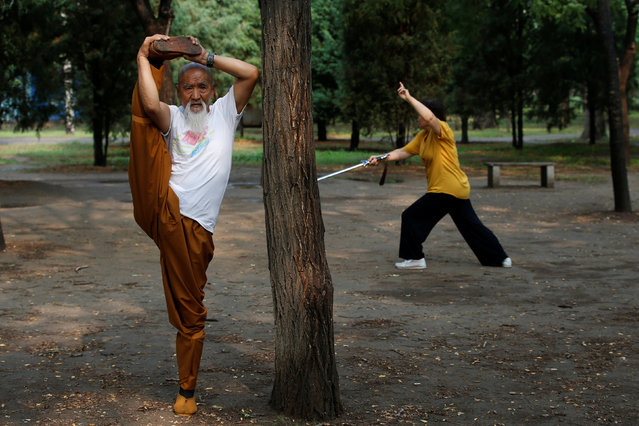
Kung Fu master Li Liangui practices “Suogugong” Kung Fu and his wife Liang Xiaoyan (R) practices Qigong at a park in Beijing, China, June 30, 2016. For 50 years, kung fu master Li Liangui has been contorting his body into eye-watering positions while practising one of the more unusual and less popular Chinese martial art forms. The 70-year-old is an expert in suogugong, or body shrinking kung fu, where practitioners dislocate their bones to help them achieve unlikely positions and feats. (Photo by Kim Kyung-Hoon/Reuters)
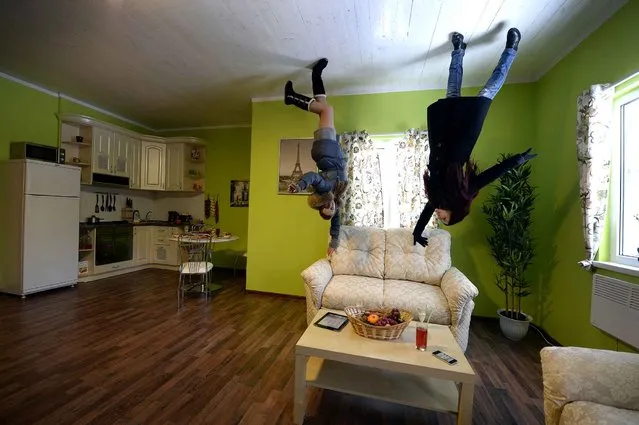
A picture rotated 180 degrees shows visitors walking inside an “Upside-down House” attraction at the VVTs the All-Russia Exhibition Center in Moscow, on January 14, 2014. The attraction to experience a new perspective of a house standing upside down was opened first time in Russia, the show organisers said. (Photo by Alexander Nemenov/AFP Photo)
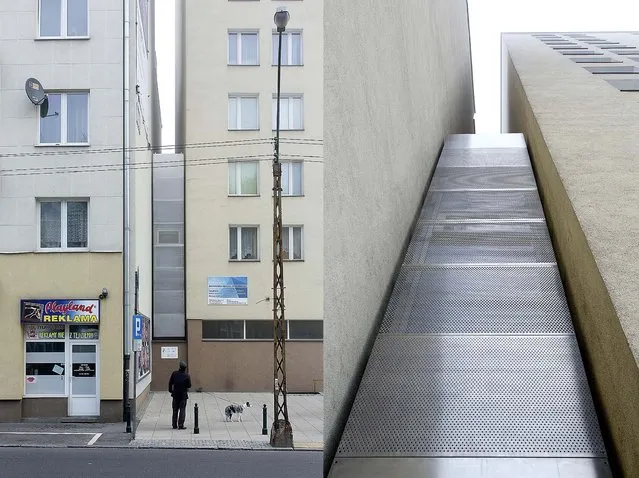
Measuring just five feet at its widest point, the ultra-thin home was unveiled in the Polish capital of Warsaw on Sunday, October 21, 2012. Photo: The Keret House is squeezed into the space between two apartment buildings in Warsaw. There's a four-inch gap between the apartment buildings to either side. A perforated steel facade was used to allow in more light. (Photo by Andrea Meichsner/The New York Times)
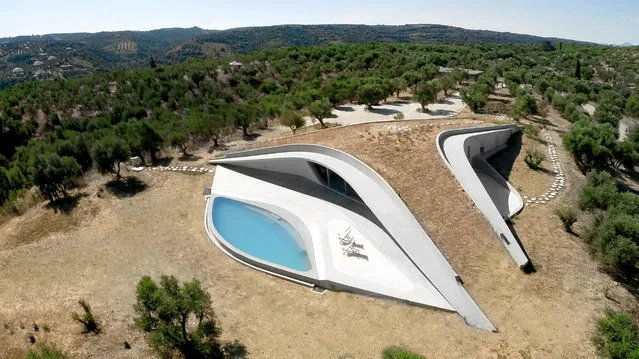
The 150-square-metre Villa Ypsilon was designed by London- and Brussels-based firm LASSA, which is headed up by architects Theo Sarantoglou Lalis and Dora Sweijd.