Loading...
Done
Mollie King and Frankie Sandford of The Saturdays performs for a dress rehearsal before the first night of their 'All Fired Up!' tour

(L-R) Mollie King and Frankie Sandford of The Saturdays performs for a dress rehearsal before the first night of their “All Fired Up!” tour at The Bournemouth International Centre on December 1, 2011 in Bournemouth, United Kingdom. (Photo by Dave J. Hogan/Getty Images)
Details
03 Dec 2011 14:28:00
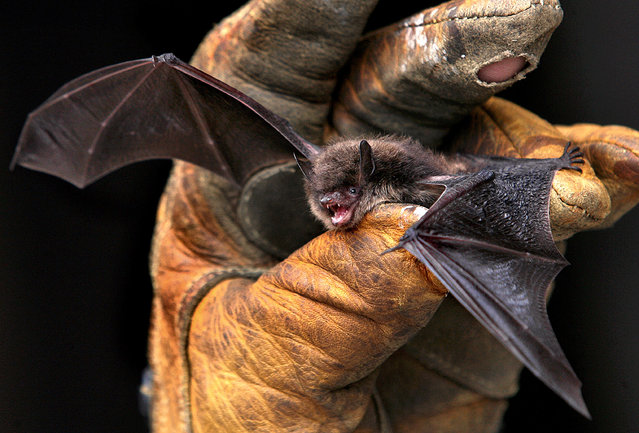
In this September 17, 2010 file photo a little brown bat is photographed in La Crosse Wis. Researchers for the first time found that little brown bats appear to be showing resistance to white-nose syndrome, which has killed millions of bats across North America. (Photo by Peter Thomson/La Crosse Tribune via AP Photo)

In this September 17, 2010 file photo a little brown bat is photographed in La Crosse Wis. Researchers for the first time found that little brown bats appear to be showing resistance to white-nose syndrome, which has killed millions of bats across North America. (Photo by Peter Thomson/La Crosse Tribune via AP Photo)
Details
13 Jan 2017 08:48:00
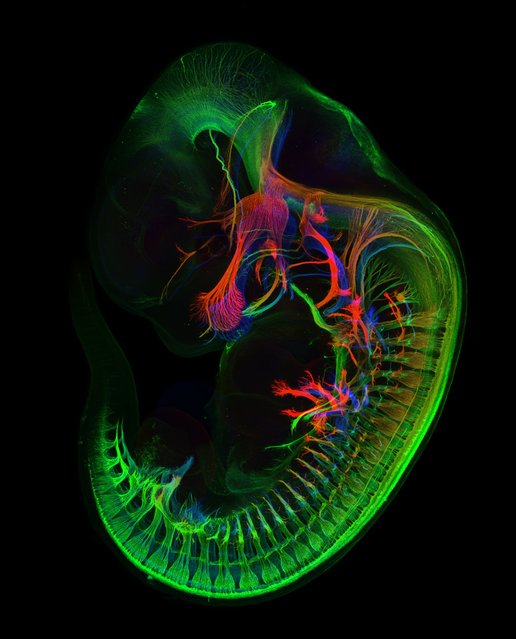
Mr. Zhong Hua, of Johns Hopkins University School of Medicine, took this image of the peripheral nerves (those outside of the brain) in an 11.5-day-old mouse embryo, magnified five times. (Photo by Zhong Hua)

Mr. Zhong Hua, of Johns Hopkins University School of Medicine, took this image of the peripheral nerves (those outside of the brain) in an 11.5-day-old mouse embryo, magnified five times. (Photo by Zhong Hua)
Details
31 Oct 2013 09:39:00
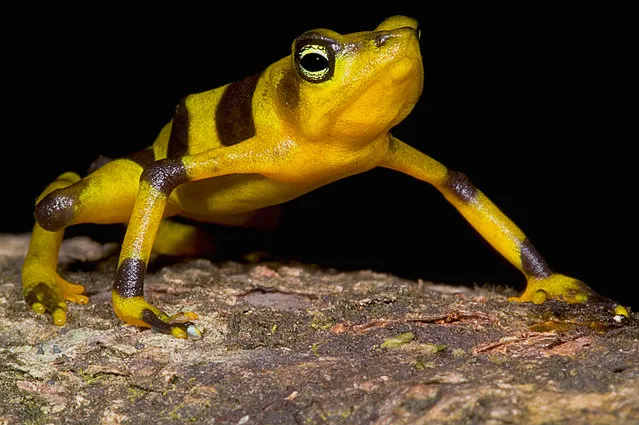
The golden harlequin toad has vanished from the wild, and only a small number live on in captivity. A fungus caused them, and many other amphibians, to die out in their home in Central America. (Photo by Danté Fenolio/The Guardian/Johns Hopkins University Press)

Wildlife photographer Danté Fenolio has headed into areas untouched by sunlight – deep seas, caves and underground – and found creatures that are exploding with colour. Here: The golden harlequin toad has vanished from the wild, and only a small number live on in captivity. A fungus caused them, and many other amphibians, to die out in their home in Central America. (Photo by Danté Fenolio/The Guardian/Johns Hopkins University Press)
Details
20 Jun 2016 12:19:00
Zeebra  Lisa Thrower, New Zealand is modelled in the Bizarre Bra Section during the 2023 World of WearableArt Awards Night at TSB Bank Arena on September 22, 2023 in Wellington, New Zealand. (Photo by Hagen Hopkins/Getty Images for World of WearableArt)

Zeebra Lisa Thrower, New Zealand is modelled in the Bizarre Bra Section during the 2023 World of WearableArt Awards Night at TSB Bank Arena on September 22, 2023 in Wellington, New Zealand. (Photo by Hagen Hopkins/Getty Images for World of WearableArt)
Details
11 Dec 2024 04:09:00
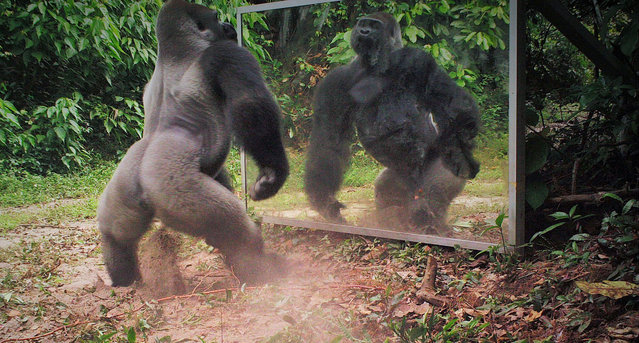
Camera trapper Xavier Hubert-Brierre put this large mirror on the side of a road through the jungle in Gabon and left a camera there to record how the animals would respond to their own reflections. A silverback gorilla thought it was seeing another silverback and responded by trying to scare off the potential challenger… (Photo by Xavier Hubert-Brierre/Johns Hopkins University Press)

Camera trapper Xavier Hubert-Brierre put this large mirror on the side of a road through the jungle in Gabon and left a camera there to record how the animals would respond to their own reflections. A silverback gorilla thought it was seeing another silverback and responded by trying to scare off the potential challenger… (Photo by Xavier Hubert-Brierre/Johns Hopkins University Press)
Details
03 May 2016 13:04:00
Performers pose during the 2022 ICC Women's Cricket World Cup match between Australia and West Indies at Basin Reserve on March 15, 2022 in Wellington, New Zealand. (Photo by Hagen Hopkins-ICC/ICC via Getty Images)

Performers pose during the 2022 ICC Women's Cricket World Cup match between Australia and West Indies at Basin Reserve on March 15, 2022 in Wellington, New Zealand. (Photo by Hagen Hopkins-ICC/ICC via Getty Images)
Details
22 Mar 2022 05:51:00
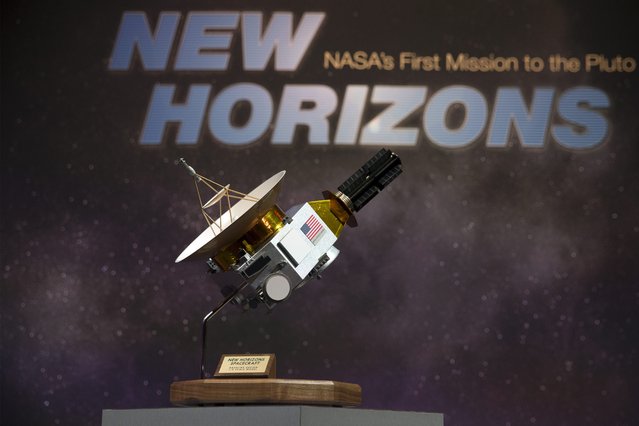
A model of the New Horizons spacecraft is seen at a live television program on NASA television celebrating the spacecraft's closest proximity to Pluto, at Johns Hopkins University Applied Physics Laboratory, site of the mission operations center, in Laurel, Maryland, USA, 14 July 2015. (Photo by Michael Reynolds/EPA)

A model of the New Horizons spacecraft is seen at a live television program on NASA television celebrating the spacecraft's closest proximity to Pluto, at Johns Hopkins University Applied Physics Laboratory, site of the mission operations center, in Laurel, Maryland, USA, 14 July 2015. At approximately 7:49 am ET (11:49 am GMT), 14 July, New Horizons was scheduled to be as close to Pluto as the spacecraft will get; about 7,800 miles (12,500 kilometers) above the surface, following a journey of more than nine years and three billion miles. This is the first mission to the Pluto System and the Kuiper Belt. (Photo by Michael Reynolds/EPA)

Details
15 Jul 2015 10:08:00