Loading...
Done
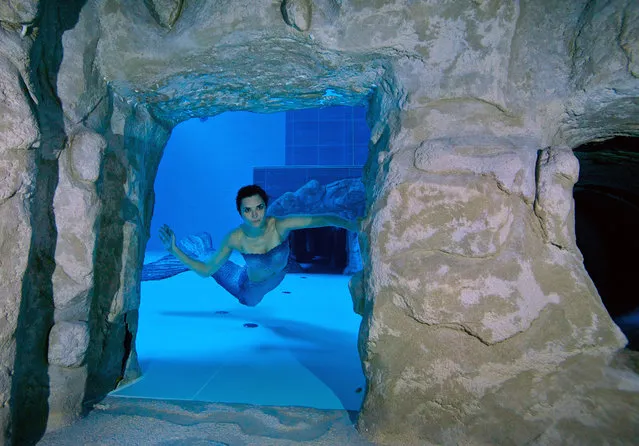
The Y-40 Deep Joy features several levels and grottos. (Photo by Courtesy Y40 Deep Joy)

The Y-40 Deep Joy is the worlds deepest pool. Y-40 is projected by Architect Emanuele Boaretto and supported by the “Boaretto Group Hotel and Resort”. The name Y-40 is inspired by mathematical symbols. “Y” is the ordinate axis of the Cartesian system and “–40” means the world's record depth or our pool- that is 40 meters underground. (Photo by Courtesy Y40 Deep Joy)
Details
07 Oct 2014 11:09:00
150 people, an empty swimming pool and loads of fake blood and guts, on October 18, 2013 in Dagenham, England. (Photo by Dave J. Hogan/Stringer)

To mark Halloween, 150 teens descended upon a swimming pool in Essex to help mobile network giffgaff recreate the famous Tomatina tomato fight... only this time, with blood and guts. Different takes #giffgaffguts. On October 18, 2013 in Dagenham, England. (Photo by Dave J. Hogan/Stringer for giffgaff)
Details
31 Oct 2013 06:50:00
An aerial view of rock salt collection pool made of tarpaulin, where rock salt is obtained by collecting the natural spring water in the mountains and evaporating the water, in Kozluk District of Batman, Turkiye on August 22, 2022. The production of rock salt, passed down from generation to generation, became the sole source of income for 45 households in the village of Derince, with a population of about 400 of Batman. (Photo by Omer Yasin Ergin/Anadolu Agency via Getty Images)

An aerial view of rock salt collection pool made of tarpaulin, where rock salt is obtained by collecting the natural spring water in the mountains and evaporating the water, in Kozluk District of Batman, Turkiye on August 22, 2022. The production of rock salt, passed down from generation to generation, became the sole source of income for 45 households in the village of Derince, with a population of about 400 of Batman. (Photo by Omer Yasin Ergin/Anadolu Agency via Getty Images)
Details
18 Mar 2023 04:24:00
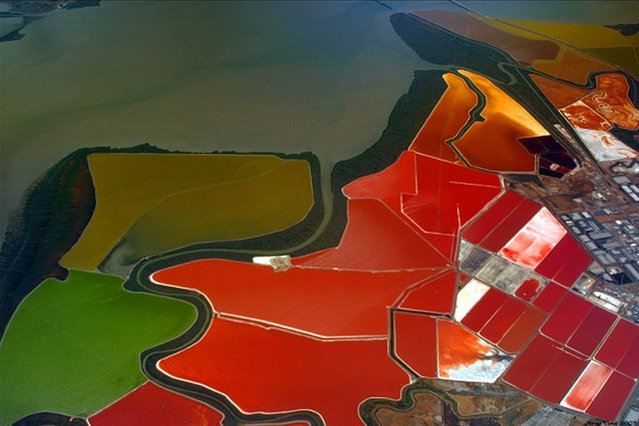
Salt ponds in San Francisco Bay

Salt evaporation ponds, also called salterns or salt pans, are shallow artificial ponds designed to produce salts from sea water or other brines. The seawater or brine is fed into large ponds and water is drawn out through natural evaporation which allows the salt to be subsequently harvested. The ponds also provide a productive resting and feeding ground for many species of waterbirds, which may include endangered species. The ponds are commonly separated by levees.
Details
11 Oct 2012 12:49:00
An egret in the second decade of April 2025 cools off in the Florida heat by gular fluttering, rapidly vibrating its throat muscles with an open beak. The mechanism helps to dissipate heat through evaporation. (Photo by Ronen Tivony/ZUMA Press Wire/Alamy Live News)

An egret in the second decade of April 2025 cools off in the Florida heat by gular fluttering, rapidly vibrating its throat muscles with an open beak. The mechanism helps to dissipate heat through evaporation. (Photo by Ronen Tivony/ZUMA Press Wire/Alamy Live News)
Details
11 May 2025 03:40:00
A woman wearing a kimono performs an uchimizu ritual outside a pachinko game parlor in Tokyo June 30, 2015. The splashing of water onto the hot asphalt in summer is an old Japanese tradition meant to cool down the air as the water evaporates. (Photo by Thomas Peter/Reuters)

A woman wearing a kimono performs an uchimizu ritual outside a pachinko game parlor in Tokyo June 30, 2015. The splashing of water onto the hot asphalt in summer is an old Japanese tradition meant to cool down the air as the water evaporates. (Photo by Thomas Peter/Reuters)
Details
19 Jul 2015 08:36:00
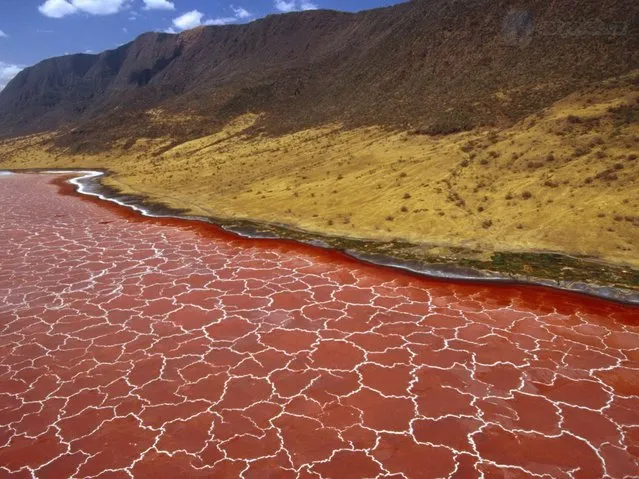
[Lake Natron in Tanzania

Lake Natron is a salt lake located in northern Tanzania, close to the Kenyan border, in the eastern branch of the East African Rift. The lake is fed by the Southern Ewaso Ng'iro River and also by mineral-rich hot springs. It is quite shallow, less than three meters (10 feet) deep, and varies in width depending on its water level, which changes due to high levels of evaporation, leaving concentrations of salt and other minerals, notably sodium carbonate (natron).
Details
05 Jun 2013 10:29:00
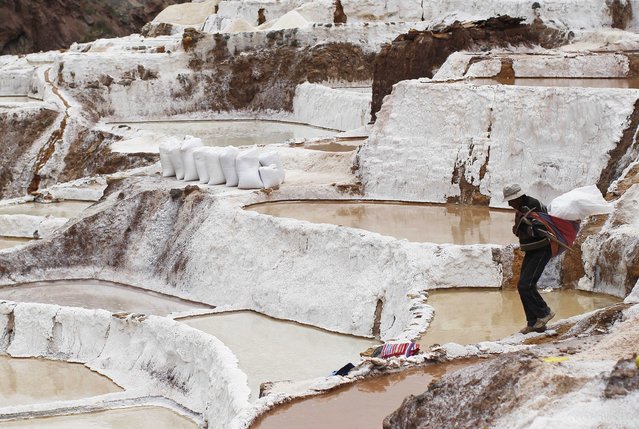
A worker carries a bag of salt after collecting it from a pond at the Maras mines in Cuzco December 3, 2014. Salt has been obtained in Maras since pre-Incan times by evaporating highly salty local subterranean stream water. The water is intricately channelled through constructions, flowing gradually down onto several hundred ancient terraced ponds. (Photo by Enrique Castro-Mendivil/Reuters)

A worker carries a bag of salt after collecting it from a pond at the Maras mines in Cuzco December 3, 2014. Salt has been obtained in Maras since pre-Incan times by evaporating highly salty local subterranean stream water. The water is intricately channelled through constructions, flowing gradually down onto several hundred ancient terraced ponds. From each pond, a local member of the mine cooperative can produce 150 to 200 kilos per month which can be sold in the markets at $0.34 per kilogram, according to miners. (Photo by Enrique Castro-Mendivil/Reuters)
Details
05 Dec 2014 13:36:00