Loading...
Done
This aerial picture taken on August 16, 2020, shows the MV Wakashio bulk carrier that had run aground and broke into two parts near Blue Bay Marine Park, Mauritius. A ship that has leaked more than 1,000 tonnes of oil in pristine waters off the Mauritius coast has split into two, its Japanese operator said August 16, 2020. (Photo by AFP Photo/Stringer)

This aerial picture taken on August 16, 2020, shows the MV Wakashio bulk carrier that had run aground and broke into two parts near Blue Bay Marine Park, Mauritius. A ship that has leaked more than 1,000 tonnes of oil in pristine waters off the Mauritius coast has split into two, its Japanese operator said August 16, 2020. (Photo by AFP Photo/Stringer)
Details
08 Sep 2020 00:03:00
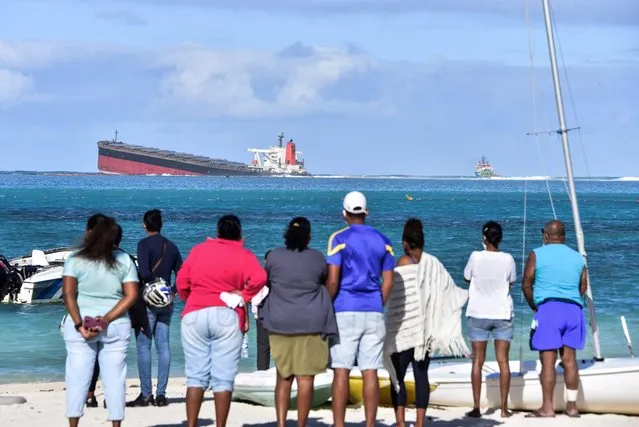
Bystanders look at MV Wakashio bulk carrier that had run aground and from which oil is leaking near Blue Bay Marine Park in south-east Mauritius on August 6, 2020. The carrier, belonging to a Japanese company but Panamanian-flagged, ran aground on July 25 and its crew was evacuated safely. The ship was empty at the time but was carrying 200 tonnes of diesel and 3,800 tonnes of bunker fuel, according to the local press. (Photo by Dev Ramkhelawon/L'Express Maurice/AFP Photo)

Bystanders look at MV Wakashio bulk carrier that had run aground and from which oil is leaking near Blue Bay Marine Park in south-east Mauritius on August 6, 2020. The carrier, belonging to a Japanese company but Panamanian-flagged, ran aground on July 25 and its crew was evacuated safely. The ship was empty at the time but was carrying 200 tonnes of diesel and 3,800 tonnes of bunker fuel, according to the local press. (Photo by Dev Ramkhelawon/L'Express Maurice/AFP Photo)
Details
27 Sep 2020 00:05:00
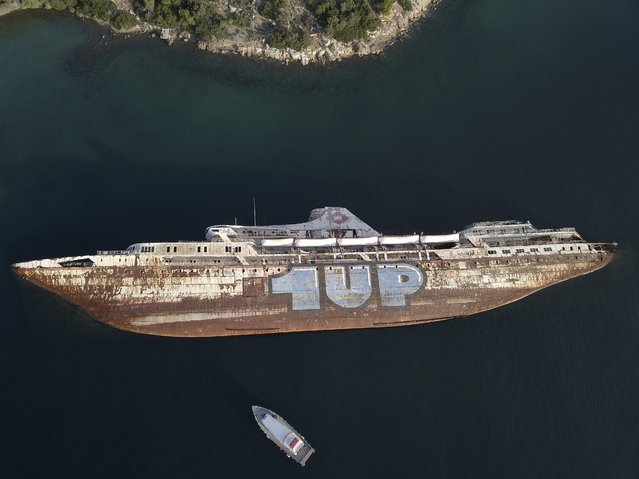
In this Friday, December 4, 2018 photo, a half sunken cruise ship lays on its side, in the Gulf of Elefsina, west of Athens. Dozens of abandoned cargo and passenger ships lie semi-submerged or completely sunken around the Gulf of Elefsina, near Greece’s major port of Piraeus. Now authorities are beginning to remove the dilapidated ships. Some of them have been there for decades, leaking hazards like oil into the environment and creating a danger to modern shipping. One expert calls the abandoned ships “an environmental bomb”. (Photo by Thanassis Stavrakis/AP Photo)

In this Friday, December 4, 2018 photo, a half sunken cruise ship lays on its side, in the Gulf of Elefsina, west of Athens. Dozens of abandoned cargo and passenger ships lie semi-submerged or completely sunken around the Gulf of Elefsina, near Greece’s major port of Piraeus. Now authorities are beginning to remove the dilapidated ships. Some of them have been there for decades, leaking hazards like oil into the environment and creating a danger to modern shipping. One expert calls the abandoned ships “an environmental bomb”. (Photo by Thanassis Stavrakis/AP Photo)
Details
08 Jan 2019 00:05:00
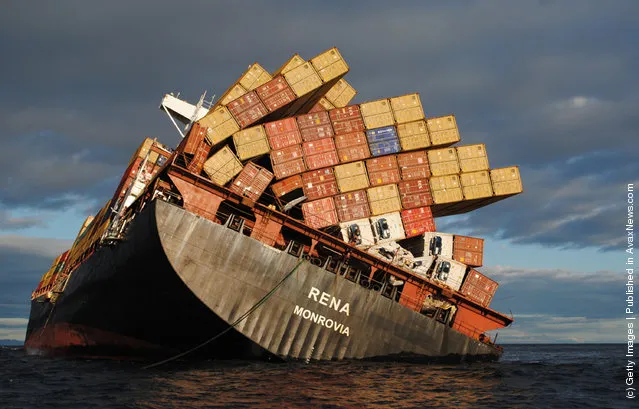
Oil Pumping From Rena Continues

The stern of the stranded cargo vessel Rena grounded on the Astrolabe Reef is seen on October 20, 2011 in Tauranga, New Zealand. Salvage crews continue to pump oil off the ship in an effort to remove as much as possible before bad weather predicted for the evening threatens to break the vessel and release more oil into the sea. Over 300 tonnes of oil has leaked from Rena since it hit the reef on October 5. (Photo by New Zealand Defence Force via Getty Images)
Details
20 Oct 2011 09:11:00
Zabou's witty graffiti. (Photo by Dez Mighty/Susan Mackey)

A female street art collective has set a new Guinness World Record to create the largest spray-painted mural by multiple artists. Over 100 international female street artists came together to create the continuous mural in south London’s Leake Street Tunnel, made famous by Banksy, on March 8, 2014. The record was broken as part of all-female street art event Femme Fierce, the largest of its kind in the UK, which aims to celebrate women street artists across the world. Photo: Zabou's witty graffiti. (Photo by Dez Mighty/Susan Mackey)
Details
12 Mar 2014 05:29:00


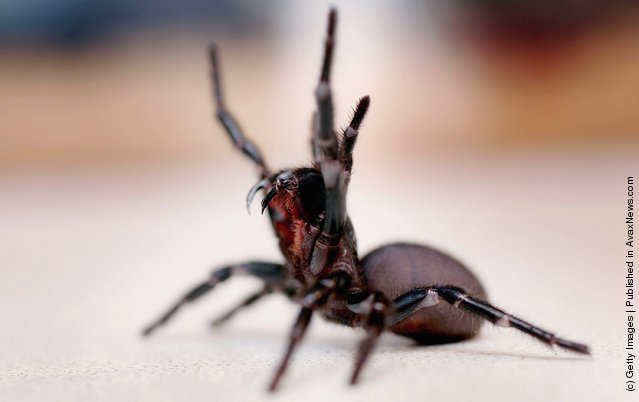
A Funnel Web spider is pictured at the Australian Reptile Park January 23, 2006 in Sydney, Australia. The Funnel Web is one of Australia's deadliest animals, with a venom that is packed with at least 40 different toxic proteins. A bite from a Funnel Web causes massive electrical over-load in the body's nervous system. Finally, fatalities occur from either heart attack or a pulmonary oedema, where the capillaries around the lungs begin to leak fluid and the patient effectively drowns. Death can come as quickly as two hours after a bite if no medical treatment is sought. Due to advances in anti-venom, there has been no death from a Funnel Web bite in Australia since 1980. Australia is home to some of the most deadly and poisonous animals on earth. (Photo by Ian Waldie/Getty Images)
Details
25 Apr 2011 07:49:00
A girl who suffers from hearing and speech disorders reacts to the camera at a rehabilitation centre supported by Bhopal Medical Appeal, for children who were born with mental and physical disabilities, in Bhopal November 11, 2014.(Photo by Danish Siddiqui/Reuters)

A girl who suffers from hearing and speech disorders reacts to the camera at a rehabilitation centre supported by Bhopal Medical Appeal, for children who were born with mental and physical disabilities, in Bhopal November 11, 2014. The rehabilitation centre only treats families they believe have been affected by the Union Carbide gas leak 30 years ago. Human rights groups say that thousands of tonnes of hazardous waste remain buried underground, and the government has conceded it is contaminated. There has, however, been no long-term epidemiological research which conclusively proves that birth defects are directly related to the drinking of the contaminated water. (Photo by Danish Siddiqui/Reuters)
Details
30 Nov 2014 12:00:00
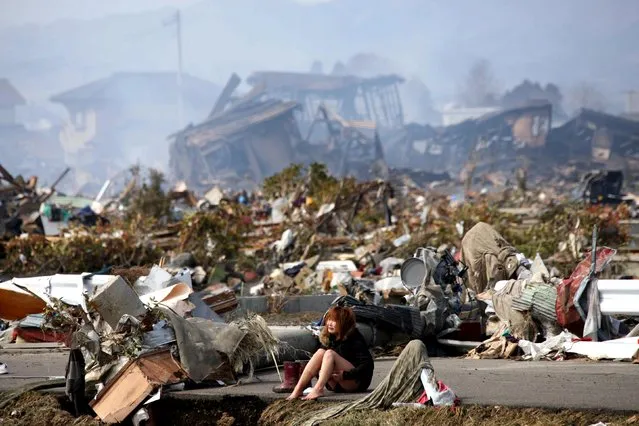
A woman cries while sitting on a road amid the destroyed city of Natori, Miyagi Prefecture in northern Japan March 13, 2011, after a massive earthquake and tsunami that are feared to have killed more than 10,000 people. (Photo by Asahi Shimbun/Reuters)

A woman cries while sitting on a road amid the destroyed city of Natori, Miyagi Prefecture in northern Japan March 13, 2011, after a massive earthquake and tsunami. Five years on from the tsunami that triggered meltdowns at Japan's Fukushima nuclear plant, the page is anything but turned. A magnitude 9 earthquake and towering tsunami on March 11, 2011 killed nearly 16,000 people along Japan's northeastern coast and left more than 2,500 missing. The 10-metre (33-foot) tsunami swept away everything in its path, including houses, ships, cars and farm buildings. (Photo by Asahi Shimbun/Reuters)
Details
09 Mar 2016 12:40:00