Loading...
Done
Christian Balderosdasco, 31, is being pulled up a mud pit after diving for 3 hours to look for gold on March 22, 2017 in Paracale, Philippines. (Photo by Jes Aznar/Getty Images)

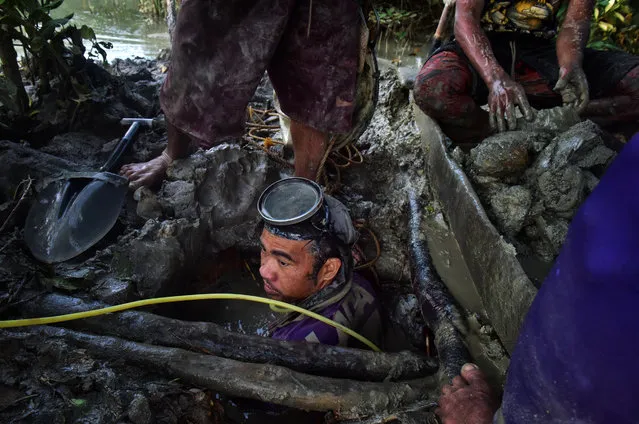
Christian Balderosdasco, 31, is being pulled up a mud pit after diving for 3 hours to look for gold on March 22, 2017 in Paracale, Philippines. Apart from tunneling and sifting sand, locals dive down murky swamps with the aid of a compressor with air flowing in a small tube for breathing, as they blindly swim under the mud for up to four hours to look for tiny rocks containing gold particles. For decades, local residents at Paracale town work in hazardous conditions scavenging under the earth and diving into tunnels filled with mud using only makeshift tools to mine for gold, often placing their health and lives at risk. (Photo by Jes Aznar/Getty Images)
Details
06 Apr 2017 09:21:00


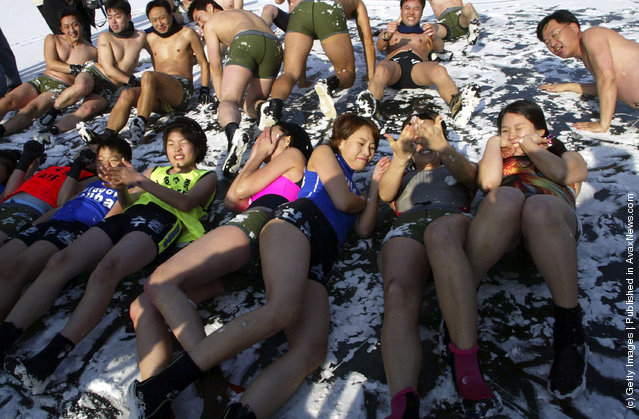
South Korean divers prepare to plunge through a hole in the ice of the frozen Imjin River on January 16, 2005 in Yeonchun, South Korea. (Photo by Chung Sung-Jun/Getty Images)
Details
29 May 2011 12:45:00
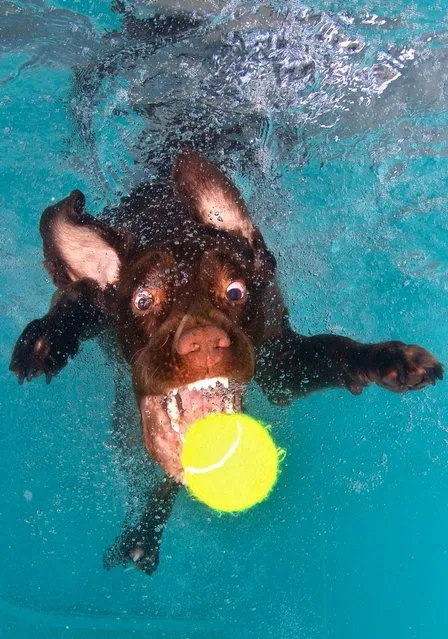
Photographer Lucy Ray says she has been scratched by the pooches who are diving underwater to try and catch a tennis ball. Their wide-eyed desperation has been captured by a specialist underwater photographer who admits she has been bitten and scratched by the pooches who only had eyes for the ball. Lucy Ray, 34, said: “A dog could have the cutest face on land but as soon as they get in the water they can be terrifying. Their eyes bulge and teeth shoot out of their mouth just like an alien as they try to catch the ball”. (Photo by Lucy Ray)

Photographer Lucy Ray says she has been scratched by the pooches who are diving underwater to try and catch a tennis ball. Their wide-eyed desperation has been captured by a specialist underwater photographer who admits she has been bitten and scratched by the pooches who only had eyes for the ball. Lucy Ray, 34, said: “A dog could have the cutest face on land but as soon as they get in the water they can be terrifying. Their eyes bulge and teeth shoot out of their mouth just like an alien as they try to catch the ball”. (Photo by Lucy Ray)
Details
15 Sep 2014 10:47:00
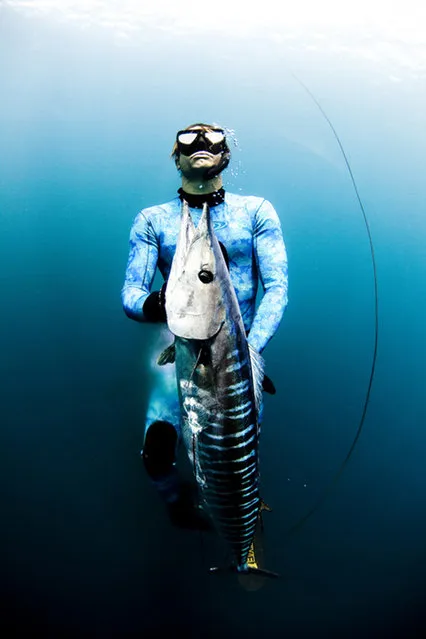
Free Dive Hunters

Without the use of any type of scuba equipment, divers descend to great depths armed with underwater guns, harpoons and strong line to stalk and hunt prey. Some of the best free-divers in the world can hold their breath for up to 5 minutes under water and go to depths greater than 100 feet.
(All photography © Eyeconic Images.)
Details
26 Jun 2013 14:17:00
Jaipur, India, 2013, (Photo by Takehiko Yagi/The Guardian)

Takehiko Yagi is a rising star in Japanese photography, and his vibrant pictures of the Hindu spring festival of Holi won the Grand Prize at the fourth annual Nikkei National Geographic Photo Prize. Diving into the Colors of Holi is his first exhibition in the US, on show at Foto Care Gallery in New York until 28 September, 2016. Here: Jaipur, India, 2013, (Photo by Takehiko Yagi/The Guardian)
Details
23 Sep 2016 09:05:00
A member of the Edo Firemanship Preservation Association displays his balancing skills atop bamboo ladder during a New Year presentation by the fire brigade in Tokyo January 6, 2015. (Photo by Thomas Peter/Reuters)

A member of the Edo Firemanship Preservation Association displays his balancing skills atop bamboo ladder during a New Year presentation by the fire brigade in Tokyo January 6, 2015. (Photo by Thomas Peter/Reuters)
Details
07 Jan 2015 14:16:00
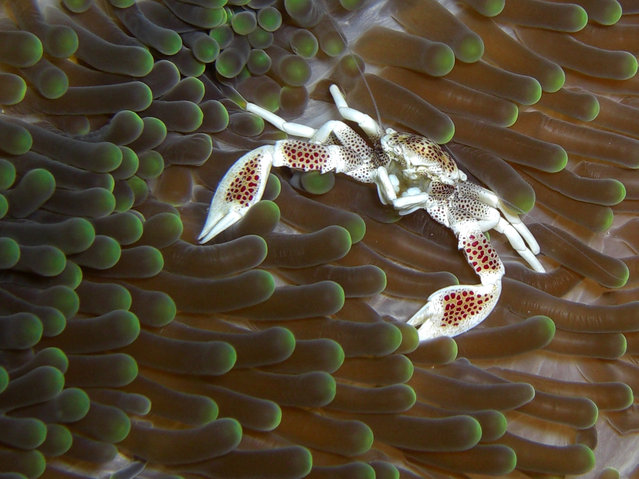
Porcelain Crab. (Photo by David M. Hogan)

Porcelain Crab. (Photo by David M. Hogan)
Details
25 Oct 2013 08:13:00
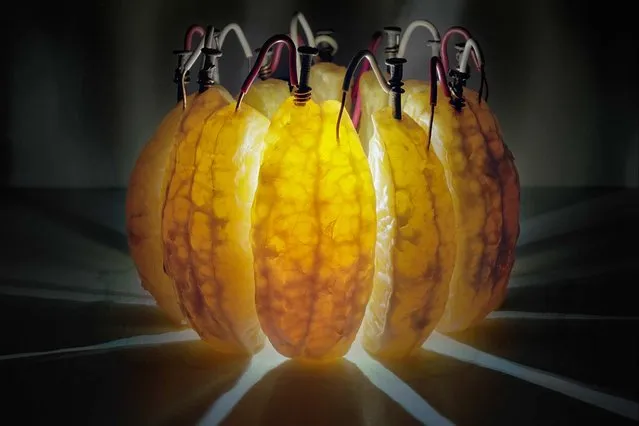
Wedges of an orange generate enough current and electrical juice – 3.5 volts – to power an LED. The fruit’s citric acid helps electrons flow from galvanized nails to copper wire in this 14-hour exposure. This image was published in September’s Visions of Earth, a trio of photos that appear in each issue of National Geographic. (Photo by Caleb Charland/National Geographic)

Wedges of an orange generate enough current and electrical juice – 3.5 volts – to power an LED. The fruit’s citric acid helps electrons flow from galvanized nails to copper wire in this 14-hour exposure. This image was published in September’s Visions of Earth, a trio of photos that appear in each issue of National Geographic. (Photo by Caleb Charland/National Geographic)
Details
06 Jan 2014 12:09:00