Loading...
Done
Dream Chaser

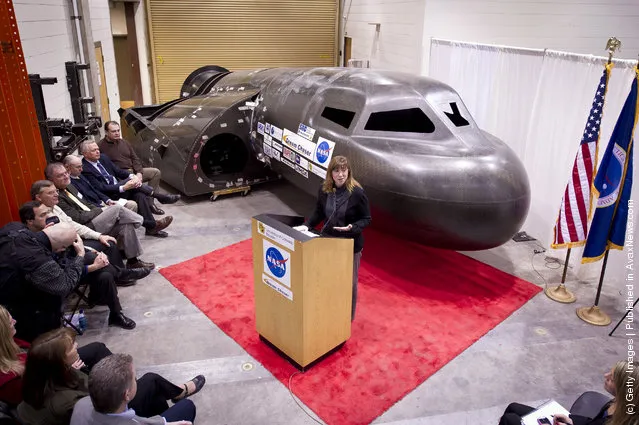
“The Dream Chaser is a planned crewed suborbital and orbital vertical-takeoff, horizontal-landing (VTHL) lifting-body spaceplane being developed by SpaceDev, a wholly owned subsidiary of Sierra Nevada Corporation (SNC). The Dream Chaser design is planned to carry seven people to and from low earth orbit. The vehicle would launch vertically on an Atlas V and land horizontally on conventional runways”. – Wikipedia

Photo: NASA Deputy Administrator Lori Garver talks during a press conference with Sierra Nevada's Dream Chaser spacecraft in the background at the University of Colorado at Boulder on February 5, 2011 in Boulder, Colorado. Sierra Nevada's Dream Chaser spacecraft is under development with support from NASA's Commercial Crew Development Program to provide crew transportation to and from low Earth orbit. NASA is helping private companies develop innovative technologies to ensure that the U.S. remains competitive in future space endeavors. (Photo by Bill Ingalls/NASA via Getty Images)
Details
12 Aug 2011 14:16:00
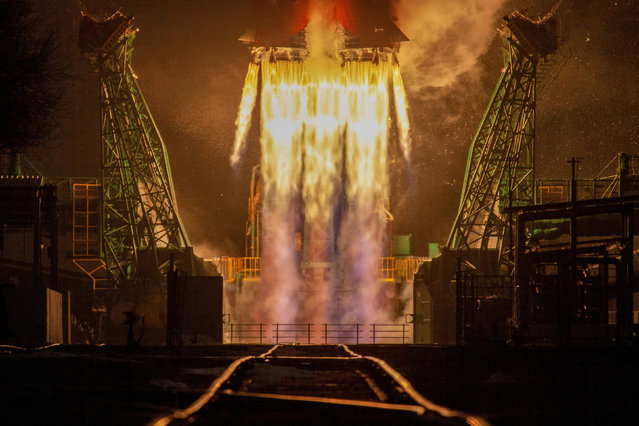
The Soyuz 2.1b rocket with a Fregat-M booster and meteorology and emergency communications satellite Arktika-M No 1 launches from Baikonur Cosmodrome in Baikonur, Kazakhstan on February 28, 2021. Arktika-M No 1 is the first of ten Arktika satellites to be launched by Roscosmos into orbit. (Photo by Roscomos/TASS)

The Soyuz 2.1b rocket with a Fregat-M booster and meteorology and emergency communications satellite Arktika-M No 1 launches from Baikonur Cosmodrome in Baikonur, Kazakhstan on February 28, 2021. Arktika-M No 1 is the first of ten Arktika satellites to be launched by Roscosmos into orbit. (Photo by Roscomos/TASS)
Details
10 Mar 2021 10:12:00
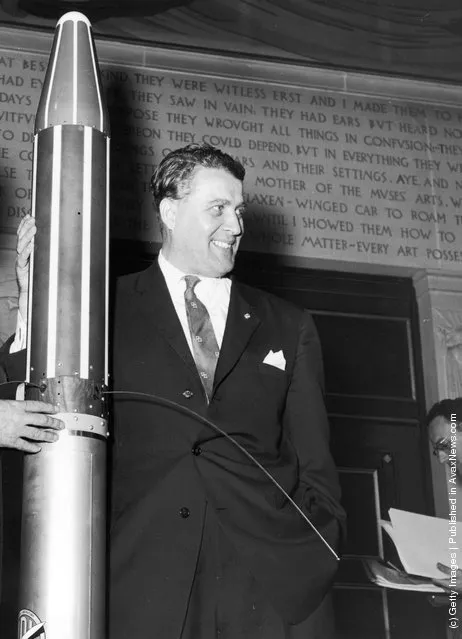
German-born American engineer Dr Wernher von Braun (1912 - 1977) with a model of the Explorer orbiting space satellite which he designed, 1958

“Wernher Magnus Maximilian Freiherr von Braun (March 23, 1912 – June 16, 1977) was a German-born rocket scientist, aerospace engineer, space architect, and one of the leading figures in the development of rocket technology in Nazi Germany during World War II and, subsequently, the United States”. – Wikipedia

Photo: German-born American engineer Dr. Wernher von Braun with a model of the Explorer orbiting space satellite which he designed. (Photo by Keystone/Getty Images). 1958
Details
22 Mar 2012 11:18:00
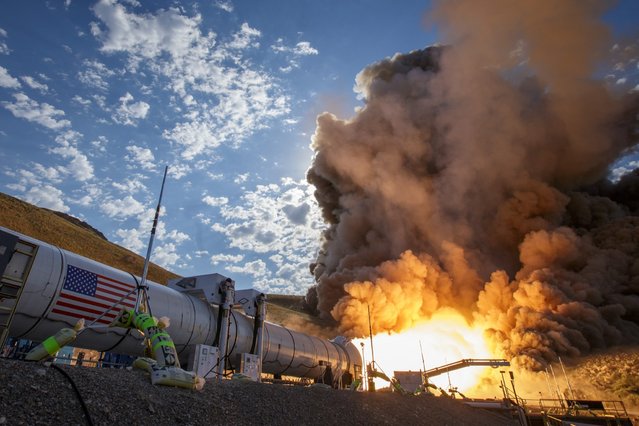
The second and final qualification motor (QM-2) test for the Space Launch System's booster, June 28, 2016, at Orbital ATK Propulsion Systems test facilities in Promontory, Utah. (Photo by Bill Ingalls/NASA)

The second and final qualification motor (QM-2) test for the Space Launch System's booster, June 28, 2016, at Orbital ATK Propulsion Systems test facilities in Promontory, Utah. During the Space Launch System flight the boosters will provide more than 75 percent of the thrust needed to escape the gravitational pull of the Earth, the first step on NASA's Journey to Mars. (Photo by Bill Ingalls/NASA)
Details
29 Jun 2016 11:32:00
Viewing The Earth From Space

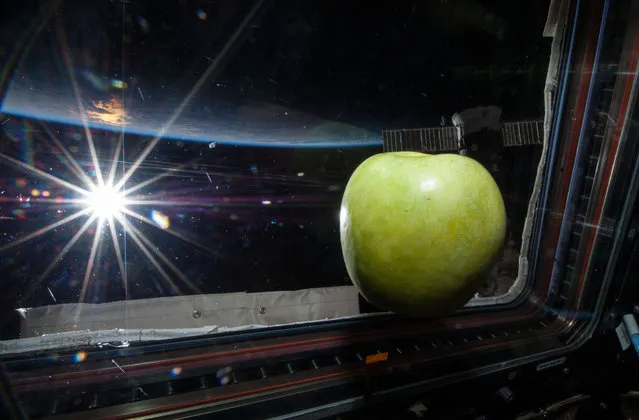
Despite any political differences between the United States and Russia, the space agencies of the two countries continue their cooperative work in Earth's orbit, aboard the International Space Station. Apart from the research being done in microgravity, ISS crew members continue to send back amazing images of our home world, photographed from low Earth orbit. Gathered here are recent images of Earth from aboard the ISS, and from a handful of other NASA satellites.
Details
01 Jun 2014 12:36:00
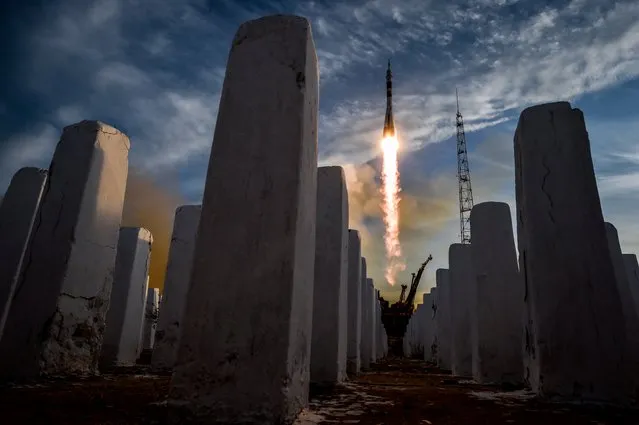
A Soyuz MS-11 rocket carrying Russian, American and Canadian astronauts takes off from the Baikonur Cosmodrome on December 3, 2018 before reached orbit later, the first manned mission since a failed launch in October. (Photo by Kirill Kudryavtsev/AFP Photo)

A Soyuz MS-11 rocket carrying Russian, American and Canadian astronauts takes off from the Baikonur Cosmodrome on December 3, 2018 before reached orbit later, the first manned mission since a failed launch in October. (Photo by Kirill Kudryavtsev/AFP Photo)
Details
05 Dec 2018 00:07:00
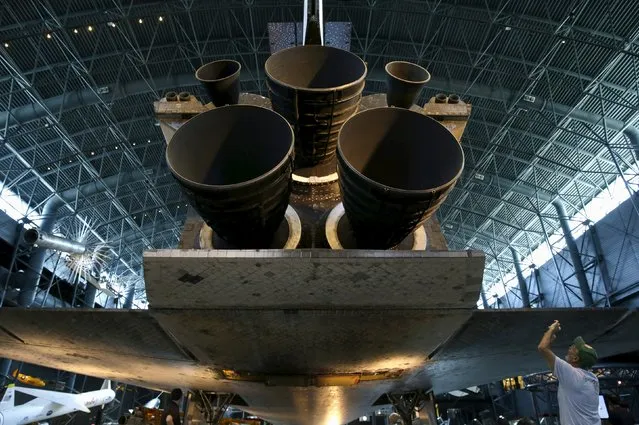
A man photographs the main engines of the space shuttle orbiter Discovery on display at the Udvar-Hazy Smithsonian National Air and Space Annex Museum in Chantilly, Virginia August 28, 2015. (Photo by Gary Cameron/Reuters)

A man photographs the main engines of the space shuttle orbiter Discovery on display at the Udvar-Hazy Smithsonian National Air and Space Annex Museum in Chantilly, Virginia August 28, 2015. Shuttle Discovery had 27 years of service and flew 39 times before being retired in 2011. (Photo by Gary Cameron/Reuters)
Details
30 Aug 2015 12:04:00
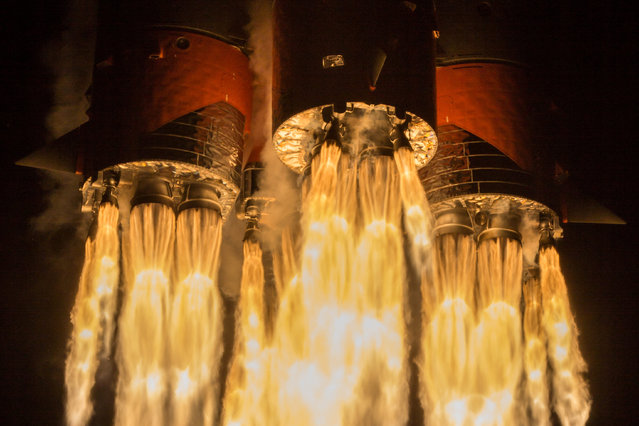
A handout photo made available by the Roscosmos State Corporation for Space Activities shows the Soyuz-2.1b launch vehicle with the OneWeb communication satellites launching from the Baikonur Cosmodrome, Kazakhstan, 07 February 2020. Thirty-four satellites from OneWeb were successfully put into orbit on a single Soyuz rocket from Baikonur. (Photo by Roscosmos/EPA/EFE)

A handout photo made available by the Roscosmos State Corporation for Space Activities shows the Soyuz-2.1b launch vehicle with the OneWeb communication satellites launching from the Baikonur Cosmodrome, Kazakhstan, 07 February 2020. Thirty-four satellites from OneWeb were successfully put into orbit on a single Soyuz rocket from Baikonur. (Photo by Roscosmos/EPA/EFE)
Details
13 Apr 2020 00:03:00