Loading...
Done
No Face Day In Chine

Employees wear "No-Face" masks during working hours at a service company in Handan, Hebei Province of China. As a service company, staff must smile to customers every day. On “No-Face Day”, staff wore masks to hide their facial expressions and allow them to relax. No-Face is a character in the 2001 animated movie “Spirited Away”, a silent masked creature who has no facial expressions.
Details
02 Aug 2015 20:49:00


Gliding past the planet Jupiter, the Cassini spacecraft captures this awe inspiring view of active Io, Jupiter's third largest satellite, with the largest gas giant as a backdrop, offering a stunning demonstration of the ruling planet's relative size, April 20, 2001. The Cassini spacecraft itself was about 10 million kilometers from Jupiter when recording the image data. (Photo courtesy of NASA/Newsmakers)
Details
23 Mar 2011 10:32:00
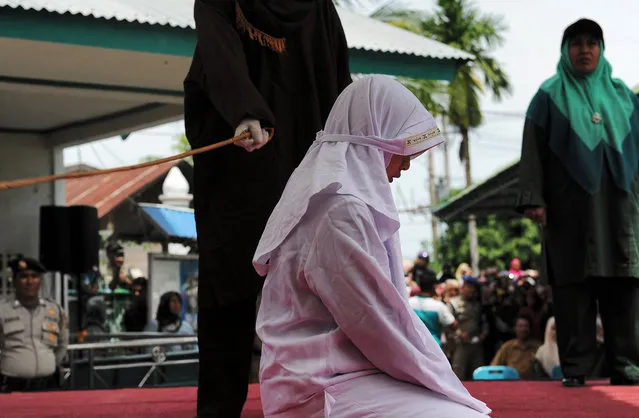
One of four Acehnese teen gets whipped for spending time in close proximity with her boyfriend who is not her husband, which is against Sharia law, in Aceh on April 18, 2017. Aceh on Sumatra island began implementing Sharia law after being granted special autonomy in 2001, an attempt by the central government in Jakarta to quell a long-running separatist insurgency. (Photo by Chaideer Mahyuddin/AFP Photo)

One of four Acehnese teen gets whipped for spending time in close proximity with her boyfriend who is not her husband, which is against Sharia law, in Aceh on April 18, 2017. Aceh on Sumatra island began implementing Sharia law after being granted special autonomy in 2001, an attempt by the central government in Jakarta to quell a long-running separatist insurgency. (Photo by Chaideer Mahyuddin/AFP Photo)
Details
19 Apr 2017 09:07:00
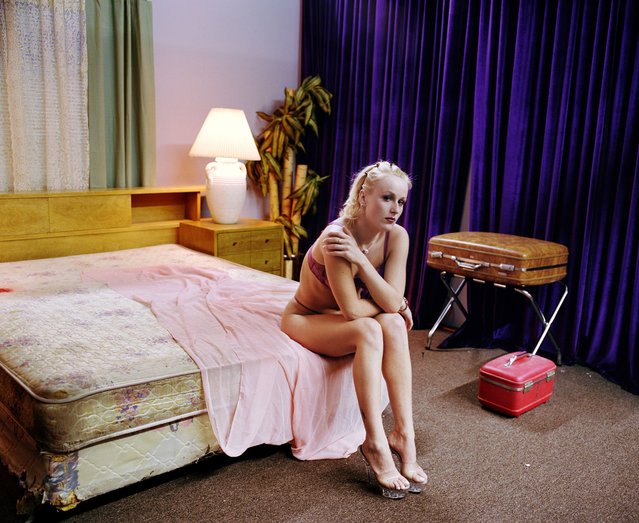
«Sharon Wild (from the series The Valley)», 2001. Larry Sultan grew up in California’s San Fernando Valley, which was a source of inspiration for a number of his projects. His series The Valley (2004) addresses the use of ordinary homes as sets for pornographic films, and asks why the ideal of middle-class domesticity lends itself to this most curious form of cultural appropriation. (Photo by Larry Sultan)

«Sharon Wild (from the series The Valley)», 2001. Larry Sultan grew up in California’s San Fernando Valley, which was a source of inspiration for a number of his projects. His series The Valley (2004) addresses the use of ordinary homes as sets for pornographic films, and asks why the ideal of middle-class domesticity lends itself to this most curious form of cultural appropriation. (Photo by Larry Sultan)
Details
03 Aug 2025 03:50:00
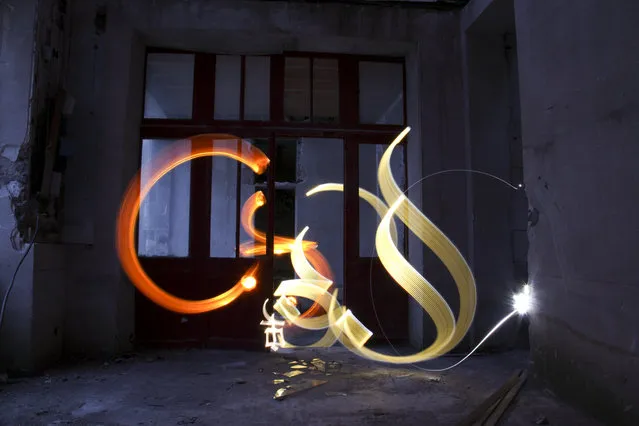
Light Calligraphy By Julien Breton

French artist Julien Breton aka Kaalam started calligraphy in 2001 by copying Arabic calligraphers. Self-taught, he began to incorporate long exposure photography to create incredible light paintings around the world. All of the images in this gallery were created in-camera, meaning there is no Photoshop trickery or post-production manipulation involved in creating these works of art.
Details
28 Jul 2014 06:24:00
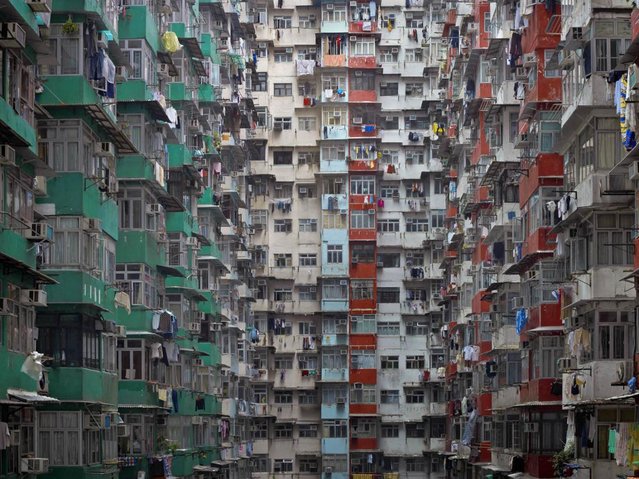
Hong Kong By Michael Wolf

The focus of the german photographer michael wolf's work is life in mega cities. Many of his projects document the architecture and the vernacular culture of metropolises. Wolf grew up in Canada, Europe and the United States, studying at UC Berkeley and at the Folkwang School with Otto Steinert in Essen, Germany. He moved to Hong Kong in 1994 where he worked for 8 years as contract photographer for Stern magazine. Since 2001, Wolf has been focusing on his own projects, many of which have been published as books.
Details
23 Jan 2013 12:02:00
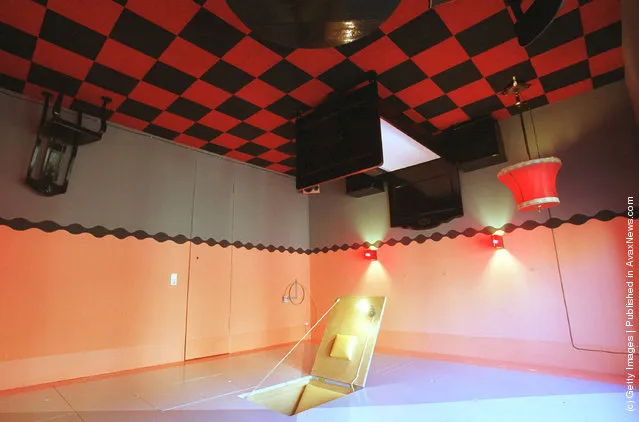
Propeller Island City Lodge – Weirdest Hotel In The World

The Upside Down Room, with furniture on the ceiling and real beds and chairs that open out of the floor, is one of many creative and even bizarre rooms shown photographed February 14, 2002 at the Propeller Island City Lodge in Berlin, Germany. Owner, artist and musician Lars Stroschen designed the rooms of the hotel, which has 28 rooms and has been open since June, 2001. (Photo by Sean Gallup/Getty Images)
Details
11 Nov 2011 10:37:00
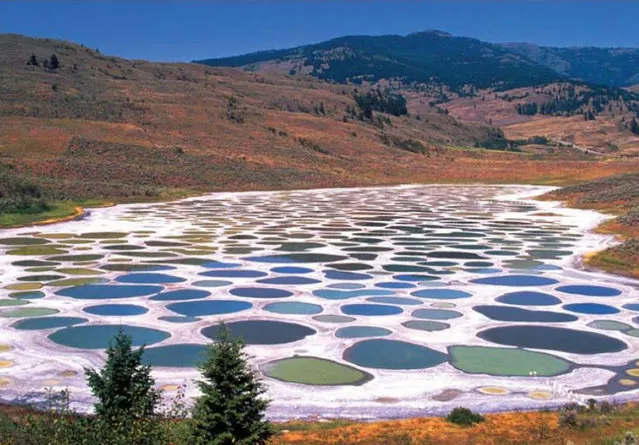
Kliluk, the Spotted Lake, Canada

Originally known to the First Nations of the Okanagan Valley as Khiluk, which was- and remains today revered as a sacred site producing therapeutic waters. During World War I the minerals of Spotted Lake were used in manufacturing ammunition. Later the area came under the control of the Ernest Smith Family, for a term of about 40 years. In 1979 Smith attempted to create interest in a spa at the lake. The First Nations responded with an effort to buy the lake; in October 2001 they finally struck a deal. First Nations arranged the purchase of 22 hectares of land for a total of $720,000, and contributed about 20% of the cost. The Indian Affairs Department paid the remainder.
Details
06 Mar 2015 12:59:00