Loading...
Done
In his series “Ballerinas of Cairo”, photographer Mohamed Taher documents Egyptian dancers making the city streets their stage – pirouetting, leaping and posing their way through their country’s sprawling capital. The photos are, at first glance, stunning snapshots of a city’s vibrant culture in motion. But considering the dangers Egyptian women face for roaming these same streets on a daily basis, their impact is far deeper. Sexual harassment continues to present not just a possibility but a terrifying reality in present-day Egypt. A 2013 United Nations report calculated that 99.3 percent of women in the country have experienced sexual harassment on the streets, a problem that’s sparked initiatives giving women a way to fight back. The violence is rooted in an extreme conservative perspective encouraging women to stay in the home. (Photo by Mohamed Taher/Ballerinas of Cairo)

In his series “Ballerinas of Cairo”, photographer Mohamed Taher documents Egyptian dancers making the city streets their stage – pirouetting, leaping and posing their way through their country’s sprawling capital. The photos are, at first glance, stunning snapshots of a city’s vibrant culture in motion. (Photo by Mohamed Taher/Ballerinas of Cairo)
Details
17 Jan 2017 12:30:00
Rougine, a 19-year-old female Arab fighter among the Syrian Democratic Forces, made up of US-backed Kurdish and Arab fighters, stands in fatigues embracing another colleague near the village of al-Torshan, 20 km on the outskirts of Raqa on February 6, 2017. Unlike Syria's Kurds, who have emphasised gender equality in both their militias and nascent autonomous governing institutions in north and northeast Syria, the Arab tribes in the same region are among the more conservative segments of the country's population, and most Arab families find the concept of female fighters “hard to accept”. (Photo by Delil Souleiman/AFP Photo)

Rougine, a 19-year-old female Arab fighter among the Syrian Democratic Forces, made up of US-backed Kurdish and Arab fighters, stands in fatigues embracing another colleague near the village of al-Torshan, 20 km on the outskirts of Raqa on February 6, 2017. (Photo by Delil Souleiman/AFP Photo)
Details
13 Feb 2017 00:05:00
Alexei Gruk, 45, mechanic and supporter of presidential candidate Pavel Grudinin, poses for a picture in St. Petersburg, Russia, January 31, 2018. “The most important thing for me is that our foreign policy stays the same”, said Gruk. “To hell with the sanctions… So what if they don’t bring foreign stuff here anymore? As if that means we have to give up. I don't care”. (Photo by Anton Vaganov/Reuters)

Most Russians intending to vote for Vladimir Putin in Sunday's election say stability is at the root of their faith in their candidate – though many young voters believe it's time for a change of leader. Putin, 65, is expected to win a fourth term in office with 69 percent of the vote, according to the latest survey by a state-run pollster. Reuters correspondents and photographers who travelled around the country talking to voters ahead of the March 18 election found nothing to contradict expectation of an emphatic Putin victory. (Photo by Anton Vaganov/Reuters)
Details
15 Mar 2018 00:01:00
The series, which was photographed between 2015 and 2017, is currently on display at the Purdy Hicks Gallery in London, running through August 24, 2018. (Photo by Leila Jefferies/Caters News Agency)

This photographer has made it her mission to change people’s perception of pigeons – focusing on some of the most beautiful of the more than 300 species found globally. Rather than focus on the gray, nondescript birds people usually associate with the term “pigeon”, Leila Jeffreys has instead decided to snap the more vibrant varieties. Whether it be the wompoo pigeon, with its deep purple breast and green wings, or the rose-crowned fruit dove, with its pink head, Jeffreys, 46, gives the birds the same attention she would give a human model. (Photo by Leila Jefferies/Caters News Agency)
Details
14 Aug 2018 00:01:00
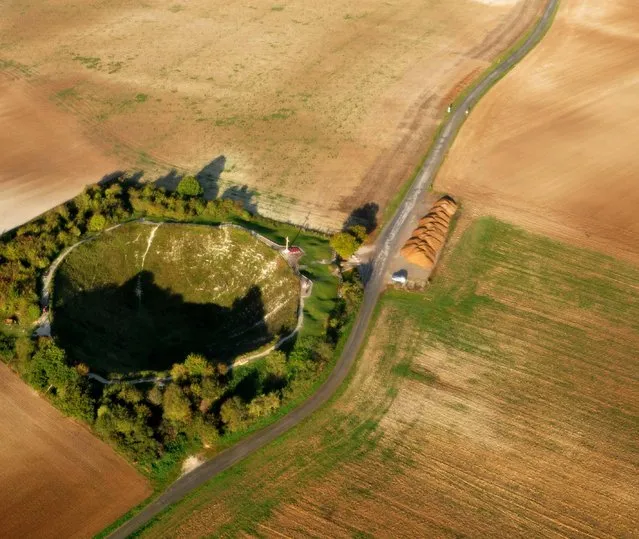
Lochnagar Crater Somme In France

It is amazing how much the humanity can change the face of the earth. Not only can it create huge craters, which look a lot like craters from meteors, they leave a big enough impact that it can be seen from space. Though this crater, caused by a massive explosion on 1 July 1916, looks large, being 90 feet deep and 300 feet across; it is nowhere big enough to be viewed for space. A common misconception is that the Great Wall of China can be seen from space. In reality, however, it is impossible. Not only is it of the same color as the earth near it, it is also not that wide. Deforestation, on the other hand, can be clearly seen from space. Also, at night, all the lights that the large cities produce are also very visible.
Details
17 Nov 2014 12:48:00
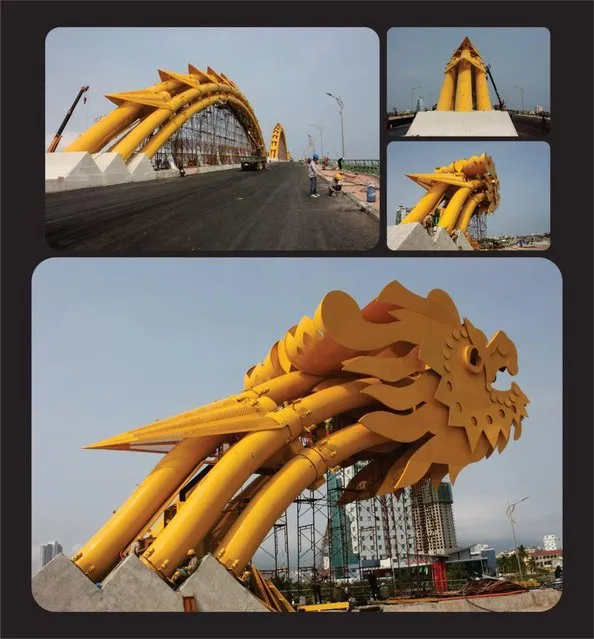
Dragon Bridge Over The River Hang

The Dragon Bridge (Vietnamese: Cầu Rồng) is a bridge over the River Hàn at Da Nang, Vietnam. Construction of the bridge began on 19 July 2009 (the same day as the inauguration of the nearby Thuận Phước Bridge) when the Prime Minister of Vietnam Nguyen Tan Dung and many high-ranking government officials attended the groundbreaking ceremony. Dragon Bridge is 666m long, 37.5m wide and has six lanes for traffic. It opened to traffic on March 29, 2013, at a cost os nearly VND 1.5 trillion dong (US$88m). The bridge was designed by the US-based Ammann & Whitney Consulting Engineers with Louis Berger Group. Construction was undertaken by Company No. 508, an affiliate of Civil Construction Engineering Corporation No.5, and Bridge Company No. 75.
Details
01 Jan 2014 08:41:00
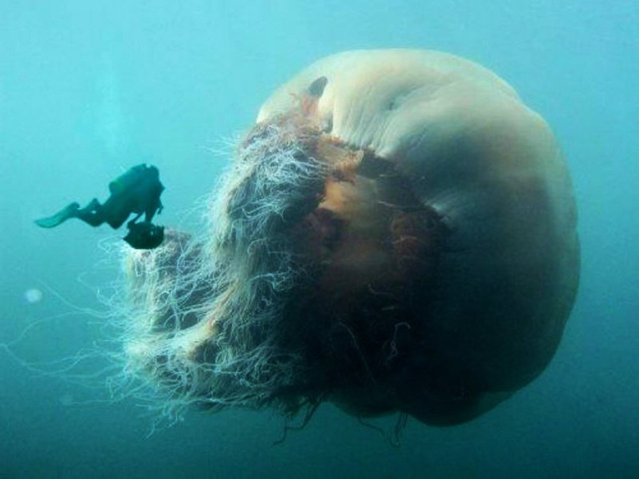
Giant Jellyfish Cyanea capillata

Cyanea capillata is the largest known species of jellyfish. Its range is confined to cold, boreal waters of the Arctic, northern Atlantic, and northern Pacific Oceans, seldom found farther south than 42°N latitude. Similar jellyfish, which may be the same species, are known to inhabit seas near Australia and New Zealand. The largest recorded specimen found, washed up on the shore of Massachusetts Bay in 1870, had a bell (body) with a diameter of 7 feet 6 inches (2.29 m) and tentacles 120 feet (37 m) long.Lion's mane jellyfish have been observed below 42°N latitude for some time—specifically in the larger bays of the east coast of the United States.
Details
24 Jul 2012 12:00:00


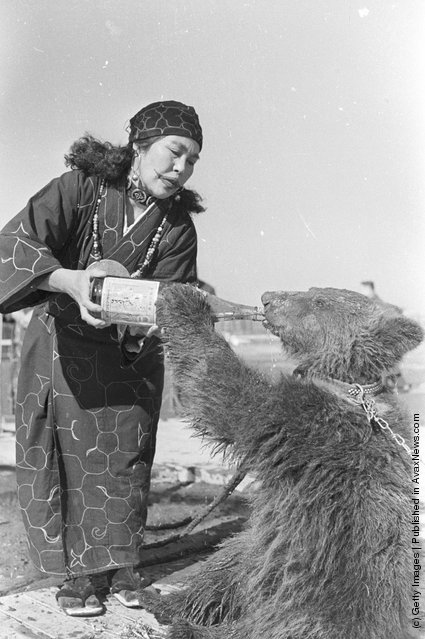
“The Ainu (アイヌ?), also called Aynu, Aino (アイノ), and in historical texts Ezo (蝦夷), are indigenous people or groups in Japan and Russia. Historically they spoke the Ainu language and related varieties and lived in Hokkaidō, the Kuril Islands, and much of Sakhalin. Most of those who identify themselves as Ainu still live in this same region, though the exact number of living Ainu is unknown. This is due to ethnic issues in Japan resulting in those with Ainu backgrounds hiding their identities and confusion over mixed heritages. In Japan, because of intermarriage over many years with Japanese, the concept of a 'pure Ainu' ethnic group is no longer feasible. Official estimates of the population are of around 25,000, while the unofficial number is upwards of 200,000 people”. – Wkipedia

Photo: A captive bear drinking from a large bottle held by an Ainu tribeswoman. (Photo by Evans/Three Lions/Getty Images). Circa 1955
Details
24 Mar 2011 14:01:00