Loading...
Done
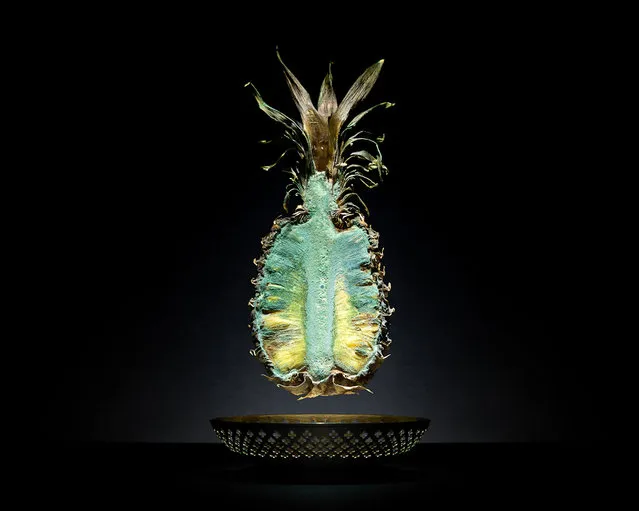
Pineapple

“One Third” – a project on food waste by an Austrian photography Klaus Pichler. According to a UN study one third of the world's food goes to waste – the largest part thereof in the industrialized nations of the global north. Equally, 925 million people around the world are threatened by starvation. The series “One Third” describes the connection between individual wastage of food and globalized food production.

Photo: Pineapple. Place of production: Guayaquil, Ecuador. Cultivation method: Outdoor plantation • Time of harvest: All- season. Transporting distance: 10.666 km (linear distance) • Means of transportation: Aircraft, truck. Carbon footprint (total) per kg: 11,94 kg • Water requirement (total) per kg: 360 l. Price: 2,10 € / kg. (Photo by Klaus Picher)
Details
02 May 2012 11:01:00
Yanelis Blanco, 24, center, dances with a group of friends at Santa Maria beach, about 15 miles from Havana. It is the closest beach to Havana. Others, from left to right are Jackson Miranda, 21, Dayan Suarez, 24, and Melisa Oliva, 15. The men in the group have a rap group together. The government is demolishing buildings all over the coast of East Havana and recovering and restoring beach dunes. (Photo by Sarah L. Voisin/The Washington Post)

Yanelis Blanco, 24, center, dances with a group of friends at Santa Maria beach, about 15 miles from Havana. It is the closest beach to Havana. Others, from left to right are Jackson Miranda, 21, Dayan Suarez, 24, and Melisa Oliva, 15. The men in the group have a rap group together. The government is demolishing buildings all over the coast of East Havana and recovering and restoring beach dunes. (Photo by Sarah L. Voisin/The Washington Post)
Details
04 Oct 2015 08:05:00
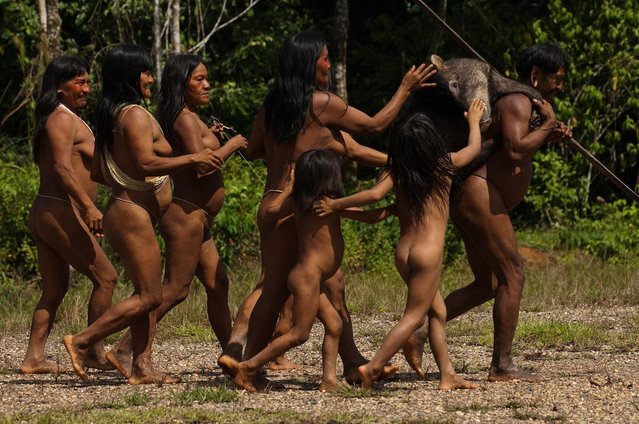
Spectacular images offering insight into the lives of the Huaorani people in the Ecuadorian Amazon have been revealed showing how they use traditional methods to hunt monkeys for food. The stunning pictures were taken by conservation photographer Pete Oxford from Torquay, Devon in the Ecuadorian Amazon. “The Huaorani Indians are a forest people highly in tune with their environment. Many are now totally acculturated since the 1950s by missionaries”, said Pete. “Today they face radical change to their culture to the proximity of oil exploration within their territory and the Yasuni National Park and Biosphere Reserve, they are vastly changed. Some still live very traditionally and for this shoot, through my Huaorani friend, a direct relative of those photographed he wanted to depict them as close to their original culture as possible. They still largely hunt with blow pipes and spears eating a lot of monkeys and peccaries”. The Huaorani are also known as the Waorani, Waodani or the Waos and are native Amerindians. Their lands are located between the Curaray and Napo rivers and speak the Huaorani language. Pete says that during his visit he was welcomed into the group and hopes that ancient cultures can be saved. Here: The tribe were seen celebrating after a hunter returned to camp with a wild pig. (Photo by Pete Oxford/Mediadrumworld.com)

Spectacular images offering insight into the lives of the Huaorani people in the Ecuadorian Amazon have been revealed showing how they use traditional methods to hunt monkeys for food. The stunning pictures were taken by conservation photographer Pete Oxford from Torquay, Devon in the Ecuadorian Amazon. Here: The tribe were seen celebrating after a hunter returned to camp with a wild pig. (Photo by Pete Oxford/Mediadrumworld.com)
Details
20 Jan 2017 07:58:00
A member of the Pena de Pavao de Krishna traditional carnival group, which celebrates Indian deities, performs in Belo Horizonte, Brazil, on February 23, 2020. The group added more accelerated northern rhythms to its repertoire in a way to raise awareness of the importance of the Amazon rainforest and the worrying rates that it is burning at. (Photo by Douglas Magno/AFP Photo)

A member of the Pena de Pavao de Krishna traditional carnival group, which celebrates Indian deities, performs in Belo Horizonte, Brazil, on February 23, 2020. The group added more accelerated northern rhythms to its repertoire in a way to raise awareness of the importance of the Amazon rainforest and the worrying rates that it is burning at. (Photo by Douglas Magno/AFP Photo)
Details
26 Feb 2020 00:07:00
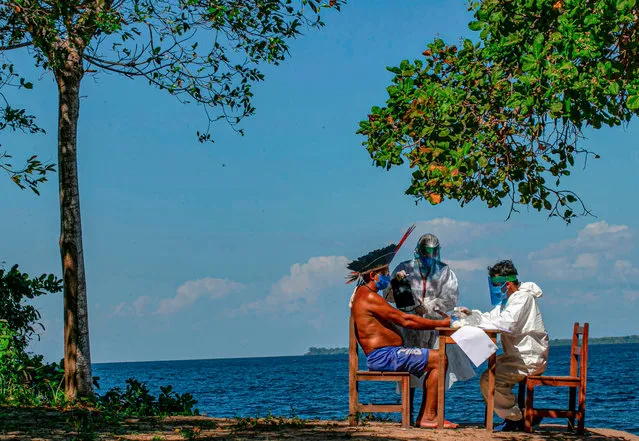
Indigenous nurses from the Special Secretariat for Indigenous Health (Sesai) of the Arapiuns ethnic group and Tapuia ethnic groups perform a rapid COVID-19 test on Chief Domingos from the Arapium tribe on the banks of the lower Tapajos River in the municipality of Santarem in western Para on July 19, 2020. (Photo by Tarso Sarraf/AFP Photo)

Indigenous nurses from the Special Secretariat for Indigenous Health (Sesai) of the Arapiuns ethnic group and Tapuia ethnic groups perform a rapid COVID-19 test on Chief Domingos from the Arapium tribe on the banks of the lower Tapajos River in the municipality of Santarem in western Para on July 19, 2020. (Photo by Tarso Sarraf/AFP Photo)
Details
22 Jul 2020 00:07:00
Orange Caramel (오렌지 캬라멜) - Lipstick (립스틱) Photoshoot

“Orange Caramel (오렌지 캬라멜), is the first sub group formed from the South Korean pop group After School. This sub-unit was formed with the third generation members: Nana, Raina and Lizzy. Orange Caramel’s concept is more lighthearted and sweet unlike many girl groups that have taken on darker, sexier concepts”. – Wikipedia


Details
07 Oct 2012 09:03:00
Members of Japanese idol group Kamen Joshi (Masked Girls)  pose for a photo after a rehearsal for a concert at their theatre in Tokyo's Akihabara district, Japan March 17, 2016. For countless girl and pop-idol bands in Japan, standing out from the crowd can be daunting, but one group – “Kamen Joshi” – seems to have found the answer by hiding behind masks. The Tokyo-based all female band has 18 members, split into three groups that perform across Japan and elsewhere in Asia. (Photo by Toru Hanai/Reuters)

Members of Japanese idol group Kamen Joshi (Masked Girls) pose for a photo after a rehearsal for a concert at their theatre in Tokyo's Akihabara district, Japan March 17, 2016. For countless girl and pop-idol bands in Japan, standing out from the crowd can be daunting, but one group – “Kamen Joshi” – seems to have found the answer by hiding behind masks. The Tokyo-based all female band has 18 members, split into three groups that perform across Japan and elsewhere in Asia. (Photo by Toru Hanai/Reuters)
Details
30 Mar 2016 11:04:00
A member of the “Ladies in White” dissident group shouts as she is carried away by police officers after they broke up a regular march of the group, detaining about 50 people, hours before U.S. President Barack Obama arrives for a historic visit, in Havana, Cuba March 20, 2016. (Photo by Ueslei Marcelino/Reuters)

A member of the “Ladies in White” dissident group shouts as she is carried away by police officers after they broke up a regular march of the group, detaining about 50 people, hours before U.S. President Barack Obama arrives for a historic visit, in Havana, Cuba March 20, 2016. (Photo by Ueslei Marcelino/Reuters)
Details
21 Mar 2016 12:41:00