Loading...
Done
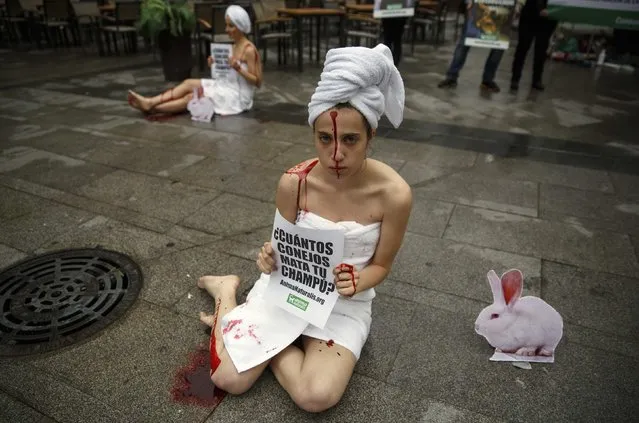
Animal rights activists covered with fake blood sit on the floor during a protest against the use of animals in research to mark World Day for Animals in Laboratories in central Madrid April 24, 2014. The sign reads, “How many rabbits do your shampoo kill?”. (Photo by Andrea Comas/Reuters)

Animal rights activists covered with fake blood sit on the floor during a protest against the use of animals in research to mark World Day for Animals in Laboratories in central Madrid April 24, 2014. The sign reads, “How many rabbits do your shampoo kill?”. (Photo by Andrea Comas/Reuters)
Details
26 Apr 2014 11:44:00
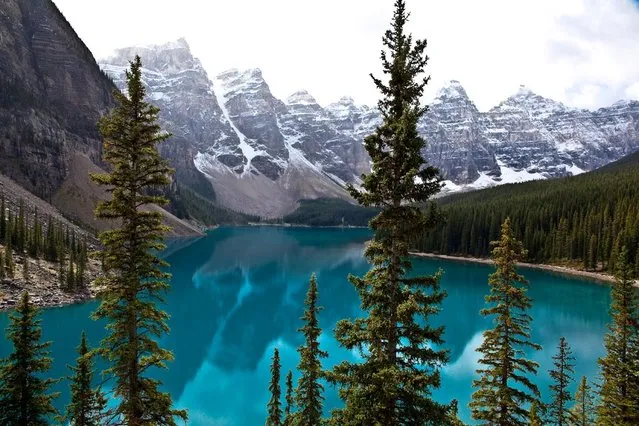
Moraine Lake Canada

Moraine Lake is a glacially-fed lake in Banff National Park, 14 kilometres (8.7 mi) outside the Village of Lake Louise, Alberta, Canada. It is situated in the Valley of the Ten Peaks, at an elevation of approximately 6,183 feet (1,885 m). The lake has a surface area of .5 square kilometres (0.19 sq mi). The lake, being glacially fed, does not reach its crest until mid to late June. When it is full, it reflects a distinct shade of blue. The colour is due to the refraction of light off the rock flour deposited in the lake on a continual basis.
Details
15 Oct 2013 11:56:00
Audi E-Bike Worthersee

One of the highlights on the Audi stand is the bicycle technology concept known as the Audi e-bike Wörthersee – a sport bike that does not fit into any of the usual categories. It is neither a pedelec nor a conventional bike, but is best described as a high-end pedelec made by Audi for sport, fun and tricks. The Audi e-bike Wörthersee combines the Audi brand’s principal competences – design, ultra, connect and e-tron – and explores the limits of what is technically feasible in terms of design, lightweight construction, networking and electric mobility.
Details
11 Jul 2014 11:34:00
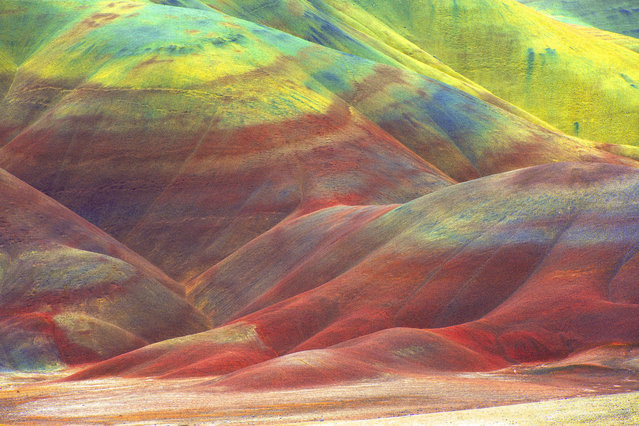
Layers of breathtaking colour streak the rolling hills of this vast desert, making the landscape appear as though it has been tie-dyed. The natural phenomenon, nicknamed the “Painted Desert”, was formed when the area was once a river floodplain. (Photo by Mark Brodkin/Solent News/SIPA Press)

Layers of breathtaking colour streak the rolling hills of this vast desert, making the landscape appear as though it has been tie-dyed. The natural phenomenon, nicknamed the “Painted Desert”, was formed when the area was once a river floodplain. Each colour corresponds to a different underground geological feature – rocks which have seemingly dyed the layers of earth above. Formed from volcanic activity, the hills at the John Day Fossil Beds National Monument in East Central Oregon, USA, are almost bursting with colour. Pictured: The colourful hills at the John Day Fossil Beds National Monument in East Central Oregon, USA. (Photo by Mark Brodkin/Solent News/SIPA Press)
Details
30 Jul 2014 11:00:00
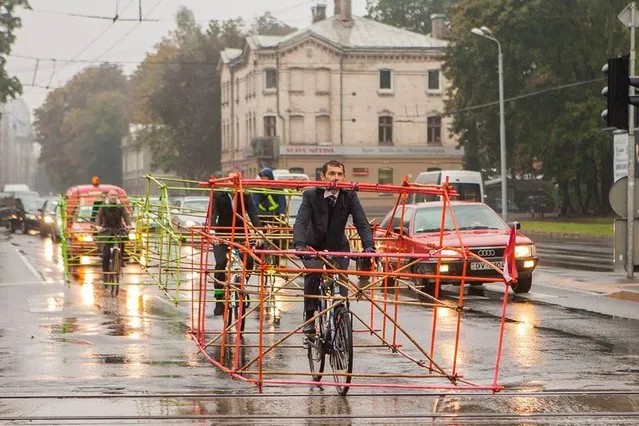
World Car Free Day

Latvian cyclists have decided to show the automobilists just how absurd it is to have only a single occupant in a car. The car takes up an enormous amount of space on the road; however, everyone is so used to it that no one ever notices it. It’s not hard to guess the thoughts of automobilists, and how they cursed those cyclists for taking up so much space. However, they have only themselves to blame. If everyone rode only bicycles to work, then there would never be such a thing as a traffic jam, the air in the city would become cleaner, while people would live longer, healthier lives, since cycling is a wonderful way to use the extra fat on your belly as the “fuel” for your bike.

Details
19 Oct 2014 12:29:00
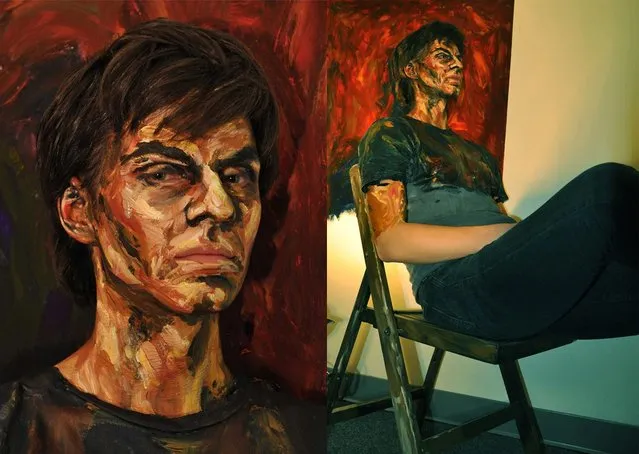
Living Paintings By Alexa Meade

The artworks that Alexa Meade makes are very unique and original. A usual painter creates a 2D or a 3D drawing on flat 2D surface. Alexa, on the other hand, draws over the body of a regular person, making them look like a 2D painting. The pictures of these people are almost uncanny, as you realize that the eyes “paintings” are real, and suddenly it dawns upon you that you are seeing a living and breathing human being. It is weird how we perceive this world, and how easy it is to trick our brain into thinking that it’s seeing a two-dimensional object. (Photo by Alexa Meade)
Details
12 Nov 2014 14:08:00
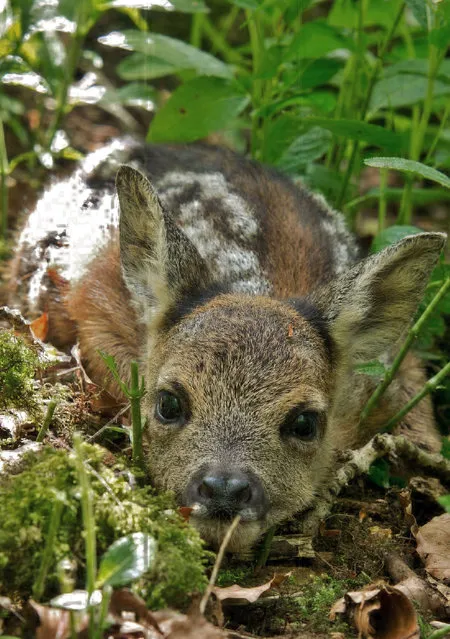
Young fawn shelters in the wood. He is so at one with nature that he knows how to call animals to him, and often gets within 30ft of them. (Photo by Adam Tatlow/BNPS)

Cotswold gamekeeper shoots amazing pictures of British wildlife – without the aid of long lenses and elaborate techniques. The photos may look like they have been shot from miles away – but amazingly Adam Tatlow is actually just feet away from his wild subjects. Photo: Young fawn shelters in the wood. He is so at one with nature that he knows how to call animals to him, and often gets within 30ft of them. (Photo by Adam Tatlow/BNPS)
Details
24 Sep 2013 08:31:00
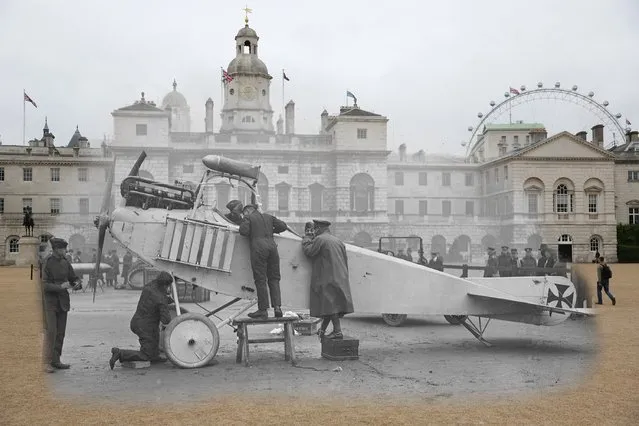
British soldiers inspect a captured German place in the Horseguards' Parade, London during World War I in November 1914, with the London Eye in the background as a reminder of just how much has changed in the last 100 years. (Photo by Peter Macdiarmid/Getty Images)

British soldiers inspect a captured German place in the Horseguards' Parade, London during World War I in November 1914, with the London Eye in the background as a reminder of just how much has changed in the last 100 years. (Photo by Peter Macdiarmid/Getty Images)
Details
29 Jul 2014 12:09:00