Loading...
Done
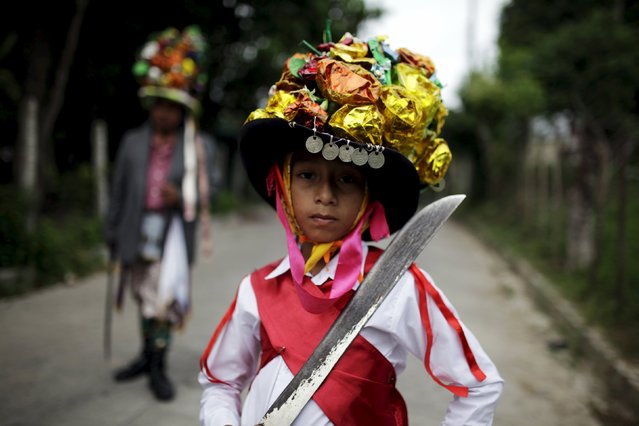
A participant in the traditional dance of Los Historiantes poses for a picture prior to performing in the festivity held in the honour of Saint James, in Santiago Nonualco July 22, 2015. The traditional dance was brought to Latin America by the Spanish, and participants each dramatise an episode of the battles between the Christians and the Moors that took place on the Iberian Peninsula about eight centuries ago, according to the dancers. (Photo by Jose Cabezas/Reuters)

A participant in the traditional dance of Los Historiantes poses for a picture prior to performing in the festivity held in the honour of Saint James, in Santiago Nonualco July 22, 2015. The traditional dance was brought to Latin America by the Spanish, and participants each dramatise an episode of the battles between the Christians and the Moors that took place on the Iberian Peninsula about eight centuries ago, according to the dancers. (Photo by Jose Cabezas/Reuters)
Details
24 Jul 2015 11:56:00
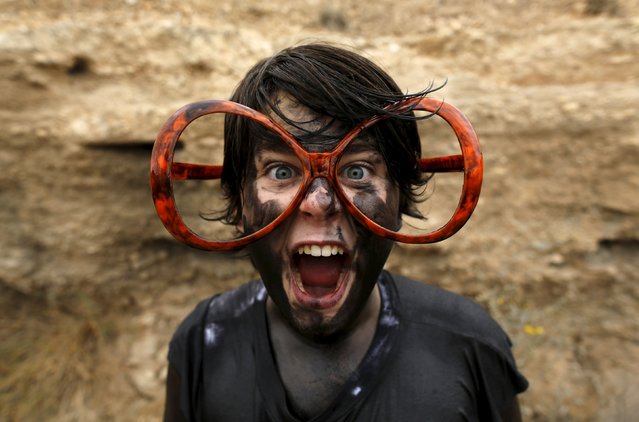
Jose, a reveller covered in grease, poses for a photo as he takes part in the annual Cascamorras festival in Baza, southern Spain September 6, 2015. The festival was inspired by a dispute between the town of Baza and Guadix over the possession of an icon of the Virgin of Piedad. The Cascamorras refers to representatives from Guadix, who were sent to Baza to recover the statue. As the Cascamorras had to stay perfectly clean to gain possession of the statue, Baza residents attempt to make them as “dirty” as possible. (Photo by Marcelo del Pozo/Reuters)

Jose, a reveller covered in grease, poses for a photo as he takes part in the annual Cascamorras festival in Baza, southern Spain September 6, 2015. The festival was inspired by a dispute between the town of Baza and Guadix over the possession of an icon of the Virgin of Piedad. The Cascamorras refers to representatives from Guadix, who were sent to Baza to recover the statue. As the Cascamorras had to stay perfectly clean to gain possession of the statue, Baza residents attempt to make them as “dirty” as possible. (Photo by Marcelo del Pozo/Reuters)
Details
07 Sep 2015 14:11:00
Gabriel of Arsenal celebrates scoring his team's third goal with teammates during the UEFA Champions League 2024/25 League Phase MD5 match between Sporting Clube de Portugal and Arsenal FC at Estadio Jose Alvalade on November 26, 2024 in Lisbon, Portugal. (Photo by Stuart MacFarlane/Arsenal FC via Getty Images)

Gabriel of Arsenal celebrates scoring his team's third goal with teammates during the UEFA Champions League 2024/25 League Phase MD5 match between Sporting Clube de Portugal and Arsenal FC at Estadio Jose Alvalade on November 26, 2024 in Lisbon, Portugal. (Photo by Stuart MacFarlane/Arsenal FC via Getty Images)
Details
03 Dec 2024 06:26:00
A woman fancy dressed as Catrina takes part in the “Catrinas Parade” along Reforma Avenue, in Mexico City on October 26, 2019. (Photo by Claudio Cruz/AFP Photo)

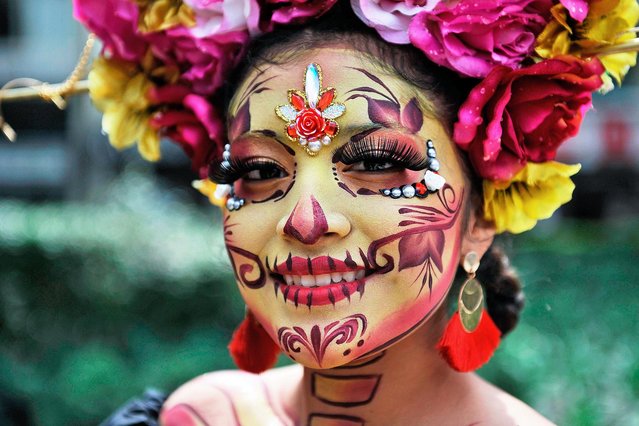
A woman fancy dressed as Catrina takes part in the “Catrinas Parade” along Reforma Avenue, in Mexico City on October 26, 2019. Mexicans get ready to celebrate the Day of the Dead highlighting the character of La Catrina which was created by cartoonist Jose Guadalupe Posada, famous for his drawings of typical local, folkloric scenes, socio-political criticism and for his illustrations of “skeletons” or skulls, including La Catrina. (Photo by Claudio Cruz/AFP Photo)
Details
29 Oct 2019 00:03:00
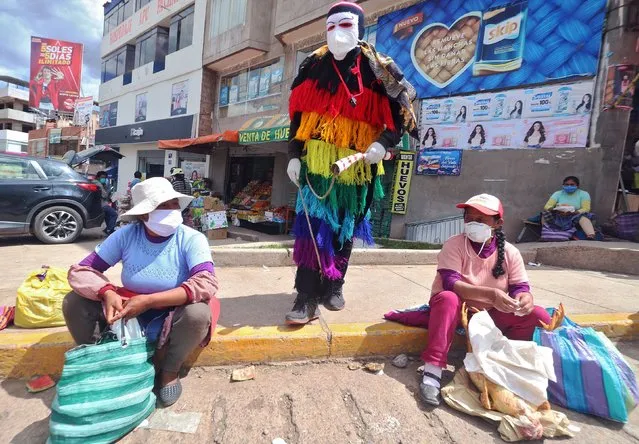
A man dressed in Andean attire as “Ukukus” or “Pabluchas”, a traditional character that acts as a vigilante imposing social order, uses a whip as a threat to force people to maintain their distance and remind them to wear face masks and gloves as a preventive measure against the novel coronavirus COVID-19, in the Vinocanchon market area in San Jeronimo district, close to the Peruvian Andean city of Cusco, on May 2, 2020. The government has identified public markets as major hotspots of the new coronavirus in Peru, where 40,459 confirmed cases and 1,124 deaths were reported on May 1. (Photo by Jose Carlos Angulo/AFP Photo)

A man dressed in Andean attire as “Ukukus” or “Pabluchas”, a traditional character that acts as a vigilante imposing social order, uses a whip as a threat to force people to maintain their distance and remind them to wear face masks and gloves as a preventive measure against the novel coronavirus COVID-19, in the Vinocanchon market area in San Jeronimo district, close to the Peruvian Andean city of Cusco, on May 2, 2020. The government has identified public markets as major hotspots of the new coronavirus in Peru, where 40,459 confirmed cases and 1,124 deaths were reported on May 1. (Photo by Jose Carlos Angulo/AFP Photo)
Details
04 May 2020 00:07:00
People fancy dressed as “Catrina” take part in the “Catrinas Parade” along Reforma Avenue, in Mexico City on October 22, 2017. (Photo by Ronaldo Schemidt/AFP Photo)

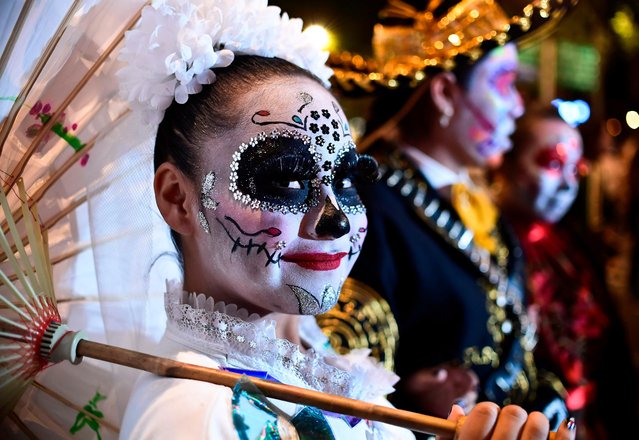
People fancy dressed as “Catrina” take part in the “Catrinas Parade” along Reforma Avenue, in Mexico City on October 22, 2017. Mexicans get ready to celebrate the Day of the Dead highlighting the character of La Catrina which was created by cartoonist Jose Guadalupe Posada, famous for his drawings of typical local, folkloric scenes, socio- political criticism and for his illustrations of “skeletons” or skulls, including La Catrina. (Photo by Ronaldo Schemidt/AFP Photo)
Details
24 Oct 2017 08:18:00


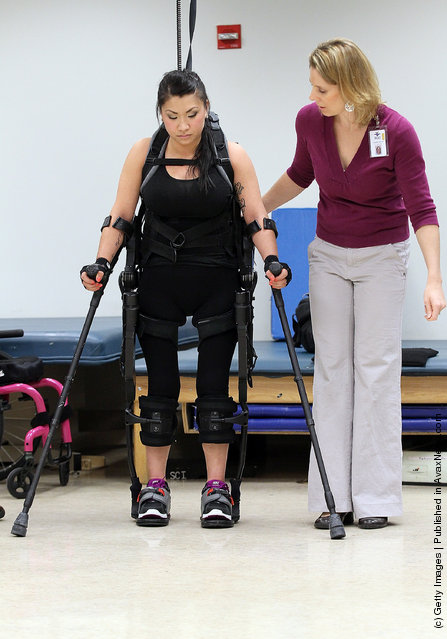
“eLEGS is a wearable, artificially intelligent, bionic device that enables people with paralysis to stand up and walk again. The exoskeleton is battery-powered and rechargeable, fitting comfortably and securely over clothing. Initially, eLEGS will be used under medical supervision for rehabilitation and training”. – BerkeleyBionics.com

Photo: Paralysis victim Stephanie Sablan (L) is helped by physical therapist Shonna Moran as she walks using eLEGS robotic legs at Santa Clara Valley Medical Center on May 25, 2011 in San Jose, California. Sablan, 24, was paralyzed from the waist down earlier this year when she was in a car accident and has begun using the newly developed eLEGS made by Berkeley Bionics. The robot-like battery powered eLEGS fit over clothing and enables people with paralysis to stand up and walk again. (Photo by Justin Sullivan/Getty Images)
Details
26 May 2011 09:56:00


#Resistiré 2020 (# I will resist 2020), the hymn recorded by more than 30 Spanish artists to beat the coronavirus together. Participating in the hymn: Alex Ubago, Andrés Suárez, Álvaro Soler, Blas Cantó, Carlos Baute, Conchita, David Bisbal, David Otero, David Summers, Despistaos, Diana Navarro, Dvicio, Mariposa Effect, Hall Effect, Ele, Georgina, India, Jose Mercé, Josemi Carmona, Manuel Carrasco, Melendi, Mikel Erentxun, Nil Moliner, Pastora Soler, Pedro Guerra, Pitingo, Rosana, Rozalén, Rulo, Sofía Ellar and Vanesa Martín. Promoted by Cadena 100, all these musicians and artists come together under the production of Pablo Cebrián to get this Resistiré, with which all funds will be for the benefit of Cáritas (Caritas Internationalis is a confederation of 165 Catholic relief, development and social service organizations operating in over 200 countries and territories worldwide. Collectively and individually, their claimed missions are to work to build a better world, especially for the poor and oppressed).
Details
14 Apr 2020 00:03:00