Loading...
Done
National September 11 Memorial And Museum

The National September 11 Memorial & Museum (branded as 9/11 Memorial and 9/11 Memorial Museum) is the principal memorial and museum commemorating the September 11 attacks of 2001, which killed nearly 3,000 people, and the World Trade Center bombing of 1993, which killed six. The memorial is located at the World Trade Center site, on the former location of the Twin Towers, which were destroyed during the attacks. The World Trade Center Memorial Foundation was renamed the National September 11 Memorial & Museum at the World Trade Center in 2007.
Details
16 May 2014 15:58:00
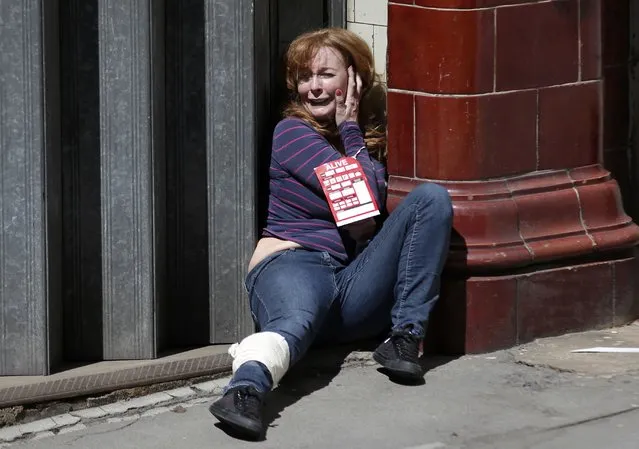
An actor plays an injured passer-by during Exercise Strong Tower, the scene of a mock terror attack at a disused underground station in central London, Britain June 30, 2015. (Photo by Peter Nicholls/Reuters)

An actor plays an injured passer-by during Exercise Strong Tower, the scene of a mock terror attack at a disused underground station in central London, Britain June 30, 2015. London police held their biggest-ever terrorism drill on Tuesday, pitting the emergency services against a group of marauding attackers, nearly 10 years since four young British Islamists killed 52 people in suicide bombings on London's transport network in July 2005. (Photo by Peter Nicholls/Reuters)
Details
01 Jul 2015 13:21:00
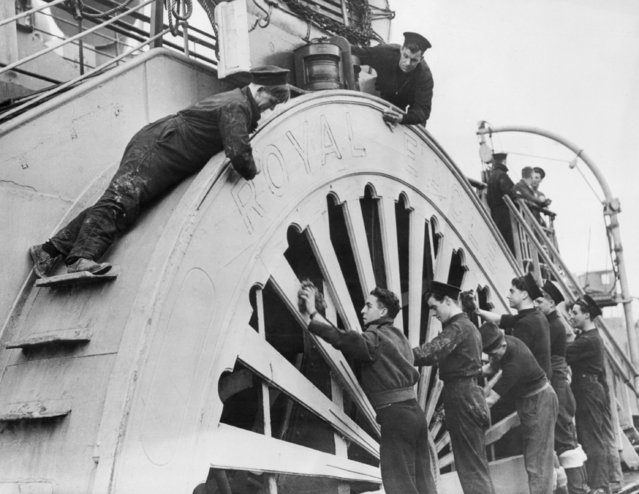
One of the largest paddle steamers afloat in Britain is the H.M.S. Royal Eagle, former peacetime excursion boat which carried passengers on pleasure jaunts from Tower Bridge to Southend, Ramscate and Margate. Commissioned two years ago as a warship of the Royal Navy, the craft has been in action 52 times against enemy aircraft. The Eagle took part in the evacuation from Dunkirk where she was dive-bombed 48 times and brought home nearly 3,000 British troops. Members of the crew cleaning the paddle boxes of H.M.S. Royal Eagle in London on January 18, 1943. (Photo by AP Photo)

One of the largest paddle steamers afloat in Britain is the H.M.S. Royal Eagle, former peacetime excursion boat which carried passengers on pleasure jaunts from Tower Bridge to Southend, Ramscate and Margate. Commissioned two years ago as a warship of the Royal Navy, the craft has been in action 52 times against enemy aircraft. The Eagle took part in the evacuation from Dunkirk where she was dive-bombed 48 times and brought home nearly 3,000 British troops. Members of the crew cleaning the paddle boxes of H.M.S. Royal Eagle in London on January 18, 1943. (Photo by AP Photo)
Details
21 Apr 2018 00:05:00
A woman cries while sitting on a road amid the destroyed city of Natori, Miyagi Prefecture in northern Japan March 13, 2011, after a massive earthquake and tsunami that are feared to have killed more than 10,000 people. (Photo by Asahi Shimbun/Reuters)

A woman cries while sitting on a road amid the destroyed city of Natori, Miyagi Prefecture in northern Japan March 13, 2011, after a massive earthquake and tsunami. Five years on from the tsunami that triggered meltdowns at Japan's Fukushima nuclear plant, the page is anything but turned. A magnitude 9 earthquake and towering tsunami on March 11, 2011 killed nearly 16,000 people along Japan's northeastern coast and left more than 2,500 missing. The 10-metre (33-foot) tsunami swept away everything in its path, including houses, ships, cars and farm buildings. (Photo by Asahi Shimbun/Reuters)
Details
09 Mar 2016 12:40:00
A pancake that looks like a cat, in Zama City, Japan. (Photo by Keisuke Inagaki/Barcroft Images)

As pancake day has creped up on us once again, a Japanese chef has combined our favourite things; cute animals and sugar. Keisuke Inagaki has been a chef at his restaurant La Ricetta in Zama City, Japan, for the last 18 years. He rose to Instagram fame from his Pokemon and anime pancake art, and the time around heis created a lifelike animal series. The 46-year-old chef began making pancakes in 2011 to raise spirits after the devastating nuclear disaster in Fukushima, Japan. Here: A pancake that looks like a cat, in Zama City, Japan. (Photo by Keisuke Inagaki/Barcroft Images)
Details
02 Mar 2017 00:03:00
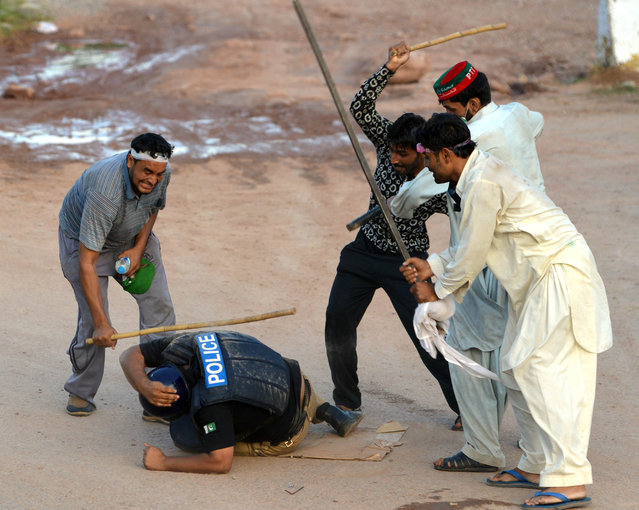
Pakistani supporters of cricketer-turned politician Imran Khan and Canadian cleric Tahir ul Qadri beat a riot policeman during an anti-government protest in Islamabad on September 1, 2014. (Photo by Aamir Qureshi/AFP Photo)

Pakistani supporters of cricketer-turned politician Imran Khan and Canadian cleric Tahir ul Qadri beat a riot policeman during an anti-government protest in Islamabad on September 1, 2014. Hundreds of protesters trying to topple Pakistan's government briefly seized the state broadcaster on September 1, intensifying the political crisis gripping the nuclear-armed nation. Deadly clashes since the weekend have raised the spectre of military intervention which gained ground after one disillusioned opposition leader said the protesters were acting according to a plan devised by the army. (Photo by Aamir Qureshi/AFP Photo)
Details
03 Sep 2014 09:38:00


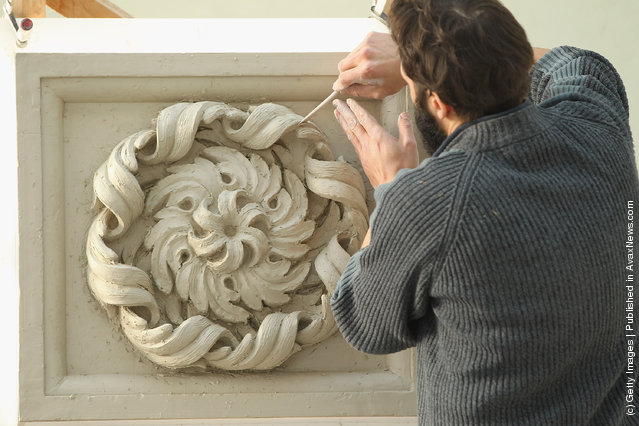
BERLIN, GERMANY - NOVEMBER 11: Sculptor Oleg Bessonov creates a rosette from clay at the Schlossbauhuette studio where a team of sculptors is creating decorative elements for the facade of the Berliner Schloss city palace on November 11, 2011 in Berlin, Germany. The Berliner Schloss was the residence of the Prussian Kaiser and was among the major architectural landmarks of Berlin until it was heavily damaged by Allied bombing in 1945. The communist authorities of East Berlin demolished the building in the 1950s, and today's Berlin government is pursuing an ambitious project to rebuild the palace according to a design by Italian architect Franco Stella, which will recreate the facade of the building but with a modern interior at a cost of approximately EUR 590 million. The Humboldt Forum, the foundation leading the project, has given the Schlossbauhuette sculptors the formidable task of recreating the hundreds of architectural elements that decorated the facade, and though some original pieces were saved, more often the sculptors have only old black and white photos as reference. (Photo by Sean Gallup/Getty Images)
Details
21 Nov 2011 11:22:00
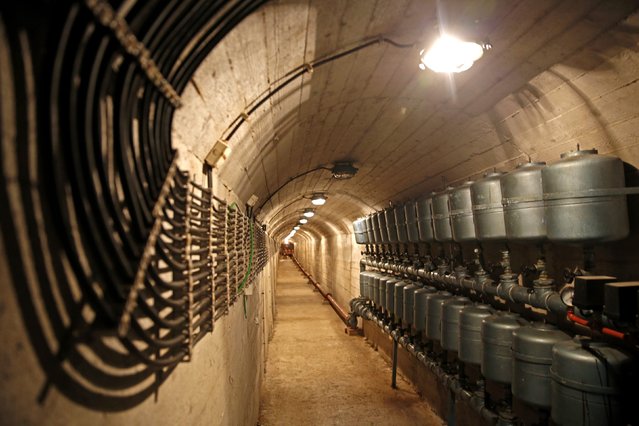
A tunnel with electric switches are seen in Josip Broz Tito's underground secret bunker (ARK) in Konjic, October 16, 2014. (Photo by Dado Ruvic/Reuters)

A tunnel with electric switches are seen in Josip Broz Tito's underground secret bunker (ARK) in Konjic, October 16, 2014. In the early 1950s, Josip Broz Tito, the late leader of the former Yugoslavia, ordered the building of the secret bunker, located 900 feet (270 m) underground and near the Bosnian town of Konjic, to safeguard the country's ruling class in case of a nuclear attack. Construction at the complex, which had a cost equivalent price tag of $4.6 billion, continued until 1979, the year before Tito died. (Photo by Dado Ruvic/Reuters)
Details
28 Nov 2014 12:14:00