Loading...
Done
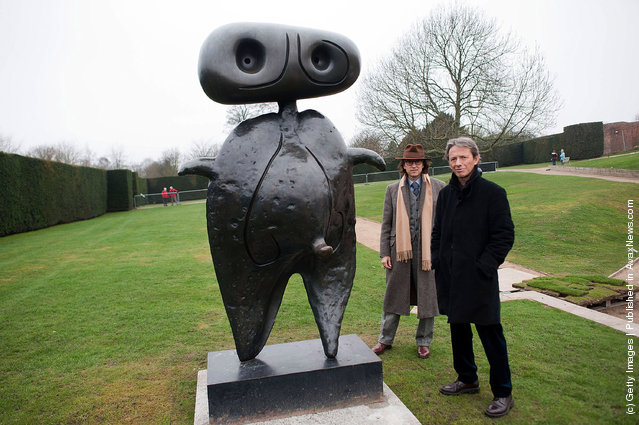
Joan Miro's, grandsons, Emilio Fernandez Miro and Joan Punyet Miro pose beside Personnage (1970) in the Yorkshire Sculpture park

“Joan Miro i Ferra (April 20, 1893 – December 25, 1983) was a Spanish Catalan painter, sculptor, and ceramicist born in Barcelona. Earning international acclaim, his work has been interpreted as Surrealism, a sandbox for the subconscious mind, a re-creation of the childlike, and a manifestation of Catalan pride. In numerous interviews dating from the 1930s onwards, Miro expressed contempt for conventional painting methods as a way of supporting bourgeois society, and famously declared an “assassination of painting” in favour of upsetting the visual elements of established painting”. – Wikipedia

Photo: Joan Miro's, grandsons, Emilio Fernandez Miro and Joan Punyet Miro pose beside Personnage (1970) in the Yorkshire Sculpture park on March 14, 2012 in Wakefield, England. Yorkshire Sculpture Park stages the first major UK survey of sculpture by Spanish artist Joan Miro. (Photo by Bethany Clarke/Getty Images)
Details
15 Mar 2012 13:47:00
Pineapple

“One Third” – a project on food waste by an Austrian photography Klaus Pichler. According to a UN study one third of the world's food goes to waste – the largest part thereof in the industrialized nations of the global north. Equally, 925 million people around the world are threatened by starvation. The series “One Third” describes the connection between individual wastage of food and globalized food production.

Photo: Pineapple. Place of production: Guayaquil, Ecuador. Cultivation method: Outdoor plantation • Time of harvest: All- season. Transporting distance: 10.666 km (linear distance) • Means of transportation: Aircraft, truck. Carbon footprint (total) per kg: 11,94 kg • Water requirement (total) per kg: 360 l. Price: 2,10 € / kg. (Photo by Klaus Picher)
Details
02 May 2012 11:01:00


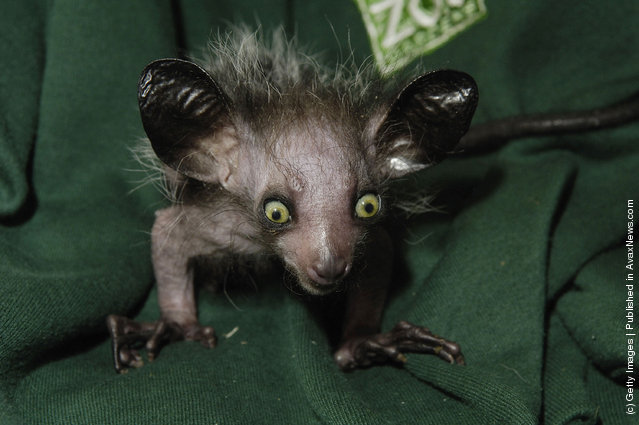
“The aye-aye (Daubentonia madagascariensis) is a lemur, a strepsirrhine primate native to Madagascar that combines rodent-like teeth and a special thin middle finger to fill the same ecological niche as a woodpecker. It is the world's largest nocturnal primate, and is characterized by its unusual method of finding food; it taps on trees to find grubs, then gnaws holes in the wood and inserts its narrow middle finger to pull the grubs out. The only other animal species known to find food in this way is the striped possum. From an ecological point of view the aye-aye fills the niche of a woodpecker as it is capable of penetrating wood to extract the invertebrates within”. – Wikipedia

Photo: In this handout image from Bristol Zoo is seen the first captive bred aye-aye in the UK named “Kintana” (meaning star in Malagasy) April 15, 2005 at Bristol Zoo Gardens, England. The zoo announced today only the second baby aye-aye to be hand-reared in the world (the first was in Jersey Zoo) and has now made his first public appearance since his birth on 11 February 2005. (Photo by Rob Cousins/Bristol Zoo via Getty Images)
Details
13 Apr 2011 13:33:00
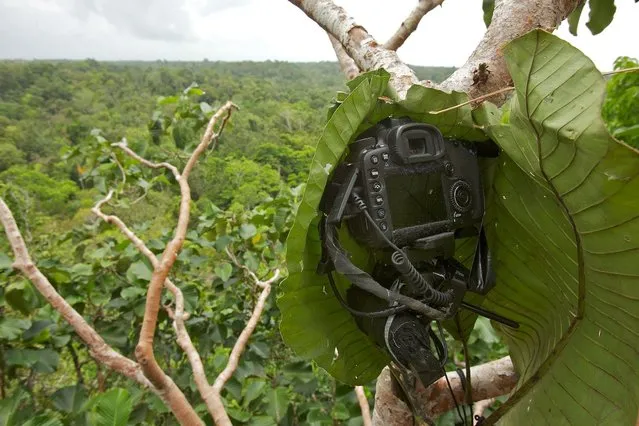
His goal with the project is to make the invisible visible. (Photo by Luis Hernan)

Luis Hernan was always curious about how wireless technologies like radio are transmitted through the air. So after finishing up his studies in architecture, computer science, and design, Hernan decided to research these invisible signals through a PhD at Newcastle University. Hernan set up a system that turned the wireless signals around him into colourful, ghostlike images using long-exposure photography, allowing people to see the strength of the signals around them. (Photo by Luis Hernan)
Details
13 Aug 2014 09:38:00
Bradley Garrett stands on the edge of the Ritz-Carlton Chicago as lightning strikes in the distance in Chicago, US. (Photo by Bradley L. Garrett/Barcroft Media)

These photographs are the work of urban explorer Dr Bradley Garrett who made headlines back in 2012 when he posted a series of snaps from the top of The Shard skyscraper while it was still under construction. Garrett, now a researcher at the University of Oxford, took these shots during his time with the London Consolidation Crew (LCC), a loose collection of urban explorers based in the English capital. Photo: Bradley Garrett stands on the edge of the Ritz-Carlton Chicago as lightning strikes in the distance in Chicago, US. (Photo by Bradley L. Garrett/Barcroft Media)
Details
24 Sep 2013 08:09:00
Tim Laman - Wildlife Photojournalist

Tim Laman is a field biologist and wildlife photojournalist. His pioneering research in the rain forest canopy in Borneo led to a PhD from Harvard and his first National Geographic article in 1997. Since then, he has pursued his passion for exploring wild places and documenting little-known and endangered wildlife by becoming a regular contributor to National Geographic. He has eighteen articles to his credit to date, all of which have had a conservation message. Some have focused on endangered species such as Orangutans or Hornbills, while others, such as a series of articles on Conservation International’s Biodiversity Hotspots, have highlighted regions under intense pressure.
Details
14 Sep 2013 10:13:00
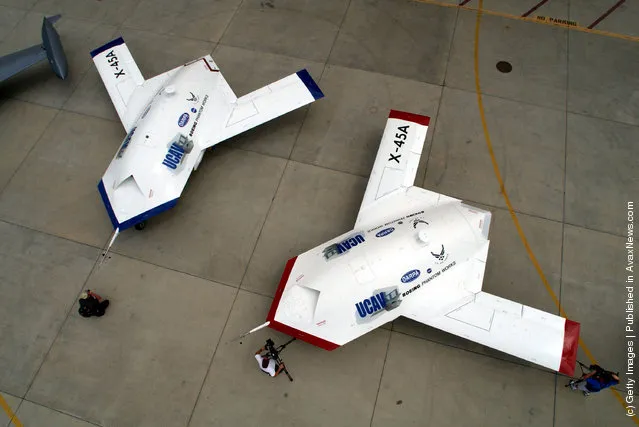
Boeing X-45A

“The Boeing X-45 unmanned combat air vehicle is a concept demonstrator for a next generation of completely autonomous military aircraft, developed by Boeing's Phantom Works. Manufactured by Boeing Integrated Defense Systems, the X-45 was a part of DARPA's J-UCAS project”. – Wikipedia

Photo: Two X-45A Unmanned Combat Air Vehicles (UCAV) are shown to members of the news media July 11, 2002 at Edwards Air Force Base, California. The X-45A, developed by The Defense Advanced Research Projects Agency and the Boeing Company, is the first unmanned system designed from inception for combat missions. (Photo by David McNew/Getty Images)
Details
22 Aug 2011 13:00:00
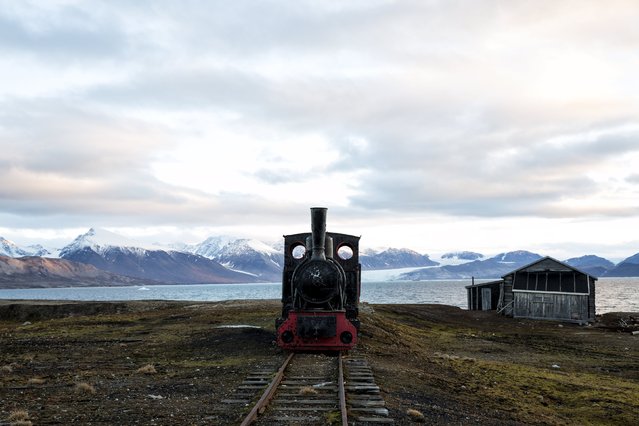
An old locomotive train that was used for transporting coal is preserved as a monument at Ny-Alesund, in Svalbard, Norway, October 11, 2015. (Photo by Anna Filipova/Reuters)

An old locomotive train that was used for transporting coal is preserved as a monument at Ny-Alesund, in Svalbard, Norway, October 11, 2015. A Norwegian chain of islands just 1,200 km (750 miles) from the North Pole is trying to promote new technologies, tourism and scientific research in a shift from high-polluting coal mining that has been a backbone of the remote economy for decades. (Photo by Anna Filipova/Reuters)
Details
29 Jan 2016 13:19:00