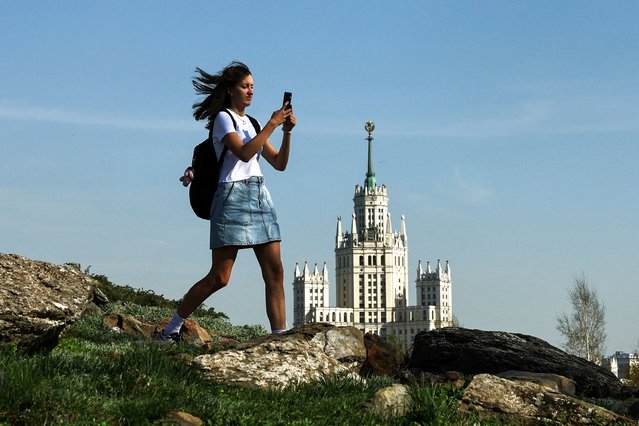
A woman walks in the Zaryadye Park, with a Soviet era skyscraper seen in the background, during a sunny day in Moscow, Russia on April 21, 2025. (Photo by Evgenia Novozhenina/Reuters)
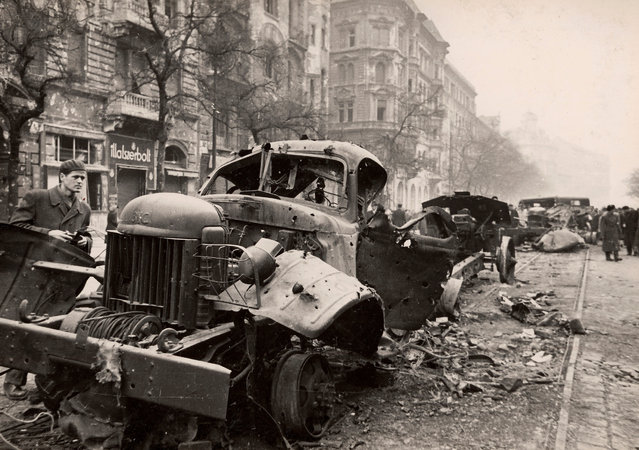
A general view shows the wreckage of armed trucks on the streets of Budapest at the time of the uprising against the Soviet-supported Hungarian communist regime in 1956. The picture was taken in the period between October 23 and November 4, 1956. (Photo by Laszlo Almasi/Reuters)
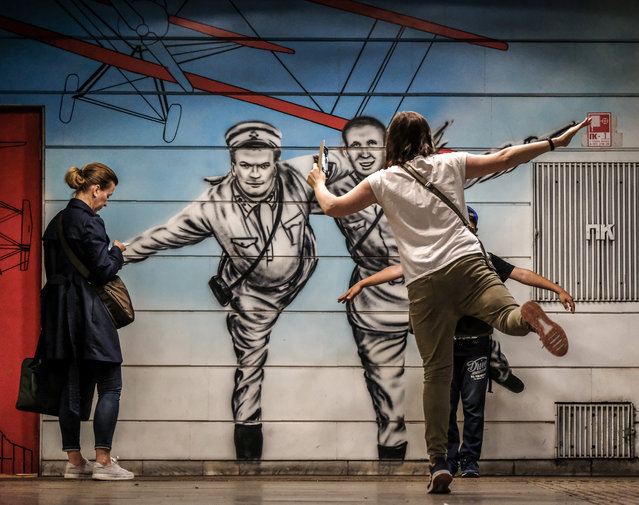
A woman instructs a boy on how to pose for pictures in front of a mural depicting Soviet pilot Valery Chkalov – who took a non-stop flight over the Arctic and landed in the US state of Washington in 1937 – at Chkalovskaya metro station in Moscow on August 14, 2019. (Photo by Yuri Kadobnov/AFP Photo)
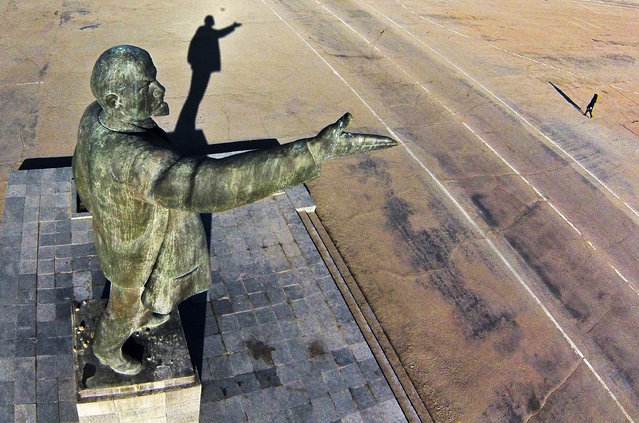
In this aerial file photo taken on Tuesday, October 31, 2017, a woman walks past a statue of Soviet Union founder Vladimir Lenin at the Russian leased Baikonur cosmodrome, in Kazakhstan. The thousands of statues of Vladimir Lenin spread across the vast region bring to mind poet Vladimir Mayakovsky's ringing line of devotion: “Lenin lived, Lenin lives, Lenin will live”. (Photo by Dmitri Lovetsky/AP Photo)
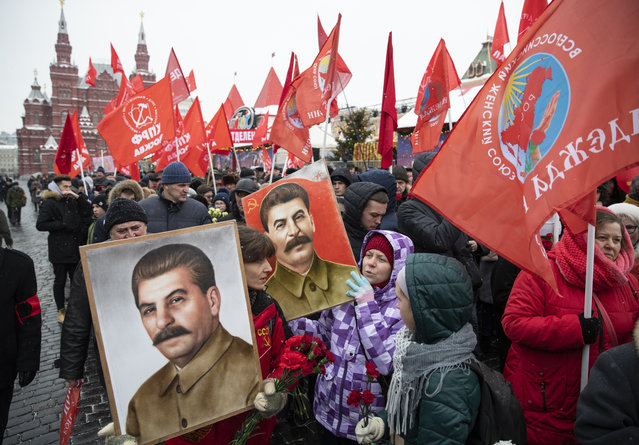
Communist supporters hold portraits of Soviet leader Josef Stalin as they queue to lay flowers at the grave of Stalin to mark the 139th anniversary of his birth, in Moscow's Red Square, Russia, Friday, December 21, 2018. (Photo by Pavel Golovkin/AP Photo)
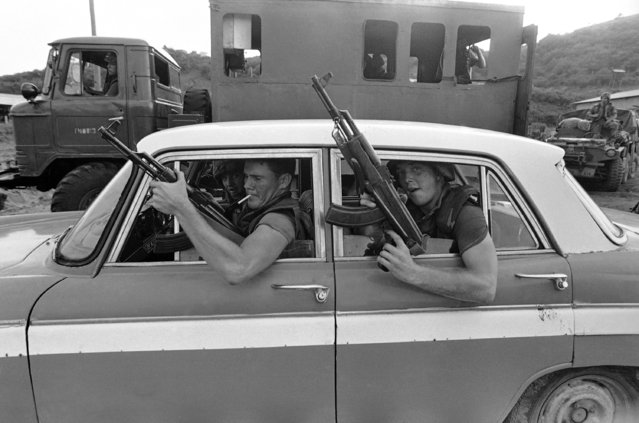
In this October 27, 1983 file photo, soldiers brandish captured AK-47 rifles from the windows of a civilian vehicle as they drive near Point Salines Airport in St. George, Grenada. In 1983, U.S. forces invaded the Caribbean island of Grenada after accusing the government of allying itself with Communist Cuba. (Photo by Doug Jennings/AP Photo)
A man takes a shower on a street from water coming from a drainpipe as it rains in Havana, Cuba, Wednesday, July 27, 2016. During the last couple of weeks short but intense tropical downpours have been coming down of Havana every afternoon. (Photo by Desmond Boylan/AP Photo)
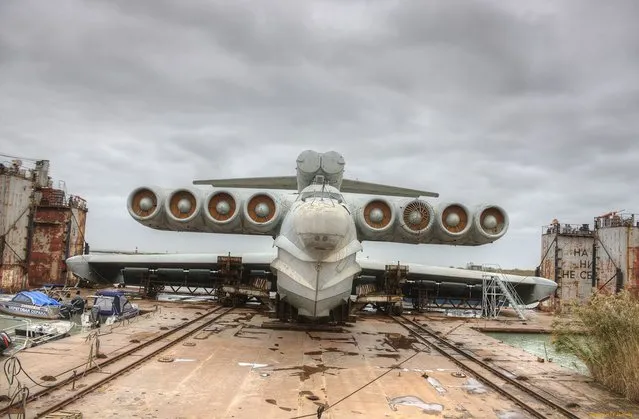
“The Lun-class ekranoplan (NATO reporting name Duck) was a ground effect vehicle (GEV) designed by Rostislav Evgenievich Alexeev and used by the Soviet and Russian navies from 1987 until sometime in the late 1990s. It “flew” using the lift generated by the ground effect of its large wings when close to the surface of the water – about four metres or less. Although they might look similar and/or have related technical characteristics, ekranoplans like the Lun are not aircraft, seaplanes, hovercraft, or hydrofoils – ground effect is a separate technology altogether. The International Maritime Organization classifies these vehicles as maritime ships. The name Lun comes from the Russian for harrier”. – Wikipedia (Photo by Igor113)