Loading...
Done
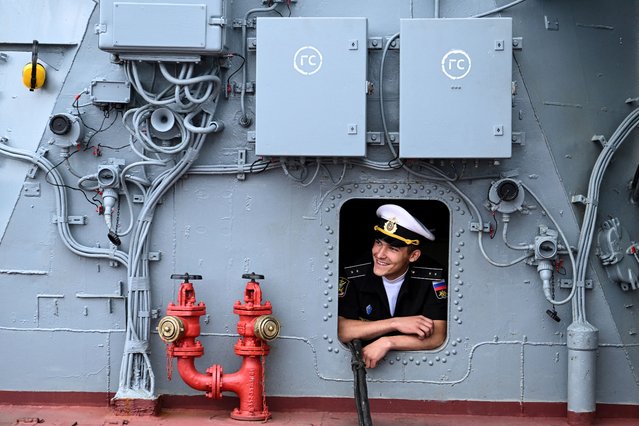
A sailor of the Marshal Shaposhnikov anti-submarine destroyer takes part in the “Vostok-2022” military exercises at the Peter the Great Gulf of the Sea of Japan outside the city of Vladivostok on September 5, 2022. The Vostok 2022 military exercises, involving several Kremlin-friendly countries including China, takes place from September 1-7 across several training grounds in Russia's Far East and in the waters off it. Over 50,000 soldiers and more than 5,000 units of military equipment, including 140 aircraft and 60 ships, are involved in the drills. (Photo by Kirill Kudryavtsev/AFP Photo)

A sailor of the Marshal Shaposhnikov anti-submarine destroyer takes part in the “Vostok-2022” military exercises at the Peter the Great Gulf of the Sea of Japan outside the city of Vladivostok on September 5, 2022. The Vostok 2022 military exercises, involving several Kremlin-friendly countries including China, takes place from September 1-7 across several training grounds in Russia's Far East and in the waters off it. Over 50,000 soldiers and more than 5,000 units of military equipment, including 140 aircraft and 60 ships, are involved in the drills. (Photo by Kirill Kudryavtsev/AFP Photo)
Details
16 Sep 2022 05:09:00
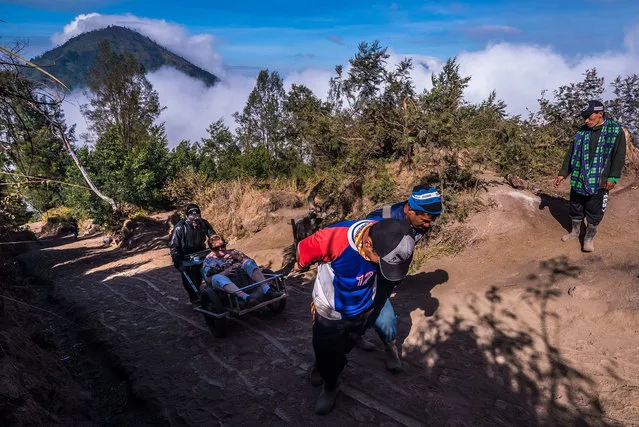
Miners pulling up lazy tourists to the rim of Kawah Ijen (Ijen Volcano), East Java, Indonesia on September 21, 2017. They will earn as much as they would bring down a load of sulfur. Nomadic Explorer, Cultural Lifestyle Photographer Claudio Sieber captured striking images of miners working at Ijen volcanic range in East Java, Indonesia. The sulphur miners risk their lives daily as they climb the active volcano carrying heavy loads, which they sell to sugar refineries. Shortly after midnight curious tourists are flocking in hundreds through the gate of Ijen's foothills to be right on time, driven by the images others took before them. Kawah Ijen is the one of the world's largest acidic volcanic crater lake; famous for its turquoise color as well as the unreal atmosphere it offers during darkness. A dusty path zigzags 3 kilometers up to the crater rim. This doesn't mean anything challenging; in particular, special sights have to be deserved anyway. The irritating smell of sulfur announces the near of the crater's existence. Arriving on the crater's rim the reward for the torture becomes visible. Blue fire darts its tongues through the fumes of sulfur dioxide. Somehow, the spectacle isn't as romantic as expected, since it is also the rough working space of approx. 150 sulfur miners who start their shift at 1 am. Lately, harvesting the abundance of devil's gold received international attention. This did obviously not really improve a miner's lifestyle; neither did it contribute to a better wage. (Photo by Claudio Sieber/Barcroft Images)

Miners pulling up lazy tourists to the rim of Kawah Ijen (Ijen Volcano), East Java, Indonesia on September 21, 2017. They will earn as much as they would bring down a load of sulfur. Nomadic Explorer, Cultural Lifestyle Photographer Claudio Sieber captured striking images of miners working at Ijen volcanic range in East Java, Indonesia. The sulphur miners risk their lives daily as they climb the active volcano carrying heavy loads, which they sell to sugar refineries. (Photo by Claudio Sieber/Barcroft Images)
Details
02 Oct 2017 08:31:00
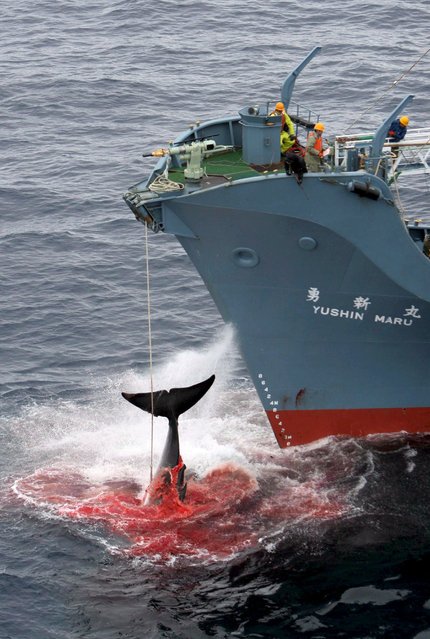
A file photograph dated 07 January 2006 and released by Greenpeace, showing the Yushin Maru, a factory ship in a Japanese whaling fleet, injuring a whale with it's first harpoon attempt. A UN court in The Hague on 31 March 2014 halted Japan's much-criticized whaling programme, ruling that it contravenes a 1986 moratorium on whale hunting. Japan must end its 'research whaling' programme, the International Court of Justice (ICJ) said. (Photo by Kate Davison/EPA)

A file photograph dated 07 January 2006 and released by Greenpeace, showing the Yushin Maru, a factory ship in a Japanese whaling fleet, injuring a whale with it's first harpoon attempt. A UN court in The Hague on 31 March 2014 halted Japan's much-criticized whaling programme, ruling that it contravenes a 1986 moratorium on whale hunting. Japan must end its 'research whaling' programme, the International Court of Justice (ICJ) said. Japan said the programme was for scientific research and permitted under international conventions. Australia had brought the case to the ICJ in 2010, charging that Japan was breaching international law by killing hundreds of whales every year for commercial purposes. Japan was “deeply disappointed” by the ruling, an unnamed government official was quoted by the Kyodo News agency as saying. But the official said Japan would stand by the ruling. (Photo by Kate Davison/EPA)
Details
01 Apr 2014 08:38:00
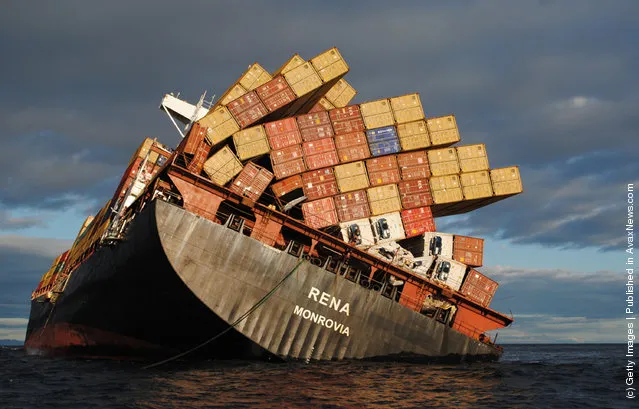
Oil Pumping From Rena Continues

The stern of the stranded cargo vessel Rena grounded on the Astrolabe Reef is seen on October 20, 2011 in Tauranga, New Zealand. Salvage crews continue to pump oil off the ship in an effort to remove as much as possible before bad weather predicted for the evening threatens to break the vessel and release more oil into the sea. Over 300 tonnes of oil has leaked from Rena since it hit the reef on October 5. (Photo by New Zealand Defence Force via Getty Images)
Details
20 Oct 2011 09:11:00
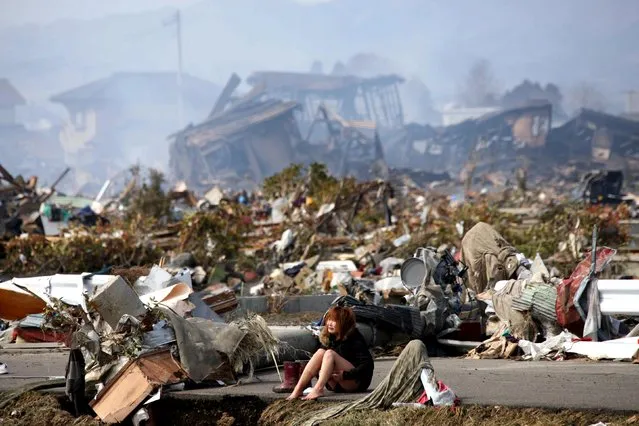
A woman cries while sitting on a road amid the destroyed city of Natori, Miyagi Prefecture in northern Japan March 13, 2011, after a massive earthquake and tsunami that are feared to have killed more than 10,000 people. (Photo by Asahi Shimbun/Reuters)

A woman cries while sitting on a road amid the destroyed city of Natori, Miyagi Prefecture in northern Japan March 13, 2011, after a massive earthquake and tsunami. Five years on from the tsunami that triggered meltdowns at Japan's Fukushima nuclear plant, the page is anything but turned. A magnitude 9 earthquake and towering tsunami on March 11, 2011 killed nearly 16,000 people along Japan's northeastern coast and left more than 2,500 missing. The 10-metre (33-foot) tsunami swept away everything in its path, including houses, ships, cars and farm buildings. (Photo by Asahi Shimbun/Reuters)
Details
09 Mar 2016 12:40:00
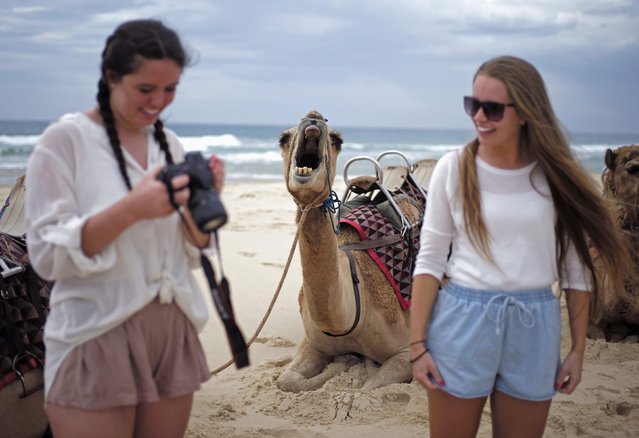
A camel yawns as a tourist checks images on her camera following a ride on a camel safari alongside the Pacific Ocean on Lighthouse Beach, north of Sydney, December 4, 2014. For 25 years camel rides on this beach have given visitors to Australia's holiday coast a rare experience available only in a handful of locations in the country. (Photo by Jason Reed/Reuters)

A camel yawns as a tourist checks images on her camera following a ride on a camel safari alongside the Pacific Ocean on Lighthouse Beach, north of Sydney, December 4, 2014. For 25 years camel rides on this beach have given visitors to Australia's holiday coast a rare experience available only in a handful of locations in the country. Australia's long history with the “ships of the desert” goes back to the 1800s when they were imported from Afghanistan and India for use as transportation across Australia's vast deserts before being released into the wild following their replacement by motorised transport. (Photo by Jason Reed/Reuters)
Details
06 Dec 2014 12:48:00
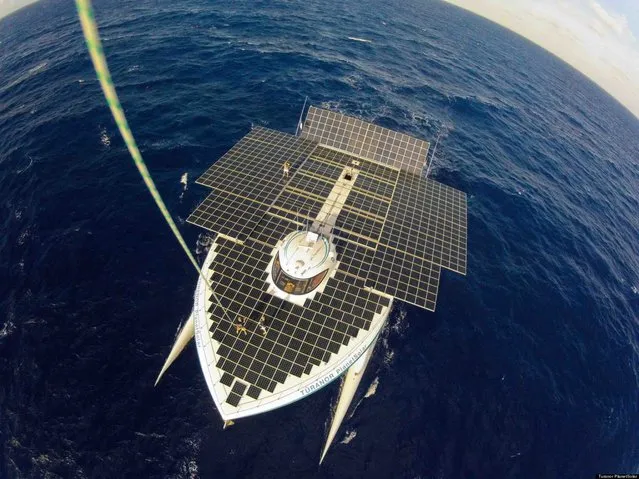
Turanor PlanetSolar

MS Tûranor PlanetSolar, known under the project name PlanetSolar, is the largest solar-powered boat in the world The vessel was designed by LOMOcean Design, built by Knierim Yachtbau in Kiel, Germany, and launched on 31 March 2010. In May 2012, it became the first ever solar electric vehicle to circumnavigate the globe. The 31-meter boat is covered in over 500 square meters of solar panels rated 93 kW, which in turn connect to one of the two electric motors in each hull. There are 8.5 tons of lithium-ion batteries in the ship's two hulls. The boat's shape allows it to reach speeds of up to 14 knots. The hull was model tested in wind tunnels and was tank tested to determine its hydrodynamics and aerodynamics. The boat has been designed to be used as a luxury yacht after the record attempt is finished.
Details
30 Oct 2013 09:06:00
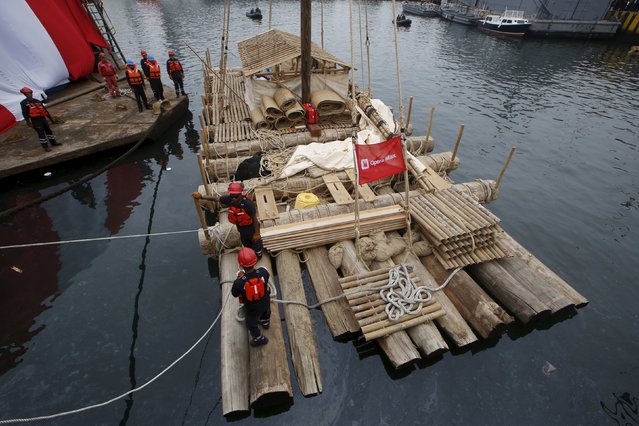
One of the two wooden rafts of the Kon-Tiki II expedition is prepared  at the port of Callao prior to the departure to Pascua island in Chile, in Callao, Peru, October 30, 2015. Fourteen men from various parts of the world set out on rafts to commemorate the  Norwegian navigator Thor Heyerdahl expedition 68 years ago. (Photo by Mariana Bazo/Reuters)

One of the two wooden rafts of the Kon-Tiki II expedition is prepared at the port of Callao prior to the departure to Pascua island in Chile, in Callao, Peru, October 30, 2015. Fourteen men from various parts of the world set out on rafts to commemorate the Norwegian navigator Thor Heyerdahl expedition 68 years ago. The original raft crossed the Pacific Ocean from South America to the Polynesian Islands. This rafts are a replica of ships used 6,000 years ago, but will be equipped with solar panel. (Photo by Mariana Bazo/Reuters)
Details
02 Nov 2015 08:00:00