Loading...
Done
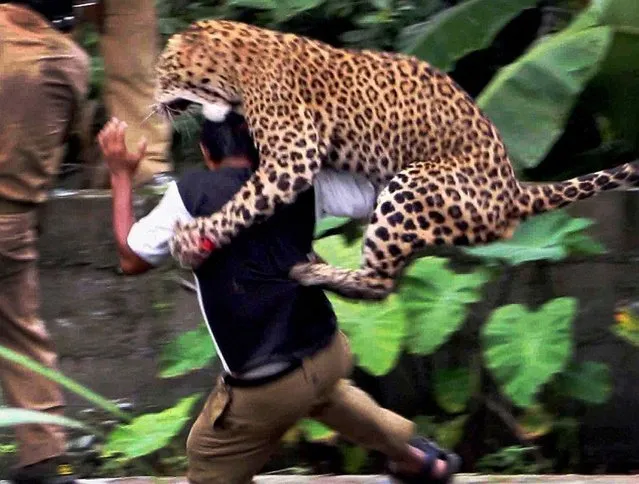
A leopard attacks a forest guard at Prakash Nagar village near Salugara on the outskirts of Siliguri on July 19, 2011. Six people were mauled by the leopard after the feline strayed into the village area before it was caught by forestry department officials. Forest officials made several attempt to tranquilised the full grown leopard that was wandering through a part of the densely populated city when curious crowds startled the animal, a wildlife official said. (Photo by Diptendu Dutta/AFP Photo)

A leopard attacks a forest guard at Prakash Nagar village near Salugara on the outskirts of Siliguri on July 19, 2011. Six people were mauled by the leopard after the feline strayed into the village area before it was caught by forestry department officials. Forest officials made several attempt to tranquilised the full grown leopard that was wandering through a part of the densely populated city when curious crowds startled the animal, a wildlife official said. (Photo by Diptendu Dutta/AFP Photo)
Details
29 Aug 2021 06:54:00
In this May 8, 2015 photo, sisters Zoraida Infante, left, and Graciela Trujillo pray on Fishermen's Beach before therapeutic swimming in the Pacific Ocean in Lima, Peru. Under overcast skies, the bathers practice thalassotherapy, which derives from the Greek “thalasso”, for “sea”, and draws on the ocean's healing properties. (Photo by Rodrigo Abd/AP Photo)

In this May 8, 2015 photo, sisters Zoraida Infante, left, and Graciela Trujillo pray on Fishermen's Beach before therapeutic swimming in the Pacific Ocean in Lima, Peru. Under overcast skies, the bathers practice thalassotherapy, which derives from the Greek “thalasso”, for “sea”, and draws on the ocean's healing properties. (Photo by Rodrigo Abd/AP Photo)
Details
21 May 2015 12:19:00
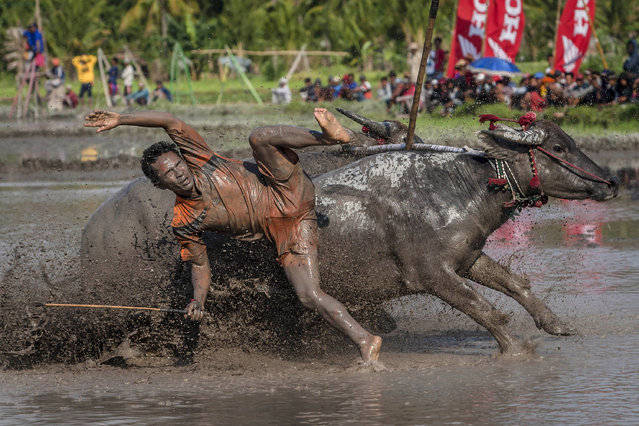
A jockey falls from his buffalos during Barapan Kebo or buffalo races as part of the Moyo festival on September 30, 2014 in Sumbawa Island, West Nusa Tenggara, Indonesia. (Photo by Ulet Ifansasti/Getty Images)

A jockey falls from his buffalos during Barapan Kebo or buffalo races as part of the Moyo festival on September 30, 2014 in Sumbawa Island, West Nusa Tenggara, Indonesia. The traditional Buffalo races, known as Barapan Kebo, are held by Samawa tribes in muddy rice fields to celebrate and provide entertainment ahead of the annual planting season. Jockeys secure themselves on a wooden structure attached to the buffalo, and maneuver across the mud in a race to the finish line. The jockeys weild long sticks, in a similar style to jousting, and direct them towards targets called “Saka”. (Photo by Ulet Ifansasti/Getty Images)
Details
04 Oct 2014 11:58:00
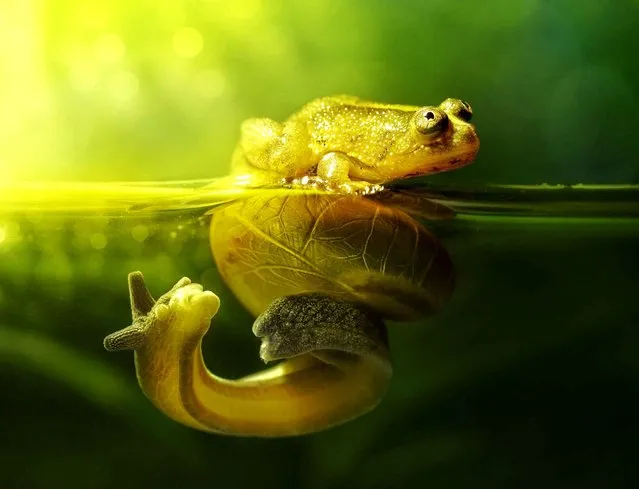
A frog sits on a leaf and instead of seeing a reflection of itself in the water below, it sees a snail, attached to the bottom of the leaf, in a fish tank in Vietnam. (Photo by Duong Quoc Dinh/Solent Ne/SIPA Press)

A frog sits on a leaf and instead of seeing a reflection of itself in the water below, it sees a snail, attached to the bottom of the leaf, in a fish tank in Vietnam. (Photo by Duong Quoc Dinh/Solent Ne/SIPA Press)
Details
26 Jan 2014 13:05:00
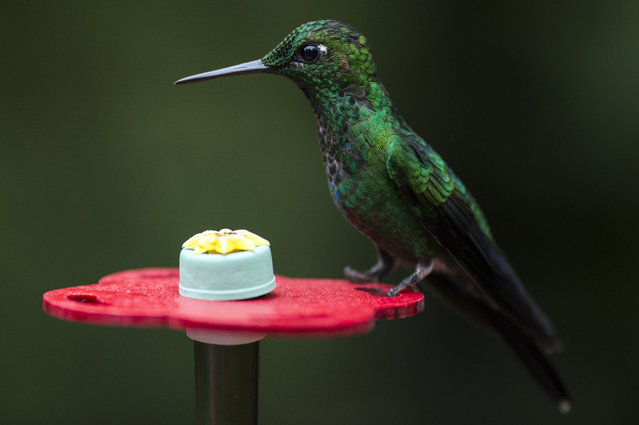
A Green Crowned Brilliant is pictured at a Hummingbird feeding station on January 15, 2016 in Alajuela Costa Rica. (Photo by Dan Kitwood/Getty Images)

A Green Crowned Brilliant is pictured at a Hummingbird feeding station on January 15, 2016 in Alajuela Costa Rica. Of the 338 known species of Hummingbird worldwide there are around 50 in Costa Rica. Hummingbirds are named for the distinctive sound made by their tiny beating wings, and are admired for their vibrantly coloured iridescent plumage. Their ability to hover, with wings beating between 12 and 90 times a second, and to fly backwards makes them different from all other birds. (Photo by Dan Kitwood/Getty Images)
Details
05 Feb 2016 10:45:00
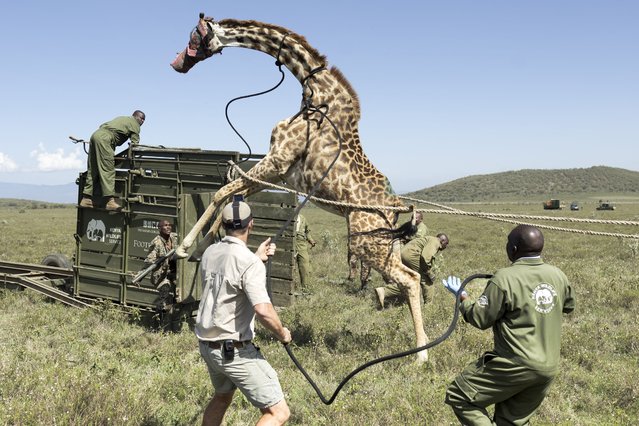
An adult female Masai giraffe rears on its hind legs as it resists efforts by Kenya Wildlife Services (KWS) rangers to guide it into a transportation crate using ropes during an exercise to translocate large herbivores from Kedong Ranch due to land subdivisions and corralling that have disrupted wildlife migratory routes in Naivasha, Nakuru County, on November 16, 2025. Driven by two long ropes held by about twenty rangers, the blindfolded giraffe enters a tall trailer that is to transport it out of its natural habitat in the Rift Valley, which is deteriorating after having been resold. This is the first step in a meticulous relocation operation in the vast Kedong ranch, part of an ancestral corridor between Mount Longonot and Hell's Gate Park, near the iconic Lake Naivasha. (Photo by Tony Karumba/AFP Photo)

An adult female Masai giraffe rears on its hind legs as it resists efforts by Kenya Wildlife Services (KWS) rangers to guide it into a transportation crate using ropes during an exercise to translocate large herbivores from Kedong Ranch due to land subdivisions and corralling that have disrupted wildlife migratory routes in Naivasha, Nakuru County, on November 16, 2025. Driven by two long ropes held by about twenty rangers, the blindfolded giraffe enters a tall trailer that is to transport it out of its natural habitat in the Rift Valley, which is deteriorating after having been resold. This is the first step in a meticulous relocation operation in the vast Kedong ranch, part of an ancestral corridor between Mount Longonot and Hell's Gate Park, near the iconic Lake Naivasha. (Photo by Tony Karumba/AFP Photo)
Details
23 Nov 2025 06:26:00
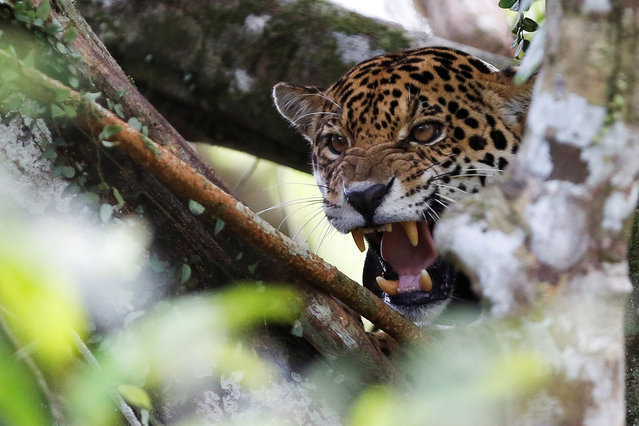
A female adult jaguar, which has a cub, growls at the Mamiraua Sustainable Development Reserve in Uarini, Amazonas state, Brazil, June 5, 2017. (Photo by Bruno Kelly/Reuters)

Brazilian jaguars, imperilled by hunters, ranchers and destruction of their habitat, have learned to survive at least one menace – flooding in the Amazon. They take to the trees. Although they can be six feet long and 200 pounds, the largest South American cats nimbly navigate treetops where they stay from April to July when the rainforest floor is under meters-deep water. Here: A female adult jaguar, which has a cub, growls at the Mamiraua Sustainable Development Reserve in Uarini, Amazonas state, Brazil, June 5, 2017. (Photo by Bruno Kelly/Reuters)
Details
07 Apr 2018 00:03:00
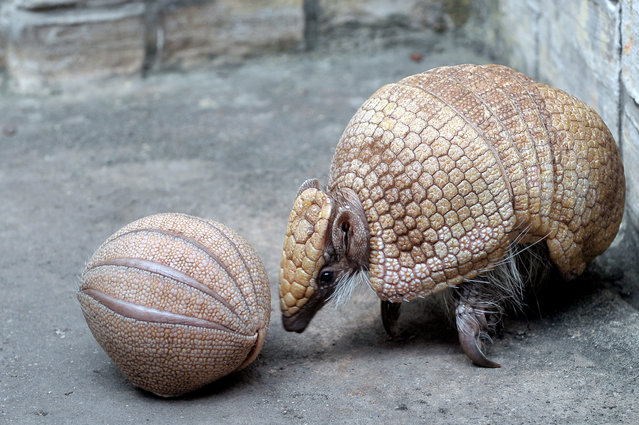
A four-week old southern three-banded armadillo (Tolypeutes matacus) is rolled up into a ball next to its mother in the tropical house of Budapest Zoo in Budapest, Hungary on May 3, 2019. The South American insect-eating mammal and its close relative, the Brasilian three-banded armadillo (Tolypeutes tricinctus) are the only two species of armadillos capable of rolling into a complete ball to defend themselves when feeling threatened. (Photo by Attila Kovács/EPA/EFE)

A four-week old southern three-banded armadillo (Tolypeutes matacus) is rolled up into a ball next to its mother in the tropical house of Budapest Zoo in Budapest, Hungary on May 3, 2019. The South American insect-eating mammal and its close relative, the Brasilian three-banded armadillo (Tolypeutes tricinctus) are the only two species of armadillos capable of rolling into a complete ball to defend themselves when feeling threatened. (Photo by Attila Kovács/EPA/EFE)
Details
05 May 2019 00:03:00