Loading...
Done
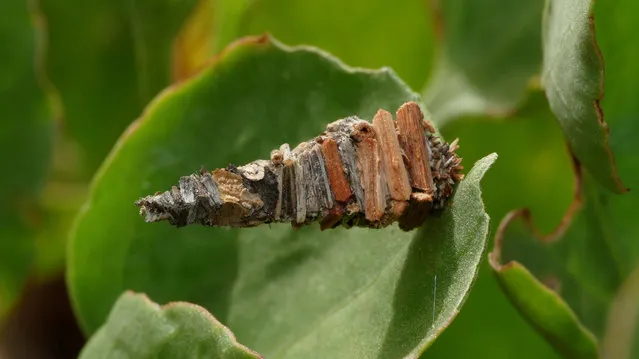
An undated handout photo made available by the Zerynthia Association shows the pupa of an amicta moneiba, a recently discovered species of moth endemic to La Gomera and El Hierro islands in the Canary Islands, Spain (issued 01 July 2020), as those two islands pulled apart from the rest of the Canary Islands 2.5 million years ago. The Institute of Evolutionary Biology of the Spanish National Research Council (CSIC) and the Zerynthia Association have recently discovered two new moth species in El Hierro and La Gomera. (Photo by Yeray Monasterio/Zerynthia/EPA/EFE)

An undated handout photo made available by the Zerynthia Association shows the pupa of an amicta moneiba, a recently discovered species of moth endemic to La Gomera and El Hierro islands in the Canary Islands, Spain (issued 01 July 2020), as those two islands pulled apart from the rest of the Canary Islands 2.5 million years ago. The Institute of Evolutionary Biology of the Spanish National Research Council (CSIC) and the Zerynthia Association have recently discovered two new moth species in El Hierro and La Gomera. (Photo by Yeray Monasterio/Zerynthia/EPA/EFE)
Details
11 Oct 2020 00:01:00
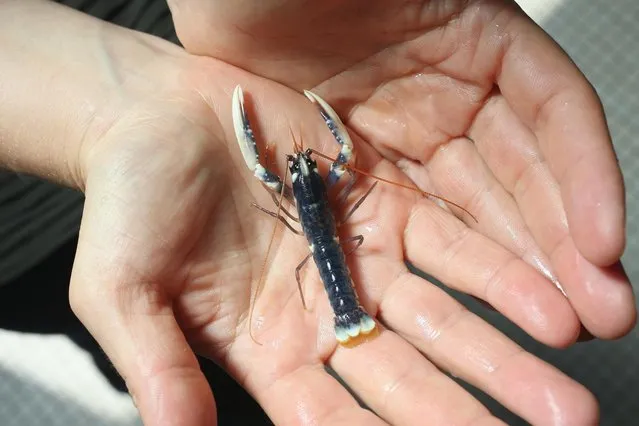
Isabel Schmalenbach, an environmental scientist with the Helgoland Biological Institute (Biologische Anstalt Helgoland), part of the Alfred Wegener Institute for Polar and Marine Research, holds a one-year old baby European lobster (Homarus gammarus) raised at the institute on August 3, 2013 on Helgoland Island, Germany. (Photo by Sean Gallup/Getty Images)

Isabel Schmalenbach, an environmental scientist with the Helgoland Biological Institute (Biologische Anstalt Helgoland), part of the Alfred Wegener Institute for Polar and Marine Research, holds a one-year old baby European lobster (Homarus gammarus) raised at the institute on August 3, 2013 on Helgoland Island, Germany. Later in the day Schmalenbach and her colleagues released a total of 415 one-year old lobsters into the North Sea as part of an effort to repopulate the lobster population around Helgoland (also called Heligoland). In the 19th century local fishermen caught up to 80,000 lobsters a year in the surrounding waters, combined with the heavy allied bombing of the island during and after World War II, as well as other environmental factors, decimated the lobster population. (Photo by Sean Gallup)
Details
05 Aug 2013 08:39:00
An engineer (L) talks to a driver of a dump truck loaded with gold-bearing soil at the Vostochny opencast of the Olimpiada gold operation, owned by Polyus Gold International company, in Krasnoyarsk region, Eastern Siberia, Russia, June 30, 2015. (Photo by Ilya Naymushin/Reuters)

An engineer (L) talks to a driver of a dump truck loaded with gold-bearing soil at the Vostochny opencast of the Olimpiada gold operation, owned by Polyus Gold International company, in Krasnoyarsk region, Eastern Siberia, Russia, June 30, 2015. Polyus Gold International is the largest gold producer in Russia and one of the top 10 gold miners globally by ounces produced, according to the official web site of the company. Olimpiada is Polyus Gold's largest operation. (Photo by Ilya Naymushin/Reuters)
Details
04 Jul 2015 11:12:00
Visitors take pictures inside Kuala Lumpur Tower's “Sky Box”, one of the city's touristic attractions, in Kuala Lumpur, Malaysia, 05 January 2024. Malaysian Tourism Minister Tiong King Sing recently said that the tourism industry “is not just an engine for economic growth but also a bridge for cultural exchange and international friendship”. (Photo by Fazry Ismail/EPA/EFE)

Visitors take pictures inside Kuala Lumpur Tower's “Sky Box”, one of the city's touristic attractions, in Kuala Lumpur, Malaysia, 05 January 2024. Malaysian Tourism Minister Tiong King Sing recently said that the tourism industry “is not just an engine for economic growth but also a bridge for cultural exchange and international friendship”. (Photo by Fazry Ismail/EPA/EFE)
Details
23 Jan 2024 09:41:00


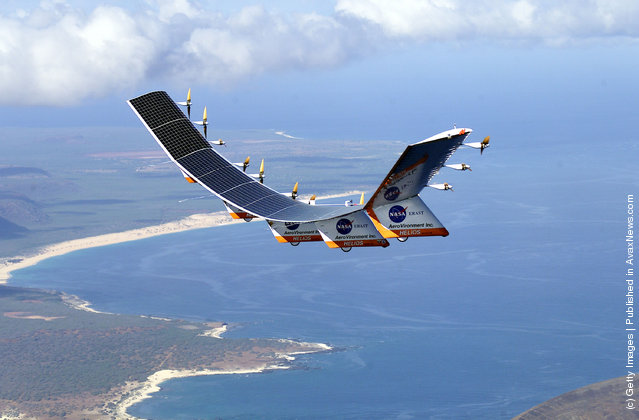
“NASA's Pathfinder, Pathfinder Plus, Centurion and Helios Prototype were an evolutionary series of solar- and fuel-cell-system-powered unmanned aerial vehicles. AeroVironment, Inc. developed the vehicles under NASA's Environmental Research Aircraft and Sensor Technology (ERAST) program. They were built to develop the technologies that would allow long-term, high-altitude aircraft to serve as “atmospheric satellites”, to perform atmospheric research tasks as well as serve as communications platforms”. – Wikipedia

Photo: The solar-electric Helios Prototype flying wing is flies over the Hawaiian islands of Niihau and Lehua during the first solar-powered test flight July 14, 2001 from the U.S. Navy's Pacific Missile Range Facility on Kauai, HI. The 18-hour flight was a functional checkout of the aircraft's systems and performance in preparation for an attempt to reach sustained flight at 100,000 feet altitude later in the summer. (Photo Courtesy of NASA/Getty Images)
Details
14 Jul 2011 09:24:00
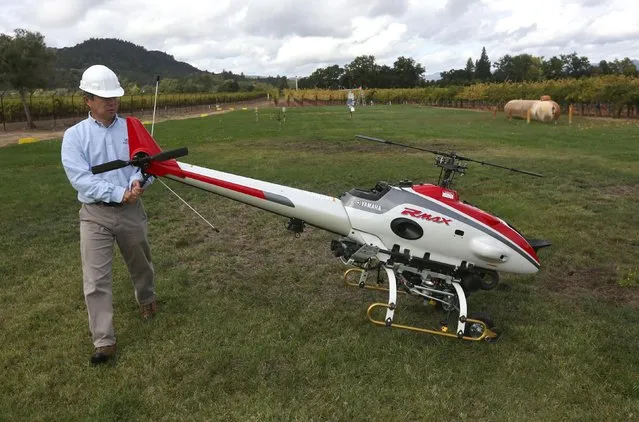
In this October 15, 2014 file photo, Katsu Nakamura, sky division manager for Yamaha USA, moves the RMax unmanned helicopter into position before a demonstration of its aerial application capabilities at the University of California, Davis' Oakville Station test vineyard in Oakville, Calif. Researchers at UC Davis have been studying the effectiveness of the drone's ability for spraying pest control and nutritional materials on the test vineyard in California's Napa Valley. (Photo by Rich Pedroncelli/AP Photo)

In this October 15, 2014 file photo, Katsu Nakamura, sky division manager for Yamaha USA, moves the RMax unmanned helicopter into position before a demonstration of its aerial application capabilities at the University of California, Davis' Oakville Station test vineyard in Oakville, Calif. Researchers at UC Davis have been studying the effectiveness of the drone's ability for spraying pest control and nutritional materials on the test vineyard in California's Napa Valley. (Photo by Rich Pedroncelli/AP Photo)
Details
07 Jan 2015 14:00:00
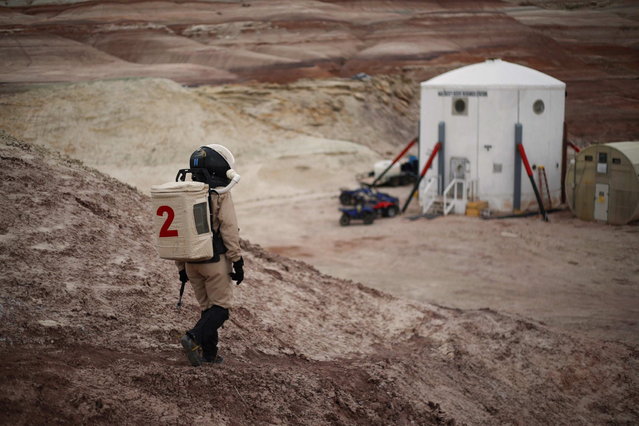
Csilla Orgel, a geologist of Crew 125 EuroMoonMars B mission, makes her way back to the Mars Desert Research Station (MDRS) in the Utah desert March 3, 2013. (Photo by Jim Urquhart/Reuters)

NASA says it could be another 20 years before humans touch down on Mars, but in a sense, the Mars Society has been exploring the red planet for more than a decade – in Utah. Photo: Csilla Orgel, a geologist of Crew 125 EuroMoonMars B mission, makes her way back to the Mars Desert Research Station (MDRS) in the Utah desert March 3, 2013. The MDRS aims to investigate the feasibility of a human exploration of Mars and uses the Utah desert's Mars-like terrain to simulate working conditions on the red planet. Scientists, students and enthusiasts work together developing field tactics and studying the terrain. All outdoor exploration is done wearing simulated spacesuits and carrying air supply packs and crews live together in a small communication base with limited amounts of electricity, food, oxygen and water. Everything needed to survive must be produced, fixed and replaced on site. (Photo by Jim Urquhart/Reuters)
Details
14 Mar 2013 12:11:00
Human canvases modelling world famous artworks including Van Gogh's Sunflowers and Edvard Munch's The Scream take to the streets of London in a bid to mend Britain's disconnect with art on September 25, 2017. Award winning body paint artist Sarah Attwell was commissioned by online art platform Rise Art to show that great art is for everybody, following research that revealed 1 in 6 Brits have never set foot in an art gallery. (Photo by Imagewise Ltd/Rex Features/Shutterstock)

Human canvases modelling world famous artworks including Van Gogh's Sunflowers and Edvard Munch's The Scream take to the streets of London in a bid to mend Britain's disconnect with art on September 25, 2017. Award winning body paint artist Sarah Attwell was commissioned by online art platform Rise Art to show that great art is for everybody, following research that revealed 1 in 6 Brits have never set foot in an art gallery. (Photo by Imagewise Ltd/Rex Features/Shutterstock)
Details
26 Sep 2017 09:21:00