Loading...
Done
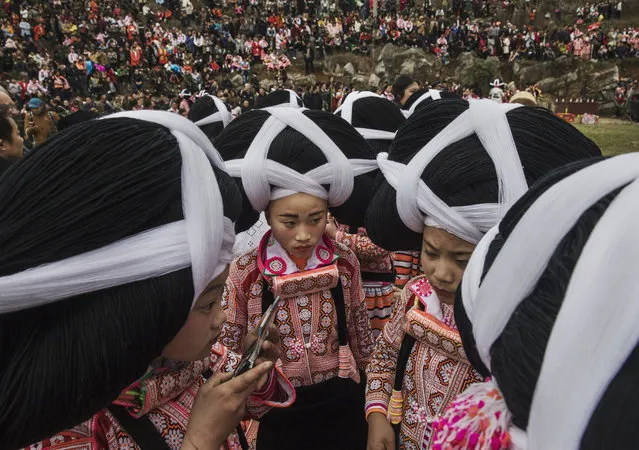
Girls of the Long Horn Miao ethnic minority group wear headdresses as they prepare gather for Tiaohua or Flower Festival as part of the Lunar New Year on February 6, 2017 in Longga village, Guizhou province, southern China. The Long Horn Miao are recognized for their declining practice of wrapping a blend of linen, wool, and the hair of their ancestors around animal horns or a wooden clip to make headdresses. Many young women say they now wear the headdresses only for special occasions and festivals, as the ornaments, which are attached by the horns to their real hair, have proved impractical for modern daily life in a fast changing world. China officially recognizes 56 different ethnic minorities, and statistics show over 7 million Chinese identifying themselves as Miao. But the small Long Horn Miao community counts only around 5000 people living in 12 villages, whose age-old traditions, language, and culture are fading. It is increasingly difficult in a modernizing China, as young people are drawn from remote rural villages to opportunities in bigger cities amongst wide-scale urbanization. Farming and labour remain the mainstays of life for the Long Horn Miao, leaving the area relatively poor in comparison with many parts of China. The government has invested significant amounts into local infrastructure and the tourism industry to try to bolster the local economy. (Photo by Kevin Frayer/Getty Images)

Girls of the Long Horn Miao ethnic minority group wear headdresses as they prepare gather for Tiaohua or Flower Festival as part of the Lunar New Year on February 6, 2017 in Longga village, Guizhou province, southern China. (Photo by Kevin Frayer/Getty Images)
Details
13 Feb 2017 00:01:00
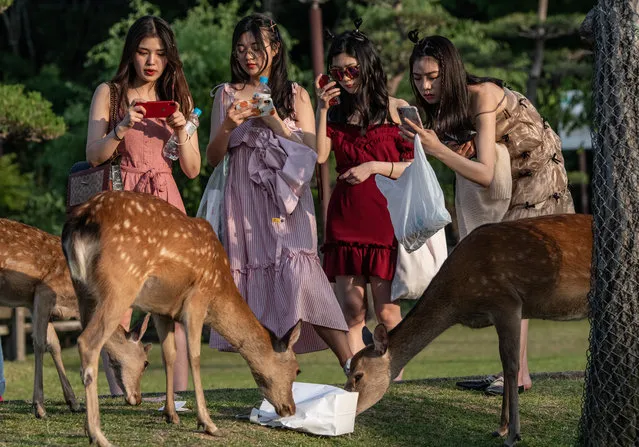
Tourists take photographs as a wild sika deer eats a bag on June 6, 2019 in Nara, Japan. Nara's free-roaming deer have become a huge attraction for tourists. However, an autopsy on a deer that was recently found dead near one of the city's famous temples discovered 3.2kg of plastic in its stomach and caused concern at the effect of tourism as Japan struggles to cope with a huge increase in domestic and international tourists. Alongside a growing Japanese tendency to holiday domestically, a record 31 million people visited the country in 2018 up 8.7 percent from the previous year, with many people now worrying about the environmental impact caused by such large visitor numbers. (Photo by Carl Court/Getty Images)

Tourists take photographs as a wild sika deer eats a bag on June 6, 2019 in Nara, Japan. Nara's free-roaming deer have become a huge attraction for tourists. However, an autopsy on a deer that was recently found dead near one of the city's famous temples discovered 3.2kg of plastic in its stomach and caused concern at the effect of tourism as Japan struggles to cope with a huge increase in domestic and international tourists. (Photo by Carl Court/Getty Images)
Details
19 Jun 2019 00:03:00
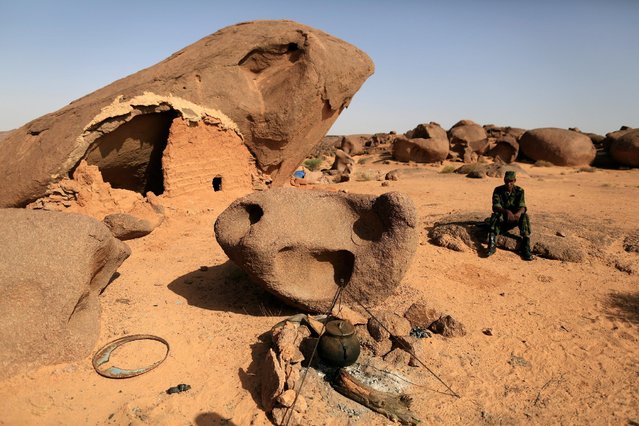
A Polisario fighter sits on a rock at a forward base on the outskirts of Tifariti, Western Sahara, September 9, 2016. At a rocky outpost in Western Sahara, a new generation of soldiers who have never known war are mobilising as tensions resurface in one of Africa's oldest disputes after a quarter century of uneasy peace. Young Sahrawi troops man new desert posts for the Polisario Front, which for more than 40 years has sought independence for the vast desert region - first in a guerrilla war against Morocco and then politically since a ceasefire deal in 1991. Now a standoff with Morocco, which controls the majority of Western Sahara, is renewing pressure for a diplomatic solution to ensure foot soldiers don't return to fighting as the last generation of commanders once did. The standoff since August has brought Moroccan and Polisario forces within 200 metres of each other in a narrow strip of land near the Mauritanian border. Rich in phosphate, Western Sahara has been contested since 1975 when Spanish colonial powers left. Morocco claimed the territory and fought the 16-year war with Polisario. (Photo by Zohra Bensemra/Reuters)

A Polisario fighter sits on a rock at a forward base on the outskirts of Tifariti, Western Sahara, September 9, 2016. At a rocky outpost in Western Sahara, a new generation of soldiers who have never known war are mobilising as tensions resurface in one of Africa's oldest disputes after a quarter century of uneasy peace. (Photo by Zohra Bensemra/Reuters)
Details
04 Nov 2016 12:09:00
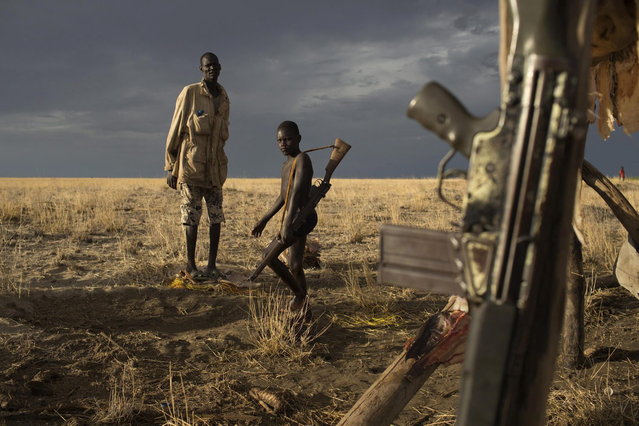
A Turkana man and a boy carrying a gun look on as a G3 battle rifle hangs from a structure used to dry fish at a fishing camp on the shores of Lake Turkana, some kilometres from Todonyang near the Kenya-Ethiopia border in northwestern Kenya October 12, 2013. (Photo by Siegfried Modola/Reuters)

A Turkana man and a boy carrying a gun look on as a G3 battle rifle hangs from a structure used to dry fish at a fishing camp on the shores of Lake Turkana, some kilometres from Todonyang near the Kenya-Ethiopia border in northwestern Kenya October 12, 2013The Turkana are traditionally nomadic pastoralists, but they have seen the pasture that they need to feed their herds suffer from recurring droughts and many have turned to fishing. However, Lake Turkana is overfished, and scarcity of food and pastureland is fuelling long-standing conflict with Ethiopian indigenous Dhaasanac, who have seen grazing grounds squeezed by large-scale government agricultural schemes in southern Ethiopia. The Dhaasanac now venture ever deeper into Kenyan territory in search of fish and grass, clashing with neighbours. Fighting between the communities has a long history, but the conflict has become ever more fatal as automatic weapons from other regional conflicts seep into the area. While the Turkana region is short of basics like grass and ground-water, it contains other resources including oil reserves and massive, newly discovered underground aquifers. (Photo by Siegfried Modola/Reuters)

Details
05 Dec 2013 12:08:00
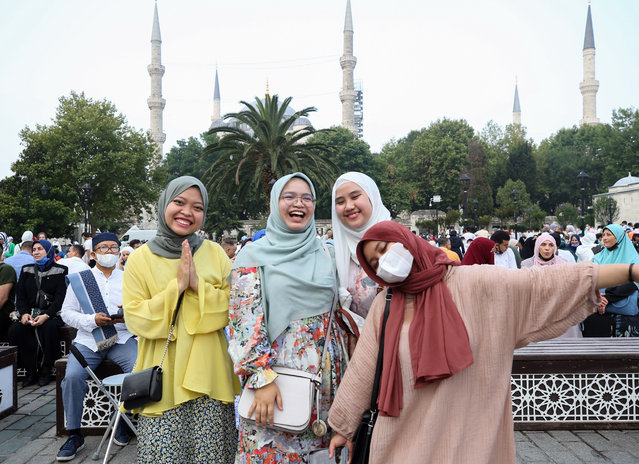
Muslims greet each other at Sultanahmet Square after performing Eid al-Adha prayer at Hagia Sophia Grand Mosque in Istanbul, Turkey on July 20, 2021. (Photo by Mehmet Murat Onel/Anadolu Agency via Getty Images)

Muslims greet each other at Sultanahmet Square after performing Eid al-Adha prayer at Hagia Sophia Grand Mosque in Istanbul, Turkey on July 20, 2021. (Photo by Mehmet Murat Onel/Anadolu Agency via Getty Images)
Details
24 Jul 2021 08:23:00
Caio Souza of Team Brazil competes on vault during Men's Qualification on day one of the Tokyo 2020 Olympic Games at Ariake Gymnastics Centre on July 24, 2021 in Tokyo, Japan. (Photo by Mike Blake/Reuters)

Caio Souza of Team Brazil competes on vault during Men's Qualification on day one of the Tokyo 2020 Olympic Games at Ariake Gymnastics Centre on July 24, 2021 in Tokyo, Japan. (Photo by Mike Blake/Reuters)
Details
26 Jul 2021 08:18:00
Surfer Gary Clisby rides his foil board on a morning swell of the coast of Carlsbad, California on May 23, 2018. (Photo by Mike Blake/Reuters)

Surfer Gary Clisby rides his foil board on a morning swell of the coast of Carlsbad, California on May 23, 2018. Harnessing the “foiling” technology more typically seen on racing catamarans in sailing's America's Cup, the surfboards appear to fly above the water thanks to a fin attached to the bottom of the board. (Photo by Mike Blake/Reuters)
Details
25 May 2018 00:03:00
The American artist’s work encompasses fashion, photography and film with characteristically vivid colour and unsettling theatricality. Here: The Big Valley, Susie and Friends, 2008. (Photo by Alex Prager Studio/Lehmann Maupin Gallery)

Alex Prager is an American art photographer and filmmaker based in Los Angeles. Her photographs primarily use staged actors, models and extras to create “meticulously designed mise en scène”, often described as film-like and hyperreal. “Alex Prager: Silver Lake Drive” is at the Photographers’ Gallery, London, 15 June – 14 October 2018. Here: The Big Valley, Susie and Friends, 2008. (Photo by Alex Prager Studio/Lehmann Maupin Gallery)
Details
15 Jun 2018 00:01:00