Loading...
Done
Revelers celebrate during fireworks marking the start of the New Year on Copacabana beach on January 1, 2017 in Rio de Janeiro, Brazil. Brazilian revelers traditionally dress in white to honor the New Year's holiday along with the Brazilian Goddess of the Sea- Iemanja. (Photo by Mario Tama/Getty Images)

Revelers celebrate during fireworks marking the start of the New Year on Copacabana beach on January 1, 2017 in Rio de Janeiro, Brazil. Brazilian revelers traditionally dress in white to honor the New Year's holiday along with the Brazilian Goddess of the Sea- Iemanja. (Photo by Mario Tama/Getty Images)
Details
01 Jan 2017 13:04:00
An animal advocate lays in fake blood in a replica of a meat package with a label that reads “meat” during a protest “The meat is murder” in the Bulgarian capital Sofia on May 8, 2016. (Photo by Nikolay Doychinov/AFP Photo)

An animal advocate lays in fake blood in a replica of a meat package with a label that reads “meat” during a protest “The meat is murder” in the Bulgarian capital Sofia on May 8, 2016. (Photo by Nikolay Doychinov/AFP Photo)
Details
10 May 2016 13:32:00
Models prepare backstage before a presentation as part of Fashion Weekend Plus Size Summer 2015 collection show in Sao Paulo, July 25, 2015. (Photo by Nacho Doce/Reuters)

Models prepare backstage before a presentation as part of Fashion Weekend Plus Size Summer 2015 collection show in Sao Paulo, July 25, 2015. (Photo by Nacho Doce/Reuters)
Details
27 Jul 2015 11:30:00
More than 6 billion people live in countries where serious levels of public sector corruption are fueling inequality and exploitation, according to Transparency International's 2015 index of perceived public sector corruption. The group's annual report measures perceptions of corruption due to the secrecy surrounding most corrupt dealings. Two thirds of the 168 countries assessed were identified as having a serious corruption problem. Somalia, which has been mired in conflict since civil war broke out in 1991, ranks bottom of the list. (Photo by Feisal Omar/Reuters)

More than 6 billion people live in countries where serious levels of public sector corruption are fueling inequality and exploitation, according to Transparency International's 2015 index of perceived public sector corruption. The group's annual report measures perceptions of corruption due to the secrecy surrounding most corrupt dealings. Two thirds of the 168 countries assessed were identified as having a serious corruption problem. Somalia, which has been mired in conflict since civil war broke out in 1991, ranks bottom of the list. (Photo by Feisal Omar/Reuters)
Details
13 May 2016 12:10:00
“Attacking Howler Monkey”. Due to a major tropical rainstorm my wife and I were forced to stay overnight in a Howler Monkey Rescue center in Panama. I used the time to explore the area and to take photos of the monkeys. Just after the rain finally stopped, I ran into this monkey that tried to mock attack me. I quickly took a couple of photos before retreating to a (more) safe distance. (Photo and caption by Christian Mueller-Planitz/National Geographic Traveler Photo Contest)

“Attacking Howler Monkey”. Due to a major tropical rainstorm my wife and I were forced to stay overnight in a Howler Monkey Rescue center in Panama. I used the time to explore the area and to take photos of the monkeys. Just after the rain finally stopped, I ran into this monkey that tried to mock attack me. I quickly took a couple of photos before retreating to a (more) safe distance. (Photo and caption by Christian Mueller-Planitz/National Geographic Traveler Photo Contest)

ATTENTION! All pictures are presented in high resolution. To see Hi-Res images – just TWICE click on any picture. In other words, click small picture – opens the BIG picture. Click BIG picture – opens VERY BIG picture.
Details
30 Jun 2013 12:25:00
A Free Syrian Army (FSA) fighter reacts as he mourns near the body of his brother, who was an FSA fighter and died during an offensive against Islamic State fighters to take control of Qabasin town, on the outskirts of the northern Syrian town of al-Bab, Syria January 10, 2017. (Photo by Khalil Ashawi/Reuters)

A Free Syrian Army (FSA) fighter reacts as he mourns near the body of his brother, who was an FSA fighter and died during an offensive against Islamic State fighters to take control of Qabasin town, on the outskirts of the northern Syrian town of al-Bab, Syria January 10, 2017. (Photo by Khalil Ashawi/Reuters)
Details
11 Jan 2017 14:24:00
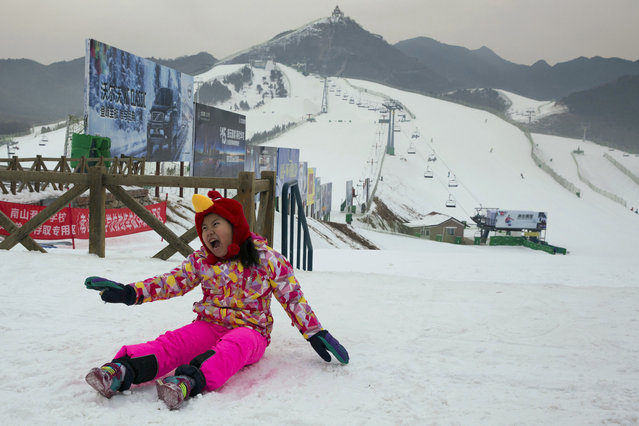
In this photo taken Saturday, January 24, 2015, a child makes a face while having her photo taken with the snow covered slopes of the Nanshan ski resort behind her in Beijing. As Beijing makes a final push in its bid for the 2022 Winter Olympics, Chinese President Xi Jinping says winning the bid will encourage over 300 million Chinese to take up winter sports by 2022, according to state-run Xinhua News agency. (Photo by Ng Han Guan/AP Photo)

In this photo taken Saturday, January 24, 2015, a child makes a face while having her photo taken with the snow covered slopes of the Nanshan ski resort behind her in Beijing. As Beijing makes a final push in its bid for the 2022 Winter Olympics, Chinese President Xi Jinping says winning the bid will encourage over 300 million Chinese to take up winter sports by 2022, according to state-run Xinhua News agency. (Photo by Ng Han Guan/AP Photo)
Details
31 Jan 2015 13:48:00
The Berenson robot strolls among visitors during the exhibition “Persona : Oddly Human” at the Quai Branly museum in Paris, France, February 23, 2016. The Berenson robot, developed in France in 2011, is the brainchild of anthropologist Denis Vidal and robotics engineer Philippe Gaussier. Its programming allows it to record reactions of museum visitors to certain pieces of art and then use the data to develop its own unique taste, which allows “Berenson” to judge whether or not it likes a certain work of art within an exhibition. (Photo by Philippe Wojazer/Reuters)

The Berenson robot strolls among visitors during the exhibition “Persona : Oddly Human” at the Quai Branly museum in Paris, France, February 23, 2016. The Berenson robot, developed in France in 2011, is the brainchild of anthropologist Denis Vidal and robotics engineer Philippe Gaussier. Its programming allows it to record reactions of museum visitors to certain pieces of art and then use the data to develop its own unique taste, which allows “Berenson” to judge whether or not it likes a certain work of art within an exhibition. (Photo by Philippe Wojazer/Reuters)
Details
25 Feb 2016 12:26:00