Loading...
Done
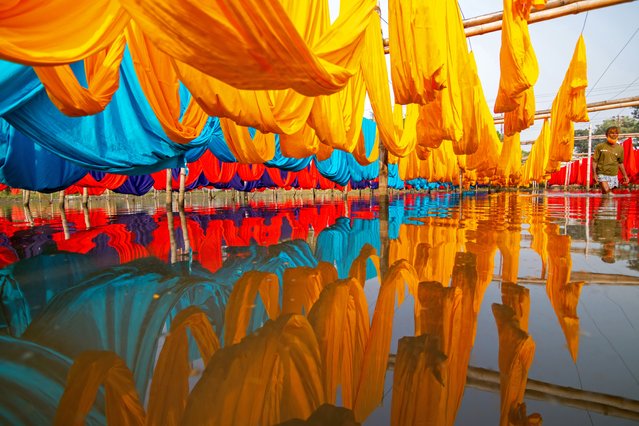
Workers hang thousands of different colorful fabrics on iron wires tied between a bamboo framework and constantly turn them so that they dry perfectly in a flooded field in Narayanganj, Bangladesh on March 16, 2022. Iron wires are used between a bamboo framework to create giant washing lines for the final part of the dying process as the fabrics are dried in the sun. Bright strands of blue, pink, orange and green-dyed cloths hang above the grassy field in a dazzling network of interlocking colors. This is the final part of the dying process after which the cloth is made into t-shirts and vests at the garment factory. (Photo by Joy Saha/ZUMA Press Wire/Rex Features/Shutterstock)

Workers hang thousands of different colorful fabrics on iron wires tied between a bamboo framework and constantly turn them so that they dry perfectly in a flooded field in Narayanganj, Bangladesh on March 16, 2022. (Photo by Joy Saha/ZUMA Press Wire/Rex Features/Shutterstock)
Details
25 Mar 2022 05:47:00


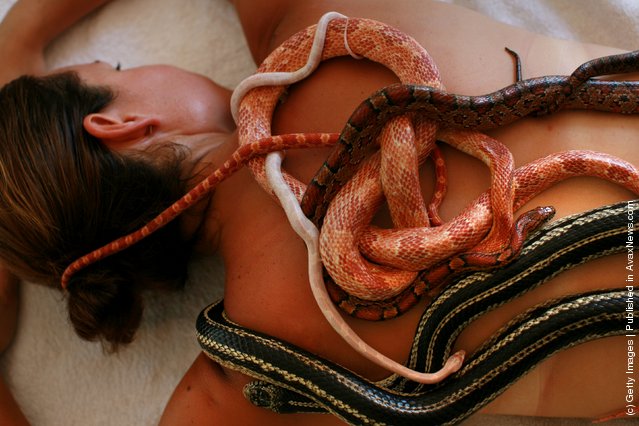
Meirav Stardinner receives a snake massage from Ada Barak at Barak's snake spa on September 11, 2008 in Talmei Elazar, Israel. Barack's income comes mostly from exhibiting her plants which eat everything from insects to small mammals. She discovered snakes' therapeutic value after letting people hold them after her act “Some people said that holding the snakes made them feel better, relaxed”, she says. “One old lady said it was soothing, like a cold compress”. Now she uses a combination of big snakes for deep massage and little ones for light massage, though all are non-venemous. (Photo by Uriel Sinai/Getty Images)
Details
07 May 2011 11:58:00
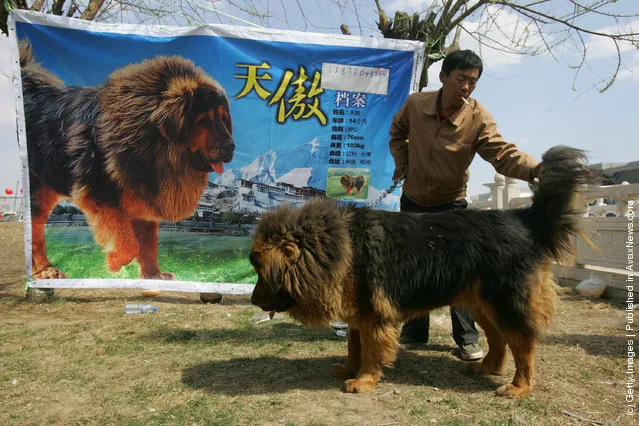
Tibetan Mastiff

“The Tibetan Mastiff also known as Do-khyi (variously translated as “home guard”, “door guard”, “dog which may be tied”, “dog which may be kept”), reflects its use as a guardian of herds, flocks, tents, villages, monasteries, and palaces, much as the old English ban-dog (also meaning tied dog) was a dog tied outside the home as a guardian. However, in nomad camps and in villages, the Do-khyi is traditionally allowed to run loose at night and woe be unto the stranger who walks abroad after dark”. – Wikipedia

Photo: A man displays a Tibetan Mastiff he raised during the Tibetan Mastiff exposition on April 7, 2007 in Langfang of Hebei Province, China. (Photo by China Photos/Getty Images)

Details
05 Oct 2011 14:27:00
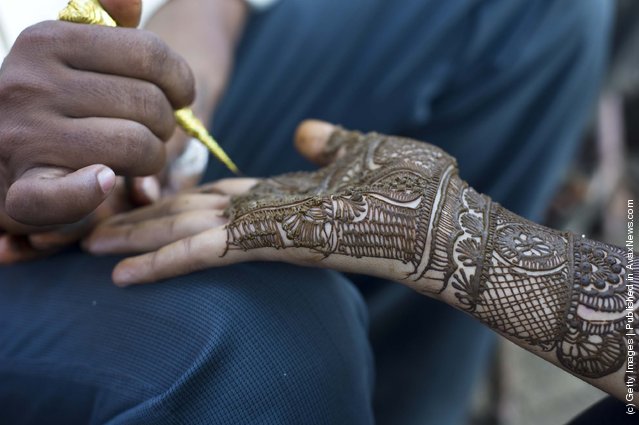
Application of henna or “Mehndi”  to a girls hand in a market in Jaipur, India

“Mehndi or menhdi is the application of henna as a temporary form of skin decoration in India, as well as by expatriate communities from the country. The word mehndi is derived from the Sanskrit word mendhikā. The use of mehndi and turmeric is described in the earliest Vedic ritual books. Haldi (Staining oneself with turmeric paste) as well as mehndi are important Vedic customs as a symbolic representation of the Outer and the Inner Sun. Vedic customs are meant to awaken the “inner light” and so the gold of the inner Sun has an important symbolic function”. – Wikipedia

Photo: Application of henna or “Mehndi” to a girls hand in a market on October 18, 2010 in Jaipur, India. (Photo by Simon de Trey-White/Getty Images)
Details
23 Nov 2011 13:33:00
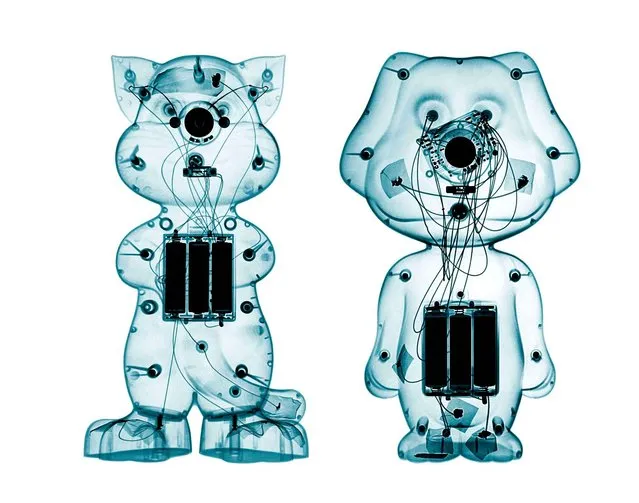
Australian photographer Brendan Fitzpatrick’s X-ray photographs expose the inner workings of toys. Fitzpatrick’s photographs are both whimsical and mechanical, evoking the curiosity of childhood and the desire to discover how things look and work from other perspectives. (Photo by Brendan Fitzpatrick)

Australian photographer Brendan Fitzpatrick’s X-ray photographs expose the inner workings of toys. Fitzpatrick’s photographs are both whimsical and mechanical, evoking the curiosity of childhood and the desire to discover how things look and work from other perspectives. The strategic placement of wires, batteries, and screws are revealed, the complexity of the inside contrasting with the seemingly simplistic design of the outside. Fitzpatrick uses chest X-ray and mammogram machines to photograph flowers, toys, and creatures, then enhances the color in the images in order to more effectively distinguish the various parts that have been exposed. This photographs are part of series he calls “Invisible Light”. (Photo by Brendan Fitzpatrick)
Details
08 Aug 2014 10:59:00
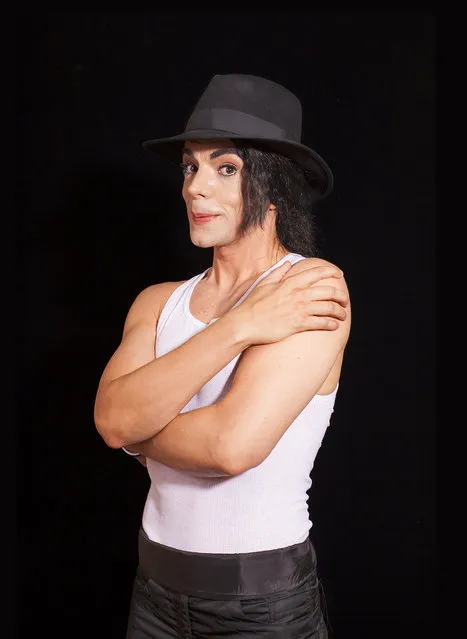
Hunt started working as Michael Jackson after receiving compliments at a Halloween party in his hometown of Fort Worth, Texas. His Michael Jackson is from the 2000s, and like a true lookalike, he uses mannerisms and a voice that he’s styled after Michael Jackson when interacting with his audiences. After working in Las Vegas, he returned to Fort Worth and finds work as an actor. (Photo and caption by Lorena Turner)

“Michael Jackson, the performer, consistently transcended racial and gender perceptions; Michael Jackson tribute artists, impersonators and lookalikes reflect this in that they embody a wide span of inspiration and intention. The current crop of impersonators are people who take great care in their appearance – some spend a lot of money and time on their make up and clothing, while others are more concerned with the physical gestures associated with his dances while expressing very little concern in the creation of an illusion”. – Lorena Turner. (Photo and caption by Lorena Turner)
Details
17 Jun 2015 08:09:00
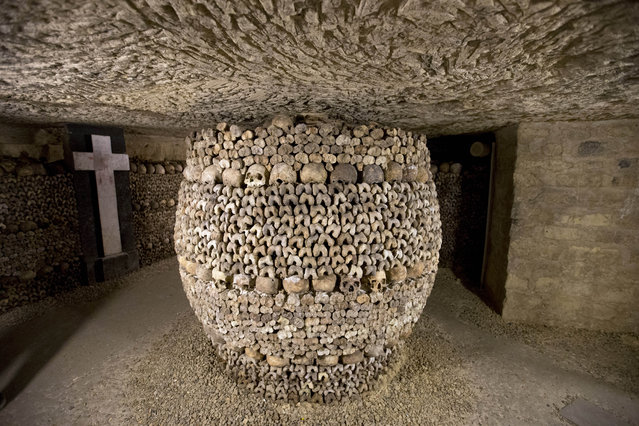
In this photo taken Tuesday, October 14, 2014, skulls and bones are stacked at the Catacombs in Paris, France. (Photo by Francois Mori/AP Photo)

In this photo taken Tuesday, October 14, 2014, skulls and bones are stacked at the Catacombs in Paris, France. The subterranean tunnels, stretching 2 kilometers (1.24 miles), cradle the bones of some 6 million Parisians from centuries past and once gave refuge to smugglers. The site used to close at 5 p.m., but is now staying open until 8 p.m. The change is mainly aimed at allowing more people to visit and reducing long lines, since it can only hold a limited number of people at a time and visits can't be reserved in advance. (Photo by Francois Mori/AP Photo)
Details
17 Oct 2014 13:27:00
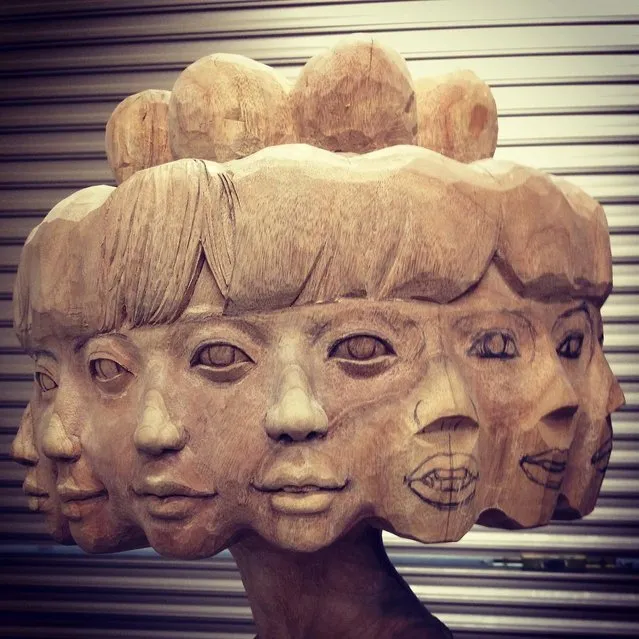
Sculpture By Yoshitoshi Kanemaki

There are many ways to interpret the creations of Yoshitoshi Kanemaki, whose works usually involve sculptures of people where two or more characters have merged into a single being. Possibly, Yoshitoshi Kanemaki is trying to express through his sculptures that everyone’s soul is multifaceted. Good emotions are mixed with the bad, love is mixed with hate, contempt with admiration. How often do you hear that a person loves someone deeply, while doing completely horrendous things, unable to see that he or she is destroying their object of love? Nevertheless, we should be thankful to the nature for all the different emotions that we are able to feel. Unlike animals, who only show simple forms of emotions, such as anger, happiness, and a few others, human soul is much deeper, allowing us to feel a full plethora of emotions. (Photo by Yoshitoshi Kanemaki)
Details
20 Nov 2014 12:26:00