Loading...
Done
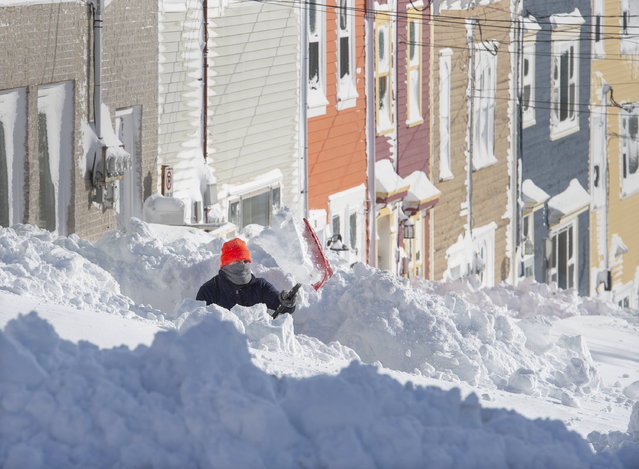
A resident digs out his walkway in St. John's Newfoundland on Saturday, January  18, 2020. The state of emergency ordered by the City of St. John's is still in place, leaving businesses closed and vehicles off the roads in the aftermath of the major winter storm that hit the Newfoundland and Labrador capital. (Photo by Andrew Vaughan/The Canadian Press via AP Photo)

A resident digs out his walkway in St. John's Newfoundland on Saturday, January 18, 2020. The state of emergency ordered by the City of St. John's is still in place, leaving businesses closed and vehicles off the roads in the aftermath of the major winter storm that hit the Newfoundland and Labrador capital. (Photo by Andrew Vaughan/The Canadian Press via AP Photo)
Details
20 Jan 2020 00:07:00
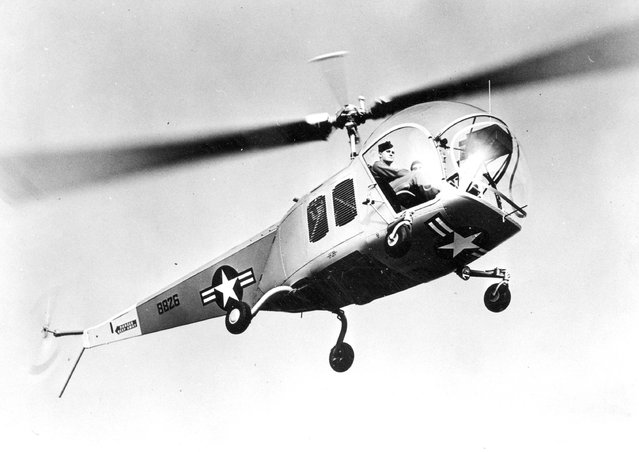
Number 10. BELL H-13 SIOUX was a two-bladed, single engine, light helicopter built by Bell Helicopter. Westland Aircraft manufactured the Sioux under license for the British military as the Sioux AH.1 and HT. (Photo by AP Photo)

Number 10. BELL H-13 SIOUX was a two-bladed, single engine, light helicopter built by Bell Helicopter. Westland Aircraft manufactured the Sioux under license for the British military as the Sioux AH.1 and HT. In 1947, the United States Air Force ordered the improved Bell Model 47A. Most were designated YR-13 and three winterized versions were designated YR-13A. The United States Army first ordered Bell 47s in 1948 under the designation H-13. These would later receive the name Sioux. The Bell-built H-13 B is seen airborne in this April 29, 1951 photo. The helicopter is equipped with a 173 horsepower engine, cruises at 85 miles per hour, climbs 900 feet in a minute and has a service ceiling of 11,500 feet. (Photo by AP Photo)
Details
08 Aug 2014 11:59:00
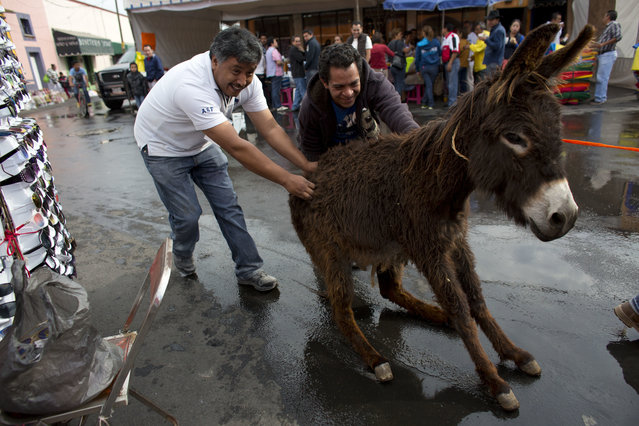
In this May 1, 2016 photo, a reluctant donkey is alternately pushed and pulled and enticed with carrots toward town hall in order to be dressed for the costume competition at the annual donkey festival in Otumba, Mexico state, Mexico. Otumba was an important donkey market during Spanish colonial times, standing at the crossroads of major roads leading to Mexico City, where the beasts pulled heavy loads and carried travelers. Today, however, farmers use tractors and pickup trucks, and the donkey population is in decline. (Photo by Rebecca Blackwell/AP Photo)

In this May 1, 2016 photo, a reluctant donkey is alternately pushed and pulled and enticed with carrots toward town hall in order to be dressed for the costume competition at the annual donkey festival in Otumba, Mexico state, Mexico. Otumba was an important donkey market during Spanish colonial times, standing at the crossroads of major roads leading to Mexico City, where the beasts pulled heavy loads and carried travelers. Today, however, farmers use tractors and pickup trucks, and the donkey population is in decline. (Photo by Rebecca Blackwell/AP Photo)
Details
04 May 2016 11:55:00
Children play in an outdoor shower as a soldier takes part in a surprise operation in the Manguinhos slum in Rio de Janeiro, Brazil, Thursday, January 18, 2018. (Photo by Leo Correa/AP Photo)

Children play in an outdoor shower as a soldier takes part in a surprise operation in the Manguinhos slum in Rio de Janeiro, Brazil, Thursday, January 18, 2018. Troops have been sent to Rio due to the increase of the violence, and in an attempt to help restore order, but so far have had little impact. The operation on Thursday took place three weeks ahead of Carnival, when thousands of tourists are expected to arrive in the city. (Photo by Leo Correa/AP Photo)
Details
20 Jan 2018 06:57:00
Police officers detain a Navalny supporter during a protest in St. Petersburg, Russia, Tuesday, February 2, 2021. A Moscow court has ordered Russian opposition leader Alexei Navalny to prison for more than 2 1/2 years on charges that he violated the terms of his probation while he was recuperating in Germany from nerve-agent poisoning. Navalny, who is the most prominent critic of President Vladimir Putin, had earlier denounced the proceedings as a vain attempt by the Kremlin to scare millions of Russians into submission. (Photo by Dmitri Lovetsky/AP Photo)

Police officers detain a Navalny supporter during a protest in St. Petersburg, Russia, Tuesday, February 2, 2021. A Moscow court has ordered Russian opposition leader Alexei Navalny to prison for more than 2 1/2 years on charges that he violated the terms of his probation while he was recuperating in Germany from nerve-agent poisoning. Navalny, who is the most prominent critic of President Vladimir Putin, had earlier denounced the proceedings as a vain attempt by the Kremlin to scare millions of Russians into submission. (Photo by Dmitri Lovetsky/AP Photo)
Details
05 Feb 2021 09:38:00
Buddy the dog peers from a vehicle before the start of a movie at a drive in cinema in Snagov, Romania, Monday, June 1, 2020. Romania further loosened the measures imposed during a nationwide lockdown in order to limit the spread of the COVID-19 infections, with museums, open air restaurants, cinemas and beaches opening for public on Monday. (Photo by Andreea Alexandru/AP Photo)

Buddy the dog peers from a vehicle before the start of a movie at a drive in cinema in Snagov, Romania, Monday, June 1, 2020. Romania further loosened the measures imposed during a nationwide lockdown in order to limit the spread of the COVID-19 infections, with museums, open air restaurants, cinemas and beaches opening for public on Monday. (Photo by Andreea Alexandru/AP Photo)
Details
21 Jun 2020 00:05:00
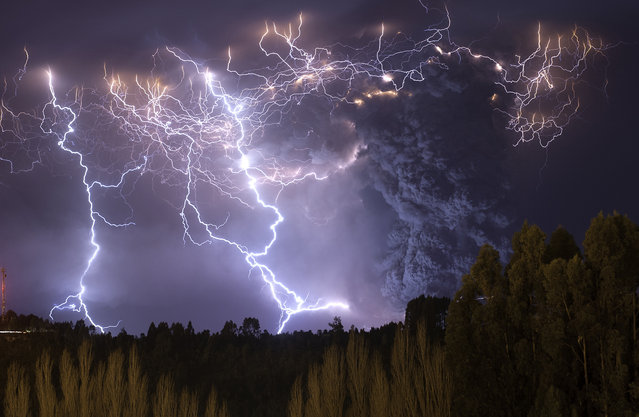
The eruption of Cordon Caulle began on June 4, 2011, located in the Region of Los Rios in Chile. For about 12 months, people and animals became accustomed to living with the daily fall of ash, which also caused problems in the air traffic in South America. The explosions and lightning during first days of the eruption could be seen from hundreds of miles around. This photograph was taken on the second night of eruption from the town of Lago Ranco. (Photo and caption by Francisco Negroni/National Geographic Traveler Photo Contest)

The eruption of Cordon Caulle began on June 4, 2011, located in the Region of Los Rios in Chile. For about 12 months, people and animals became accustomed to living with the daily fall of ash, which also caused problems in the air traffic in South America. The explosions and lightning during first days of the eruption could be seen from hundreds of miles around. This photograph was taken on the second night of eruption from the town of Lago Ranco. (Photo and caption by Francisco Negroni/National Geographic Traveler Photo Contest)

ATTENTION! All pictures are presented in high resolution. To see Hi-Res images – just TWICE click on any picture. In other words, click small picture – opens the BIG picture. Click BIG picture – opens VERY BIG picture.
Details
23 Jun 2013 11:24:00
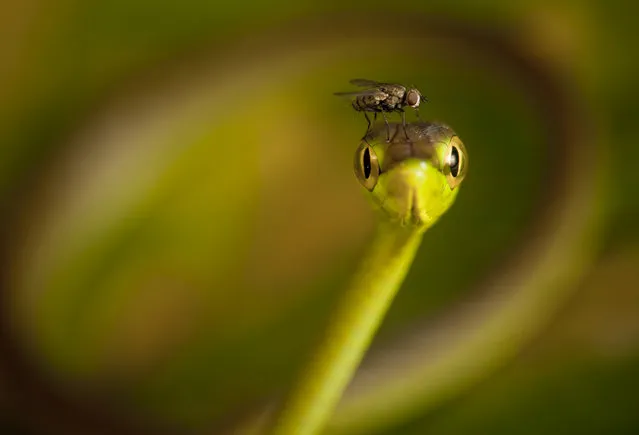
“Fly cap for a vine snake”. A fly lands on the head of a vine snake in the Choco of Colombia. (Photo and caption by Robin Moore/National Geographic Traveler Photo Contest)

“Fly cap for a vine snake”. A fly lands on the head of a vine snake in the Choco of Colombia. (Photo and caption by Robin Moore/National Geographic Traveler Photo Contest)

ATTENTION! All pictures are presented in high resolution. To see Hi-Res images – just TWICE click on any picture. In other words, click small picture – opens the BIG picture. Click BIG picture – opens VERY BIG picture.
Details
24 Jun 2013 11:36:00