Loading...
Done
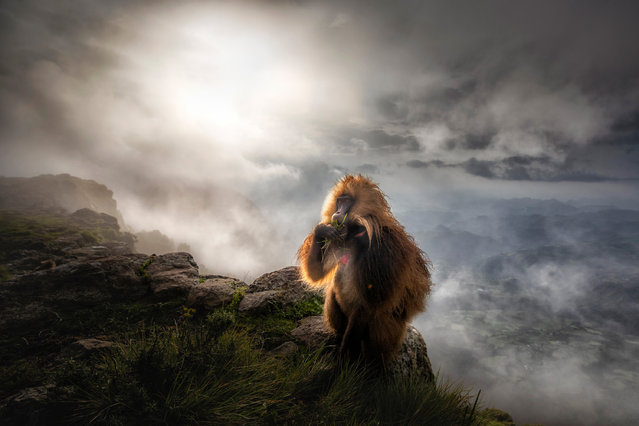
Highly commended, mammals: Gelada after the storm – Marco Gaiotti (Italy). “Gelada baboons are the only monkey species in the world that feed on grasses. They are native to the tableland of Ethiopia. Every morning large family groups wander from their sleeping places in the steep rock face, up to 1,000 metres high, to the feeding grounds at the tablelands. This image clearly depicts their feeding strategy: they pull out bunches of grass, sort the stalks and then lift them to their mouth. This shot was taken towards the end of the rainy season after a heavy storm”. (Photo by Marco Gaiotti/2019 GDT European Wildlife Photographer of the Year)

Highly commended, mammals: Gelada after the storm – Marco Gaiotti (Italy). “Gelada baboons are the only monkey species in the world that feed on grasses. They are native to the tableland of Ethiopia. Every morning large family groups wander from their sleeping places in the steep rock face, up to 1,000 metres high, to the feeding grounds at the tablelands. This image clearly depicts their feeding strategy: they pull out bunches of grass, sort the stalks and then lift them to their mouth. This shot was taken towards the end of the rainy season after a heavy storm”. (Photo by Marco Gaiotti/2019 GDT European Wildlife Photographer of the Year)
Details
31 Oct 2019 00:03:00
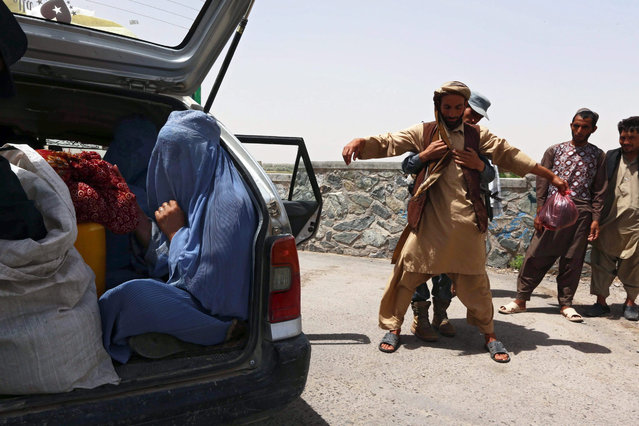
An Afghan policeman frisks a man while a burqa-cald woman sits in the trunk of a car on a roadside in Herat, Afghanistan, 05 July 2015. At least 18 police, two civilians and 30 rebels were killed in central Afghanistan during three days of fierce fighting, police said on 04 July. The clashes ended 04 July after security forces retook control of nine police checkpoints that had fallen to the rebels. (Photo by Jalil Rezayee/EPA)

An Afghan policeman frisks a man while a burqa-cald woman sits in the trunk of a car on a roadside in Herat, Afghanistan, 05 July 2015. At least 18 police, two civilians and 30 rebels were killed in central Afghanistan during three days of fierce fighting, police said on 04 July. The clashes ended 04 July after security forces retook control of nine police checkpoints that had fallen to the rebels. (Photo by Jalil Rezayee/EPA)
Details
06 Jul 2015 10:44:00
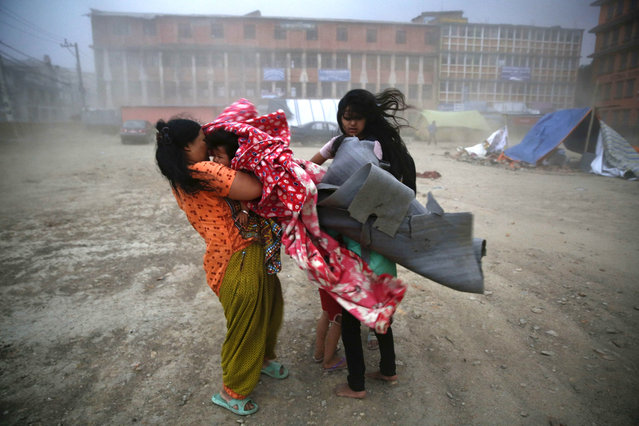
A storm whips through a tented area occupied by Nepalese earthquake survivors as a mother grabs her infant child and runs to find shelter in Kathmandu, Nepal 23 May 2015. Nepalese, who lost their homes in earthquake and fear aftershocks, have been living in temporary shelter in open ground which they had to flee because of the heavy rain and powerful wind. (Photo by Narendra Shrestha/EPA)

A storm whips through a tented area occupied by Nepalese earthquake survivors as a mother grabs her infant child and runs to find shelter in Kathmandu, Nepal 23 May 2015. Nepalese, who lost their homes in earthquake and fear aftershocks, have been living in temporary shelter in open ground which they had to flee because of the heavy rain and powerful wind. (Photo by Narendra Shrestha/EPA)
Details
25 May 2015 10:00:00
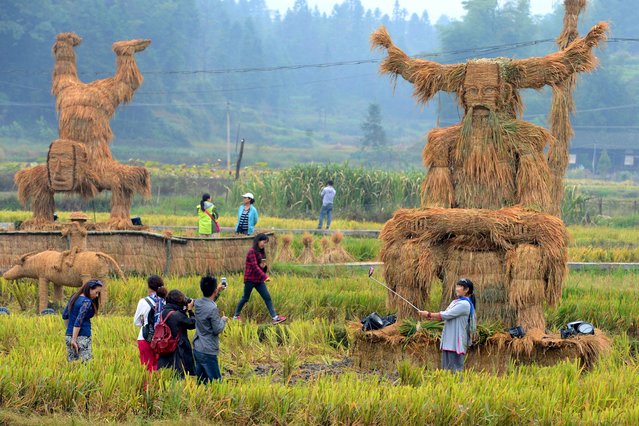
Tourists take pictures of straw figurines of traditional deities Shennong (R) and Zhang Wulang (L back) during China's National Day Holiday, in Xinhua county, Hunan province, October 4, 2015. (Photo by Reuters/China Daily)

Tourists take pictures of straw figurines of traditional deities Shennong (R) and Zhang Wulang (L back) during China's National Day Holiday, in Xinhua county, Hunan province, October 4, 2015. (Photo by Reuters/China Daily)
Details
07 Oct 2015 08:08:00
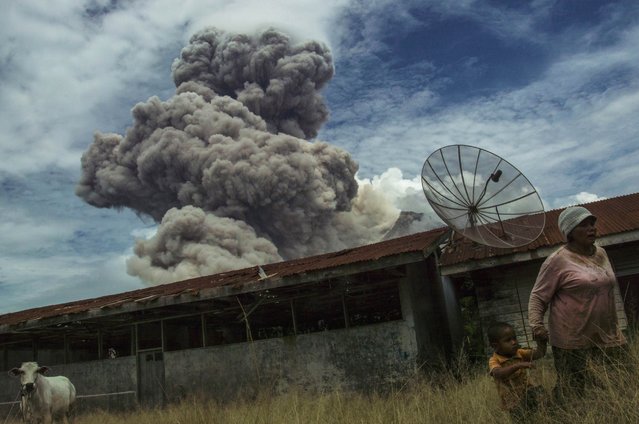
In this photograph taken on April 1, 2015, an Indonesian resident and child walk away from an abandoned school building as Mount Sinabung erupts in Karo district on the Indonesian island of Sumatra. According to authorities about 3,500 people were displaced after the February 2014 eruption of Mount Sinabung volcano and many are still living in evacuation centers as the volcano remains active. (Photo by Sutanta Aditya/AFP Photo)

In this photograph taken on April 1, 2015, an Indonesian resident and child walk away from an abandoned school building as Mount Sinabung erupts in Karo district on the Indonesian island of Sumatra. According to authorities about 3,500 people were displaced after the February 2014 eruption of Mount Sinabung volcano and many are still living in evacuation centers as the volcano remains active. (Photo by Sutanta Aditya/AFP Photo)
Details
04 Apr 2015 10:32:00
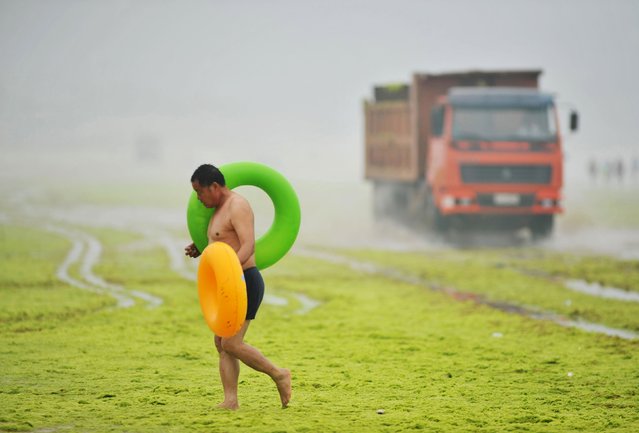
A man carries floats as he walks on an algae covered beach as a truck collecting algae passes by, along the coastline in Qingdao, Shandong province, July 6, 2015. (Photo by Reuters/China Daily)

A man carries floats as he walks on an algae covered beach as a truck collecting algae passes by, along the coastline in Qingdao, Shandong province, July 6, 2015. (Photo by Reuters/China Daily)
Details
08 Jul 2015 12:41:00
Ocean voyage

Do you think that history is a science? Well, not exactly. First, and foremost, history is the state's “legend of wars”, it’s official regalia. Of course, public historians are not interested in scientific truth – quite the opposite. In this respect, any attempt to present a state’s history as altruistic and benevolent as possible is welcomed and encouraged – as opposed to any revisionism attempts that may be more accurate. In this matter, Chinese have surpassed us all – they revised in highly creative manner (but rather shamelessly) the technology already invented by Europeans, a process that resulted in oldest state on the planet. Here is an interesting paradox: ask any sinologist about the Middle Kingdom during second century B.C., and he will describe it to you in such a vivid manner as if he has been living there all his life – but as soon as you will ask him to describe Chinese history in the 19-20th centuries… let's say, his eagerness will be greatly diminished. However, we will discuss China in a different article, and in the meantime we will try to understand how exactly historic “legend of wars” is formed and functions – based on a specific and well-known example. A great example is Ferdinand Magellan's first voyage around the world.
Details
14 Nov 2011 09:11:00
Takeoka Chisaka, Hiroshima, Japan. “One morning in August 1945, I was walking home from the night shift at a factory in Hiroshima. As I reached my door, there was a huge explosion. When I came to, my head was bleeding and I had been blasted 30m away”. (Photo and caption by Sasha Maslov)

Takeoka Chisaka, Hiroshima, Japan. “One morning in August 1945, I was walking home from the night shift at a factory in Hiroshima. As I reached my door, there was a huge explosion. When I came to, my head was bleeding and I had been blasted 30m away. The atomic bomb had detonated. When I found my mother, her eyes were badly burned. A doctor said they had to come out, but he didn’t have the proper tools so used a knife instead. It was hellish. I became a peace-worker after the war. In the 1960s, at a meeting at the UN, I met one of the people who created the atomic bomb. He apologised”. (Photo and caption by Sasha Maslov)
Details
11 May 2015 11:56:00