Bet: Oshane Grant, 42, of Easton, Bristol, was expecting to pocket £9,250 if France, Serbia and Argentina's football teams all scored at least three goals in their World Cup 2014 qualifiers (dailymail).
Real life doll Alina Kovalevskaya poses for a photograph on May 29, 2014 in Odessa, Ukraine. Alina Kovalevskaya is a walking, talking, breathing living doll on the lookout for her real-life Ken. The 21-year-old is from Odessa, Ukraine – the same city as real-life Barbie Valeria Lukyanova, who has made headlines around the world for her unique look and controversial opinions. The pair were friends, but their relationship has since soured. Alina has made a splash online, with her YouTube videos showing off her doll-like charms attracting hundreds of thousands of views. (Photo by Aleksey Solodunov/Barcroft Media)
Andrew Hepher, Vice President of Lubricants Technology, Shell unveils the Shell Concept Car in Beijing, China, Friday, April 22, 2016. Built as proof of energy efficiency that can be achieved with the latest technologies, Shell unveiled the concept car ahead of the bi-annual Beijing Auto Show where the world's top car manufacturers will showcase their own upcoming products. (Photo by Ng Han Guan/AP Photo)
A Japan soccer fan reacts as she watches Japan's FIFA Women's World Cup final match against the U.S. in Vancouver, at a public viewing event in Tokyo, Japan, July 6, 2015. Japan lost the match 5-2 to the U.S. (Photo by Toru Hanai/Reuters)
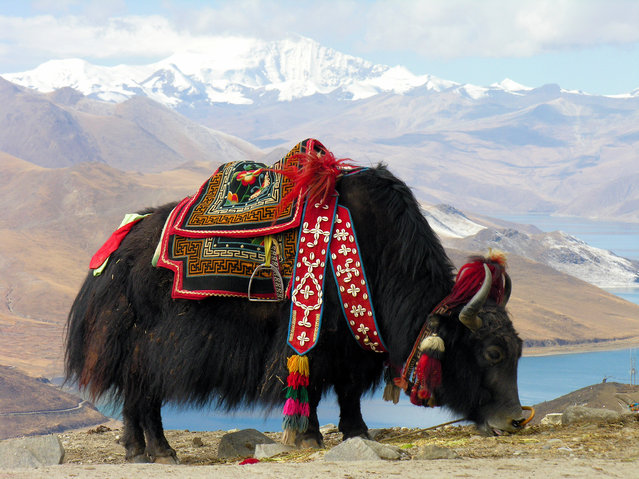
Yak near Yamdrok lake, Tibet. It is a long-haired bovinae found throughout the Himalayan region of south Central Asia, the Tibetan Plateau and as far north as Mongolia and Russia. The Tibetan economy is dominated by subsistence agriculture. Due to limited arable land, the primary occupation of the Tibetan Plateau is raising livestock, such as sheep, cattle, goats, camels, yaks, dzo, and horses. The Tibetan yak is an integral part of Tibetan life. (Photo by Dennis Jarvis)
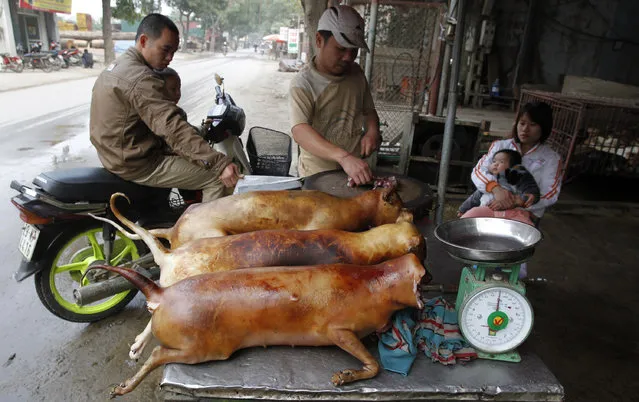
A vendor (C) cuts slaughtered dogs for sale at his roadside stall in Duong Noi village, outside Hanoi December 16, 2011. While animal rights activists have condemned eating dog meat as cruel treatment of the animals, it is still an accepted popular delicacy for some Vietnamese, as well in some other Asian countries. Duong Noi is well-known as a dog-meat village, where hundreds of dogs are killed each day for sale as popular traditional food. Dog-eating as a custom is rooted in Vietnam and was developed as a result of poverty. One kilogram of dog meat costs about 130,000 dongs ($6.2). (Photo by Reuters/Kham)
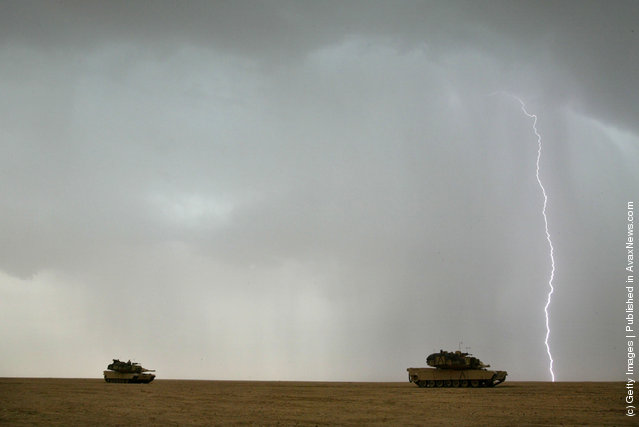
A lighting bolt flashes in the sky as U.S. Army M1A1 Abram tanks roll through the desert December 9, 2002 near the Iraqi border in Kuwait. (Photo by Joe Raedle/Getty Images)