Loading...
Done
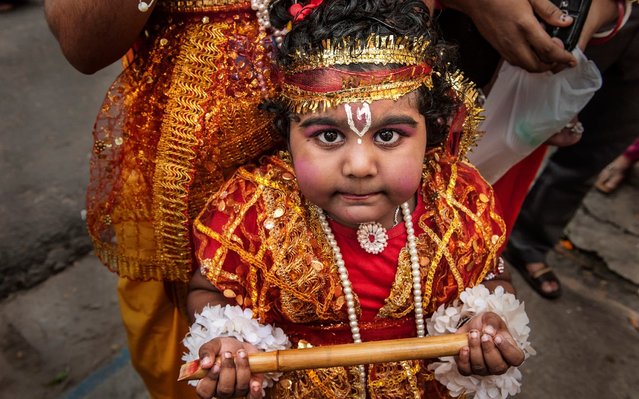
A toddler dressed as Hindu Lord Krishna takes part in Krishna Janmashtami celebrations at a temple in Kolkata, India, on August 23, 2019. Krishna Janmashtami is an annual Hindu festival that celebrates the birth of Lord Krishna, the eighth avatar of Vishnu. (Photo by Tumpa Mondal/Xinhua News Agency)

A toddler dressed as Hindu Lord Krishna takes part in Krishna Janmashtami celebrations at a temple in Kolkata, India, on August 23, 2019. Krishna Janmashtami is an annual Hindu festival that celebrates the birth of Lord Krishna, the eighth avatar of Vishnu. (Photo by Tumpa Mondal/Xinhua News Agency)
Details
31 Oct 2019 00:01:00
Young dancers from the Style Dance Academy perform during a Mother's Day block party in Caracas, Venezuela, Sunday, May 19, 2019. (Photo by Rodrigo Abd/AP Photo)

Young dancers from the Style Dance Academy perform during a Mother's Day block party in Caracas, Venezuela, Sunday, May 19, 2019. Although Mother's Day was officially celebrated the previous weekend, people in the Petare area organized the neighborhood party to celebrate the mothers of their community. (Photo by Rodrigo Abd/AP Photo)
Details
28 May 2019 00:01:00
“A very delicate person, beneath the flamboyance”. Jasper, Ladbroke Grove, 1977. “In the 1970s, Australia was rather cut off. I’d always wanted to live abroad, so I moved to Rome and then London. I was an art historian, but started studying photography part-time. I was interested in the demi-monde culture and began mixing in all sorts of circles. Jasper was a rather wonderful character. He was from Sydney, but he was living downstairs from me in Ladbroke Grove, in a flat rented to some gay friends. It was fairly eclectic. Jasper was always playing around with clothes and makeup. If he was looking particularly wonderful, I might get out my lights and take a shot. Or he might put makeup on me. He wasn’t always in drag, but he was permanently in diva mode, dependably louche, funny and naughty. I think all that comes across in the image. He was actually a very delicate person, though, beneath the wit and flamboyance. Jasper floated through London all too briefly. His real name was Peter MacMahon, but to us he was only ever Jasper Havoc, an alter ego he’d created while part of a transvestite troupe called Sylvia and the Synthetics. They were legendary in Sydney gay culture. On this day, we’d been taking some pictures inside and had gone out into the streets to fool around some more. Jasper was wearing a corset and fishnets ensemble, with other bits and pieces, and we joked about him being trashy as he lay in the skip. We just took the shot for ourselves. It wasn’t done with any publication in mind, or anything else. This was way before the internet and people didn’t share images. If you dressed up, it was just for that moment”. (Photo by Jane England)

“A very delicate person, beneath the flamboyance”. Jasper, Ladbroke Grove, 1977. “In the 1970s, Australia was rather cut off. I’d always wanted to live abroad, so I moved to Rome and then London. I was an art historian, but started studying photography part-time. I was interested in the demi-monde culture and began mixing in all sorts of circles. Jasper was a rather wonderful character...”. (Photo by Jane England)
Details
26 Jun 2017 09:04:00
A dhobi, or a washerman washes cloths on the banks of the River Gomti in Lucknow, India, Saturday, September 12, 2020. Dhobis are traditional laundry workers who wash clothes by hand and dry them in the sun, an occupation which has been in existence for generations. Most cities in India have a Dhobi Ghat, or washermen's area, where the city's pile of clothes is laundered. This practice is still popular in India, despite of modern technology. Around 1,000 families work in Lucknow's Dhobi Ghat. However, in light of the novel coronavirus, their wages have decreased drastically. With each family earning around US$100-200 per month. (Photo by Rajesh Kumar Singh/AP Photo)

A dhobi, or a washerman washes cloths on the banks of the River Gomti in Lucknow, India, Saturday, September 12, 2020. Dhobis are traditional laundry workers who wash clothes by hand and dry them in the sun, an occupation which has been in existence for generations. Most cities in India have a Dhobi Ghat, or washermen's area, where the city's pile of clothes is laundered. This practice is still popular in India, despite of modern technology. Around 1,000 families work in Lucknow's Dhobi Ghat. However, in light of the novel coronavirus, their wages have decreased drastically. With each family earning around US$100-200 per month. (Photo by Rajesh Kumar Singh/AP Photo)
Details
25 Sep 2020 00:03:00
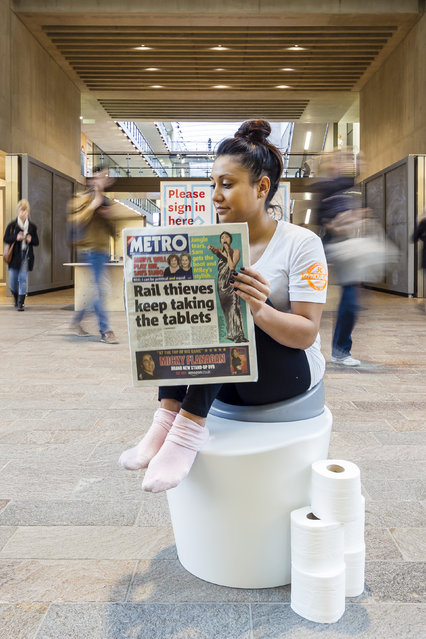
A model poses with “The Wellbeing Toilet” the winning entry from a Dyno-Rod Initiative to create a new design for the domestic toilet at Central Saint Martins on November 18, 2013 in London, England. The concept was commissioned to mark 50 years of Dyno-Rod and World Toilet Day on November 19th, 2013 The “Wellbeing Toilet” looks at the health and wellbeing aspect of getting rid of your bodily waste by being sculpted to enhance the position of your body by enabling you to squat rather than sit. (Photo by Miles Willis/Getty Images for Dyno-Rod)

A model poses with “The Wellbeing Toilet” the winning entry from a Dyno-Rod Initiative to create a new design for the domestic toilet at Central Saint Martins on November 18, 2013 in London, England. The concept was commissioned to mark 50 years of Dyno-Rod and World Toilet Day on November 19th, 2013 The “Wellbeing Toilet” looks at the health and wellbeing aspect of getting rid of your bodily waste by being sculpted to enhance the position of your body by enabling you to squat rather than sit. (Photo by Miles Willis/Getty Images for Dyno-Rod)
Details
20 Nov 2013 07:54:00
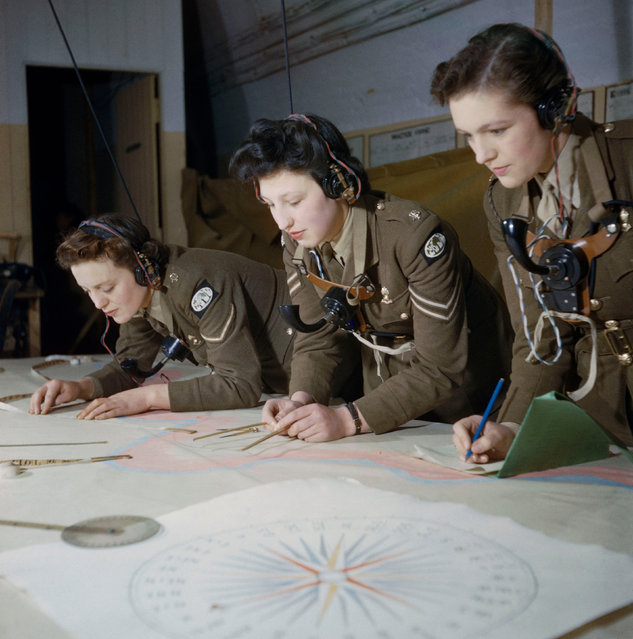
Auxiliary Territorial Service (ATS) plotters at work at Coastal Artillery Headquarters in Dover, December 1942. (Photo by Ted Dearberg/IWM/PA Wire)

Auxiliary Territorial Service (ATS) plotters at work at Coastal Artillery Headquarters in Dover, December 1942. The Auxiliary Territorial Service was the women's branch of the British Army during the Second World War. It was formed on 9 September 1938, initially as a women's voluntary service, and existed until 1 February 1949, when it was merged into the Women's Royal Army Corps. The ATS had its roots in the Women's Auxiliary Army Corps (WAAC), which was formed in 1917 as a voluntary service. During the First World War its members served in a number of jobs including clerks, cooks, telephonists and waitresses. The WAAC was disbanded after four years in 1921. (Photo by Ted Dearberg/IWM/PA Wire)
Details
13 Jul 2017 07:52:00
Women sell bananas in the street, after traders in markets were prohibited from selling any non-food items in an attempt to halt the spread of the new coronavirus, in Kampala, Uganda Thursday, March 26, 2020. (Photo by Ronald Kabuubi/AP Photo)

Women sell bananas in the street, after traders in markets were prohibited from selling any non-food items in an attempt to halt the spread of the new coronavirus, in Kampala, Uganda Thursday, March 26, 2020. (Photo by Ronald Kabuubi/AP Photo)
Details
14 Apr 2020 00:01:00
A child carrying a small broom walks by a line of National Guard members deployed to Bellevue Square as community members clean up after looting and vandalism that occurred Sunday at Bellevue Square in downtown Bellevue, Washington, U.S. June 1, 2020. (Photo by Lindsey Wasson/Reuters)

A child carrying a small broom walks by a line of National Guard members deployed to Bellevue Square as community members clean up after looting and vandalism that occurred Sunday at Bellevue Square in downtown Bellevue, Washington, U.S. June 1, 2020. (Photo by Lindsey Wasson/Reuters)
Details
18 Jun 2020 00:05:00