A flock of sheep huddles together while snow spindrift is whipped up by strong winds in Swaledale, North Yorkshire, UK on March 17, 2017. (Photo by Paul Kingston/NNP North News & Pictures Ltd)
Vogue Italia is hosting a series of shows in Milan exploring how the magazine seeks to engage with hot social and political issues and provoke debate through images by top photographers. The Photo Vogue festival in Milan is hosting three exhibitions. The first, Fashion and Politics in Vogue Italia, looks at the magazine’s ambition to be a catalyst for change – in subtle and playful ways. Here: David LaChapelle – October 2004. (Photo by David LaChapelle/The Guardian)
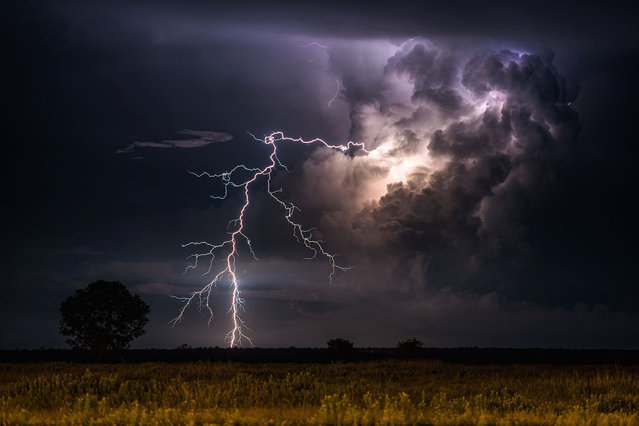
An incredible clear-air lightning display from storms to the east of Noonamah, just outside Darwin on April 6, 2015. (Photo by Jacci Ingham/The Guardian)
Naked activists for animal rights, covered in fake blood, perform during a protest against the use of fur and leather, at Catalunya Square in Barcelona, Spain, December 16, 2018. (Photo by Albert Gea/Reuters)
A Syrian man sells vegetables in front of a damaged tank in Homs, on December 20, 2024. Islamist-led rebels took Damascus in a lightning offensive on December 8, ousting president Bashar al-Assad and ending five decades of Baath rule in Syria. (Photo by Sameer Al-Doumy/AFP Photo)
Brazilian supermodel Adriana Lima walks the runway during the 2025 Victoria's Secret Fashion Show in New York City, U.S., October 15, 2025. (Photo by Brendan McDermid/Reuters)
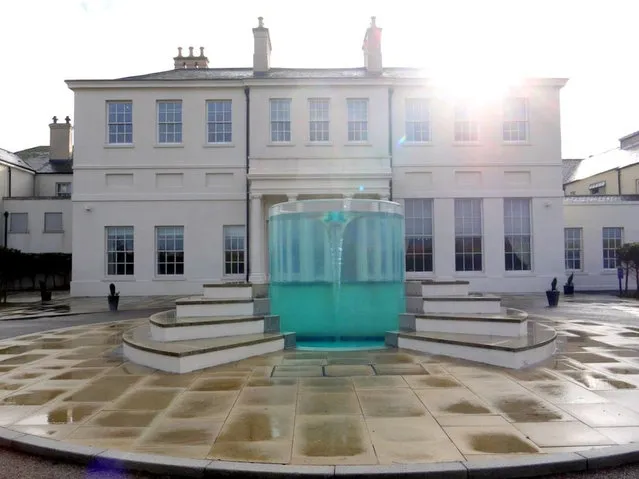
The sirens Charybdis and Scylla resided in the Sicilian Sea. Homer tells us that because Charybdis had stolen the oxen of Hercules, Zeus struck her with a thunderbolt and changed her into a whirlpool whose vortex swallowed up ships. In Charybdis the circular movement of water inside a transparent acrylic cylinder forms an air-core vortex in the centre. Steps wrap around the cylinder and allow spectators to view the vortex from above. The cylinder was manufactured in Grand Junction, Colorado.
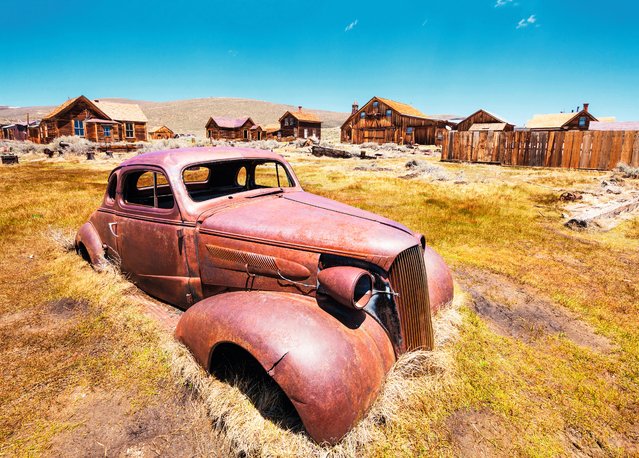
Kieron Connolly’s new book of photographs of more than 100 once-busy and often elegant buildings gives an idea of how the world might look if humankind disappeared. Here: Bodie, Mono County, California. Gold was discovered at Bodie in 1859 (just after the initial California gold rush) and it went from mining camp to boomtown. Its decline began in 1880, when word spread of new boomtowns elsewhere. The Standard Consolidated Mine closed in 1913, and four years later the Bodie Railway was abandoned. By 1940 the population was down to 40. Today, Bodie is maintained in a state of arrested decay as a visitor attraction. (Photo by Alamy Stock Photo)