Loading...
Done
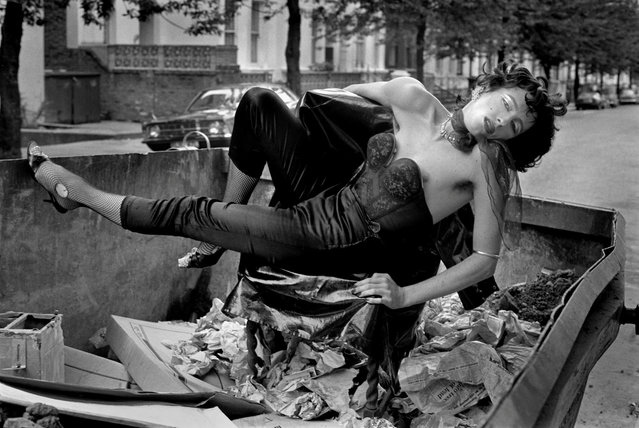
“A very delicate person, beneath the flamboyance”. Jasper, Ladbroke Grove, 1977. “In the 1970s, Australia was rather cut off. I’d always wanted to live abroad, so I moved to Rome and then London. I was an art historian, but started studying photography part-time. I was interested in the demi-monde culture and began mixing in all sorts of circles. Jasper was a rather wonderful character. He was from Sydney, but he was living downstairs from me in Ladbroke Grove, in a flat rented to some gay friends. It was fairly eclectic. Jasper was always playing around with clothes and makeup. If he was looking particularly wonderful, I might get out my lights and take a shot. Or he might put makeup on me. He wasn’t always in drag, but he was permanently in diva mode, dependably louche, funny and naughty. I think all that comes across in the image. He was actually a very delicate person, though, beneath the wit and flamboyance. Jasper floated through London all too briefly. His real name was Peter MacMahon, but to us he was only ever Jasper Havoc, an alter ego he’d created while part of a transvestite troupe called Sylvia and the Synthetics. They were legendary in Sydney gay culture. On this day, we’d been taking some pictures inside and had gone out into the streets to fool around some more. Jasper was wearing a corset and fishnets ensemble, with other bits and pieces, and we joked about him being trashy as he lay in the skip. We just took the shot for ourselves. It wasn’t done with any publication in mind, or anything else. This was way before the internet and people didn’t share images. If you dressed up, it was just for that moment”. (Photo by Jane England)

“A very delicate person, beneath the flamboyance”. Jasper, Ladbroke Grove, 1977. “In the 1970s, Australia was rather cut off. I’d always wanted to live abroad, so I moved to Rome and then London. I was an art historian, but started studying photography part-time. I was interested in the demi-monde culture and began mixing in all sorts of circles. Jasper was a rather wonderful character...”. (Photo by Jane England)
Details
26 Jun 2017 09:04:00
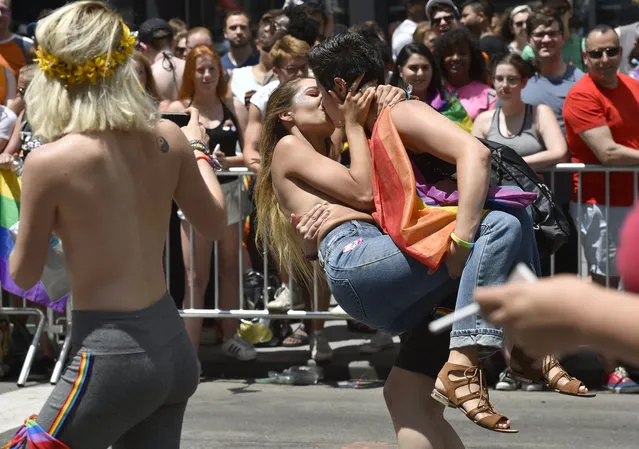
Pride rally 2017 on fifth avenue in  Manhattan, New York, June 25, 2017. (Photo by R. Umar Abbasi)

Pride rally 2017 on fifth avenue in Manhattan, New York, June 25, 2017. Thouands cheered as members of LGBT community danced and marched under a bright summer sun. Many participants carried political themed signs as President Trump's adminstration has angered some in the LGBT community. (Photo by R. Umar Abbasi)
Details
27 Jun 2017 08:42:00
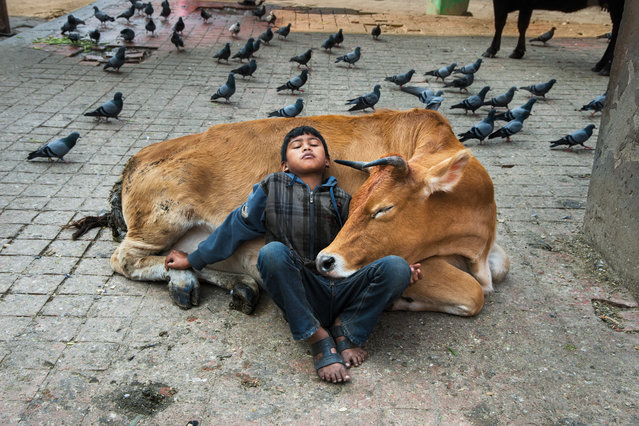
A boy rests against a cow, Kathmandu, Nepal, 2013. “Cows have been designated the national animal in Nepal. They roam freely, and are considered sacred by the 80% of Nepalis who are Hindu”. (Photo by Steve McCurry/The Guardian)

The legendary US photographer’s favourite shots of creatures and how they interact with humans feature in “Animals”, his latest book. Here: A boy rests against a cow, Kathmandu, Nepal, 2013. “Cows have been designated the national animal in Nepal. They roam freely, and are considered sacred by the 80% of Nepalis who are Hindu”. (Photo by Steve McCurry/The Guardian)
Details
07 Nov 2019 00:01:00
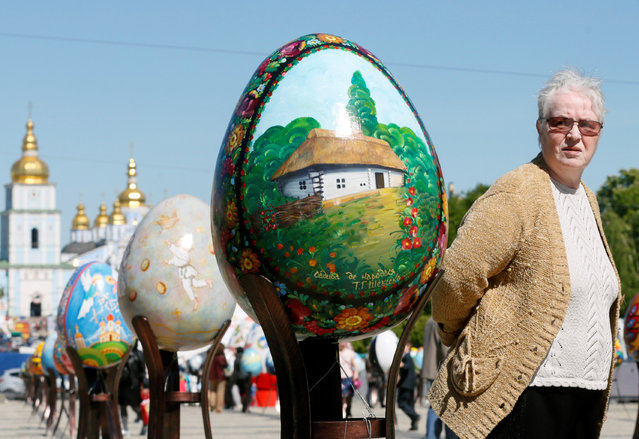
A woman looks at traditional Ukrainian Easter eggs “Pysanka”, installed as part of the upcoming celebrations of Easter, in central Kiev, Ukraine, April 29, 2016. A pysanka is a Ukrainian Easter egg, decorated with traditional Ukrainian folk designs using a wax-resist (batik) method. The word pysanka comes from the verb pysaty, “to write”, as the designs are not painted on, but written with beeswax. Many other eastern European ethnic groups decorate eggs using wax resist for Easter. These include the Belarusians, Bulgarians, Croats, Czechs, Hungarians, Lithuanians, Poles, Romanians, Serbs, Slovaks, Slovenes and Sorbs. (Photo by Valentyn Ogirenko/Reuters)

A woman looks at traditional Ukrainian Easter eggs “Pysanka”, installed as part of the upcoming celebrations of Easter, in central Kiev, Ukraine, April 29, 2016. A pysanka is a Ukrainian Easter egg, decorated with traditional Ukrainian folk designs using a wax-resist (batik) method. The word pysanka comes from the verb pysaty, “to write”, as the designs are not painted on, but written with beeswax. Many other eastern European ethnic groups decorate eggs using wax resist for Easter. These include the Belarusians, Bulgarians, Croats, Czechs, Hungarians, Lithuanians, Poles, Romanians, Serbs, Slovaks, Slovenes and Sorbs. (Photo by Valentyn Ogirenko/Reuters)
Details
30 Apr 2016 09:00:00
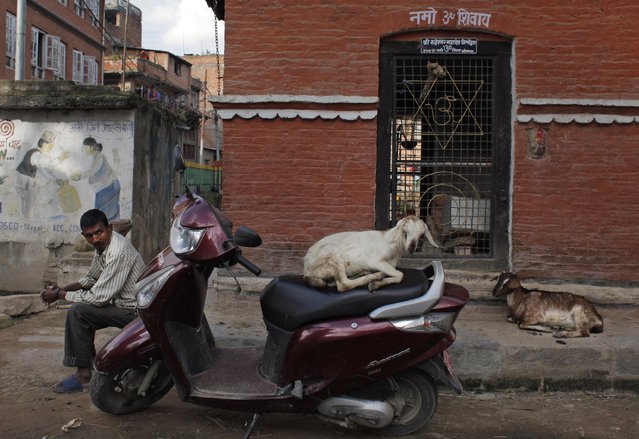
A Nepalese man sits outside a Hindu temple as a goat rests on a parked scooter in Khokana, Lalitpur District, Nepal, Monday, Sept. 26, 2016. Writing on the wall offers prayers to Hindu god Shiva. (Photo by Niranjan Shrestha/AP Photo)

A Nepalese man sits outside a Hindu temple as a goat rests on a parked scooter in Khokana, Lalitpur District, Nepal, Monday, September 26, 2016. Writing on the wall offers prayers to Hindu god Shiva. (Photo by Niranjan Shrestha/AP Photo)
Details
27 Sep 2016 09:27:00
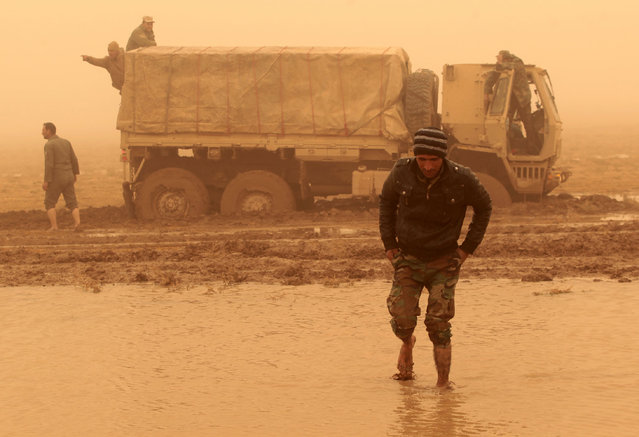
Iraqi army soldiers attempt to move their truck stuck in the mud near the village of Al-Boutha al-Sharqiyah, west of Mosul, on December 2, 2016, during a broad offencive by Iraq forces to retake the main hub city from Islamic State group jihadists. (Photo by Ahmad Al-Rubaye/AFP Photo)

Iraqi army soldiers attempt to move their truck stuck in the mud near the village of Al-Boutha al-Sharqiyah, west of Mosul, on December 2, 2016, during a broad offencive by Iraq forces to retake the main hub city from Islamic State group jihadists. (Photo by Ahmad Al-Rubaye/AFP Photo)
Details
05 Dec 2016 11:38:00
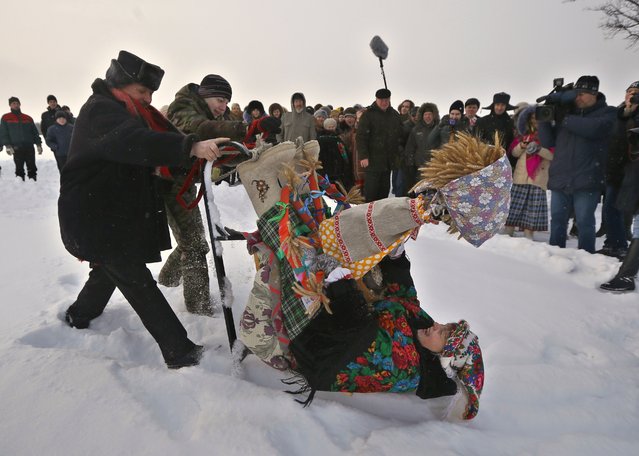
Belarusians wearing national costumes celebrate a Pull the Kolyada Up the Oak rite in the village of Martsiyanauka, some 77 km (48 miles) east of capital Minsk, Belarus, Thursday, January 21, 2016. (Photo by Sergei Grits/AP Photo)

Belarusians wearing national costumes celebrate a Pull the Kolyada Up the Oak rite in the village of Martsiyanauka, some 77 km (48 miles) east of capital Minsk, Belarus, Thursday, January 21, 2016. The merry ancient rite Pull the Kolyada Up the Oak marks the end of Orthodox Christmas celebrations in Belarus. On Jan. 21 a wheel, the so-called Kolyada, would be pulled up an oak or any old tree. The Belarusians believed that the ritual heralds a good harvest, luck and happiness for the entire year. (Photo by Sergei Grits/AP Photo)
Details
22 Jan 2016 10:13:00
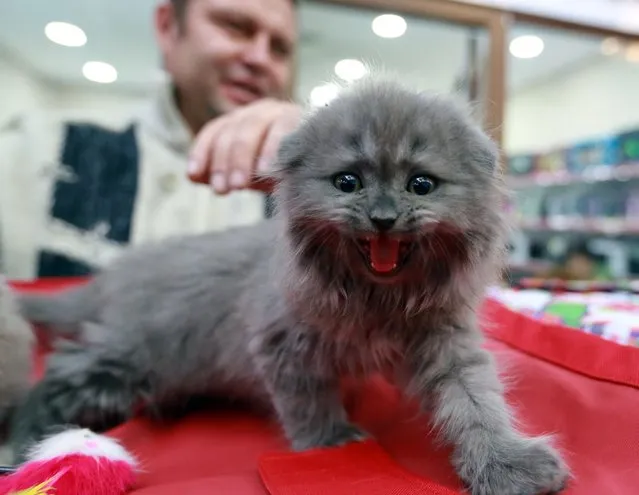
Scottish Fold  cat is displayed during a cat exhibition in Bishkek, Kyrgyzstan, 26 November 2017. (Photo by Igor Kovalenko/EPA/EFE/Rex Features/Shutterstock)

Scottish Fold cat is displayed during a cat exhibition in Bishkek, Kyrgyzstan, 26 November 2017. Cats owners from Kyrgyzstan and Kazakhstan gathered in Bishkek to show their pets. (Photo by Igor Kovalenko/EPA/EFE/Rex Features/Shutterstock)
Details
29 Nov 2017 09:18:00