Loading...
Done
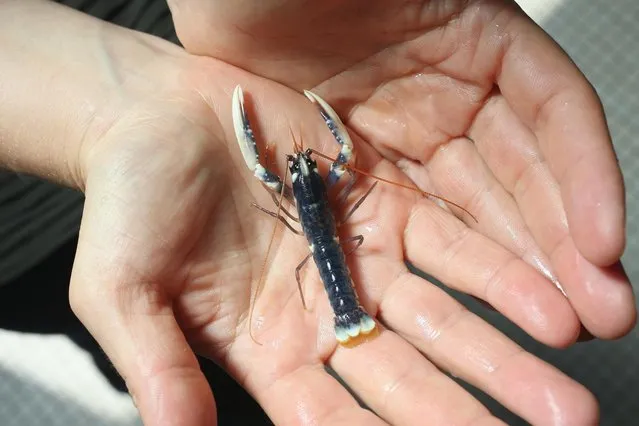
Isabel Schmalenbach, an environmental scientist with the Helgoland Biological Institute (Biologische Anstalt Helgoland), part of the Alfred Wegener Institute for Polar and Marine Research, holds a one-year old baby European lobster (Homarus gammarus) raised at the institute on August 3, 2013 on Helgoland Island, Germany. (Photo by Sean Gallup/Getty Images)

Isabel Schmalenbach, an environmental scientist with the Helgoland Biological Institute (Biologische Anstalt Helgoland), part of the Alfred Wegener Institute for Polar and Marine Research, holds a one-year old baby European lobster (Homarus gammarus) raised at the institute on August 3, 2013 on Helgoland Island, Germany. Later in the day Schmalenbach and her colleagues released a total of 415 one-year old lobsters into the North Sea as part of an effort to repopulate the lobster population around Helgoland (also called Heligoland). In the 19th century local fishermen caught up to 80,000 lobsters a year in the surrounding waters, combined with the heavy allied bombing of the island during and after World War II, as well as other environmental factors, decimated the lobster population. (Photo by Sean Gallup)
Details
05 Aug 2013 08:39:00
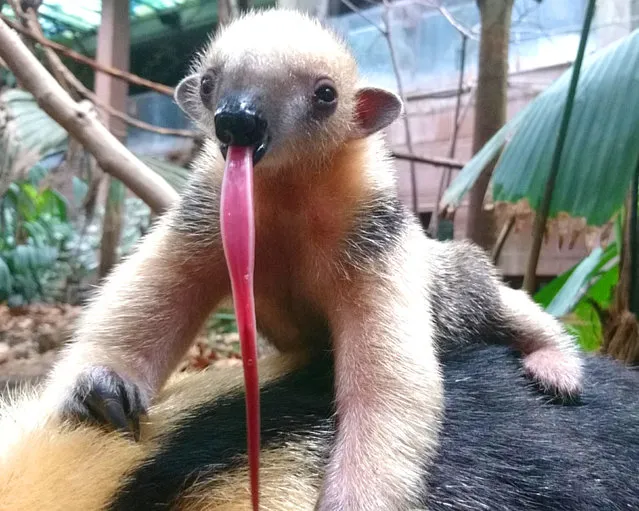
A baby tamandua, or anteater, named Poco sticks out its tongue on May 31, 2018. ZSL London Zoo is celebrating the creature’s surprise birth after they found a male to be the companion of its mother Ria last October. (Photo by ZSL London Zoo/PA Wire)

A baby tamandua, or anteater, named Poco sticks out its tongue on May 31, 2018. ZSL London Zoo is celebrating the creature’s surprise birth after they found a male to be the companion of its mother Ria last October. (Photo by ZSL London Zoo/PA Wire)
Details
03 Jun 2018 00:03:00
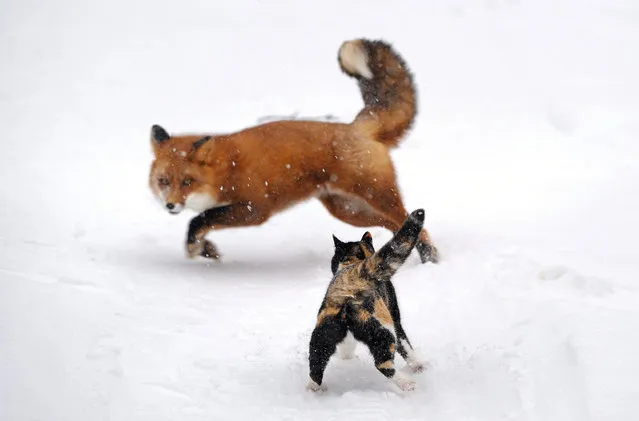
Respect, Kronotsky nature reserve, Russia. The photographer’s cat, Ryska – her name means little lynx in Russian – stands outside their cabin and with aggressive posturing warns off a fox. In winter, foxes would regularly visit the cabin searching for food. If one peered in at the window, possible when the snow was deep, Ryska would sit on the other side, fur raised, and growl. When outside, she would hold her ground. The foxes were not always frightened and so encounters could be a sort of dance. (Photo by Igor Shpilenok/Unforgettable Behaviour/NHM)

Respect, Kronotsky nature reserve, Russia. The photographer’s cat, Ryska – her name means little lynx in Russian – stands outside their cabin and with aggressive posturing warns off a fox. In winter, foxes would regularly visit the cabin searching for food. If one peered in at the window, possible when the snow was deep, Ryska would sit on the other side, fur raised, and growl. When outside, she would hold her ground. The foxes were not always frightened and so encounters could be a sort of dance. (Photo by Igor Shpilenok/Unforgettable Behaviour/NHM)
Details
08 Apr 2017 09:14:00
Dog puppy “Sandy” protects against the rain with an umbrella fixed on her leash during a stroll in Rust, southern Germany, on May 26, 2013. (Photo by Patrick Seeger/AFP Photo)

Dog puppy “Sandy” protects against the rain with an umbrella fixed on her leash during a stroll in Rust, southern Germany, on May 26, 2013. (Photo by Patrick Seeger/AFP Photo)
Details
02 Jun 2013 07:43:00
A Balinese Hindu blows fire, during a parade carrying Ogoh-ogoh effigies symbolising evil spirits, during a ritual before Nyepi, the day of silence, in Palembang, South Sumatra province, Indonesia March 8, 2016. Nyepi is a day of silence for self-reflection celebrating the Balinese Hindu new year, where people may not use lights, light fires, work, travel nor enjoy entertainment. (Photo by Darren Whiteside/Reuters)

A Balinese Hindu blows fire, during a parade carrying Ogoh-ogoh effigies symbolising evil spirits, during a ritual before Nyepi, the day of silence, in Palembang, South Sumatra province, Indonesia March 8, 2016. Nyepi is a day of silence for self-reflection celebrating the Balinese Hindu new year, where people may not use lights, light fires, work, travel nor enjoy entertainment. (Photo by Darren Whiteside/Reuters)
Details
09 Mar 2016 13:49:00
PETA (People for the Ethical Treatment of Animals) activists wear crocodile masks during a demonstration against the use of crocodile skins ahead of Milan's Fashion Week, in Milan's Duomo Square, Italy, Tuesday, February 21, 2017. Milan Fashion Week opens Wednesday. (Photo by Antonio Calanni/AP Photo)

PETA (People for the Ethical Treatment of Animals) activists wear crocodile masks during a demonstration against the use of crocodile skins ahead of Milan's Fashion Week, in Milan's Duomo Square, Italy, Tuesday, February 21, 2017. Milan Fashion Week opens Wednesday. (Photo by Antonio Calanni/AP Photo)
Details
22 Feb 2017 10:41:00
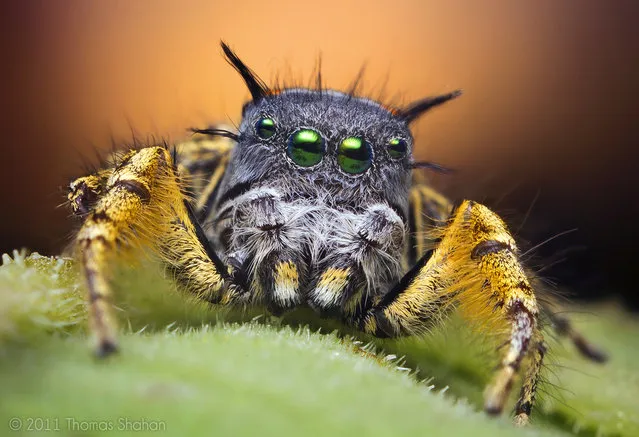
Adult Male Jumping Spider at Sunset – Phidippus mystaceus

“Hey! I'm Thomas Shahan, an artist and macrophotographer from Oklahoma. In my spare time over the past few years, I've been shooting portraiture of local arthropods. Why would I devote countless hours to tramping through forests, fields and the like searching for insects and spiders? Well, despite some common beliefs, arthropods (members of the phylum Arthropoda – insects, spiders, crustaceans...) represent an endlessly varied, wildly beautiful and fascinating bunch of animals with surprisingly personable faces and behavior. Often, all it takes is simply inspecting their lives on a closer level to turn repulsion to reverence”. – Thomas Shahan

Photo: Adult Male Jumping Spider at Sunset – Phidippus mystaceus. (Photo by Thomas Shahan; Source: Flickr)
Details
23 Apr 2012 14:07:00
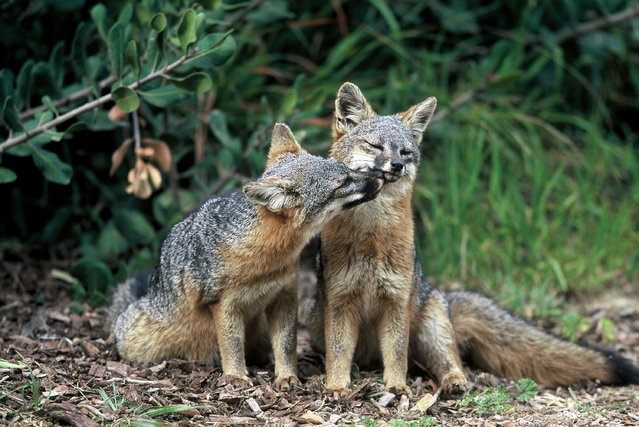
This undated photo provided by the U.S. Fish and Wildlife Service shows two island foxes in Channel Islands National Park, Calif. Three fox subspecies native to California's Channel Islands were removed from the list of endangered species Thursday, August 11, 2016, in what federal officials have called the fastest recovery of any mammal listed under the Endangered Species Act. (Photo by Chuck Graham/U.S. Fish and Wildlife Service via AP Photo)

This undated photo provided by the U.S. Fish and Wildlife Service shows two island foxes in Channel Islands National Park, Calif. Three fox subspecies native to California's Channel Islands were removed from the list of endangered species Thursday, August 11, 2016, in what federal officials have called the fastest recovery of any mammal listed under the Endangered Species Act. (Photo by Chuck Graham/U.S. Fish and Wildlife Service via AP Photo)
Details
12 Aug 2016 12:04:00