Loading...
Done
A General Atomics MQ-9 Reaper stands on the runway during “Black Dart”, a live-fly, live fire demonstration of 55 unmanned aerial vehicles, or drones, at Naval Base Ventura County Sea Range, Point Mugu, near Oxnard, California July 31, 2015. (Photo by Patrick T. Fallon/Reuters)

A General Atomics MQ-9 Reaper stands on the runway during “Black Dart”, a live-fly, live fire demonstration of 55 unmanned aerial vehicles, or drones, at Naval Base Ventura County Sea Range, Point Mugu, near Oxnard, California July 31, 2015. (Photo by Patrick T. Fallon/Reuters)
Details
02 Aug 2015 13:02:00
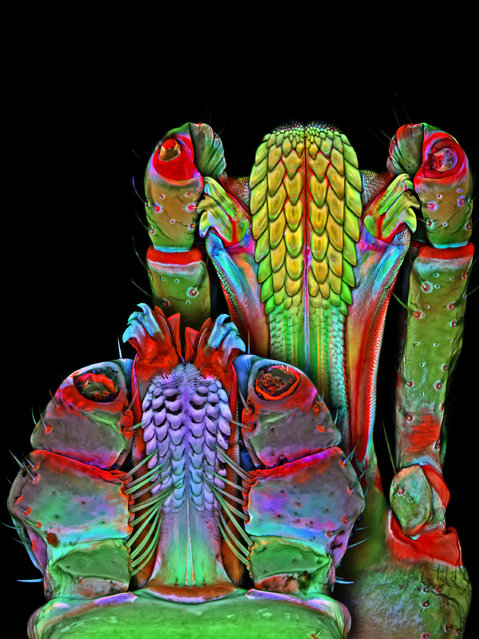
Underside of the Brown dog tick and Lonestar tick mouthparts; Confocal, 100X. Janelia Farm Research Campus, Howard Hughes Medical Institute (HHMI), Ashburn, Virginia, USA. (Photo by Dr. Igor Robert Siwanowicz/Nikon Small World 2014)

Now celebrating its 40th year, Nikon Small World is widely regarded as the leading forum to recognize proficiency and photographic excellence of photography taken under the microscope. To select the winners, competition judges analyzed entries from all over the world covering subjects ranging from chemical compounds to up-close-and-personal looks at biological specimens. The 2014 winners will be revealed on October 30th. In 2014, the competition received over 1,200 entries from more than 79 countries around the world. (Photo by Dr. Igor Robert Siwanowicz/Nikon Small World 2014)
Details
17 Oct 2014 13:10:00
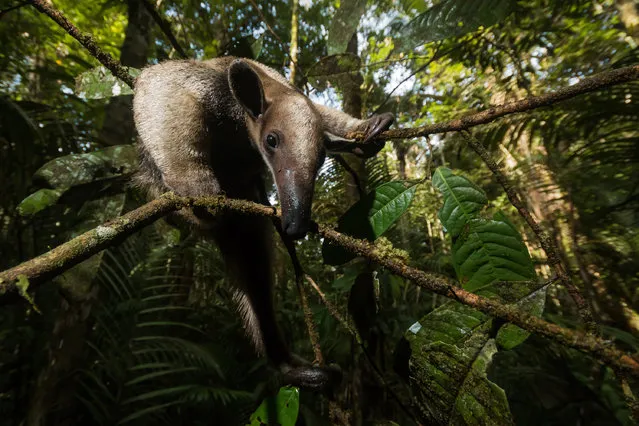
Individuals and populations student winner. Limbing in the Tropics, photographed in Manaus, Brazil. While walking in the Amazon rainforest looking for bat roosts to set up mist nets to capture bats for scientific research, a faint and almost imperceptible noise suddenly caught this photographer’s attention. An anteater was climbing with exceptional ability in a tangled mess of branches and lianas. With an unbelievable calmness, the animal watched the photographer at work and seemed to enjoy being the subject of an impromptu photography session in the most biodiverse ecosystem on Earth. (Photo by Adrià López Baucells/University of Lisbon/British Ecological Society)

Individuals and populations student winner. Limbing in the Tropics, photographed in Manaus, Brazil. While walking in the Amazon rainforest looking for bat roosts to set up mist nets to capture bats for scientific research, a faint and almost imperceptible noise suddenly caught this photographer’s attention. An anteater was climbing with exceptional ability in a tangled mess of branches and lianas. (Photo by Adrià López Baucells/University of Lisbon/British Ecological Society)
Details
05 Dec 2018 00:03:00
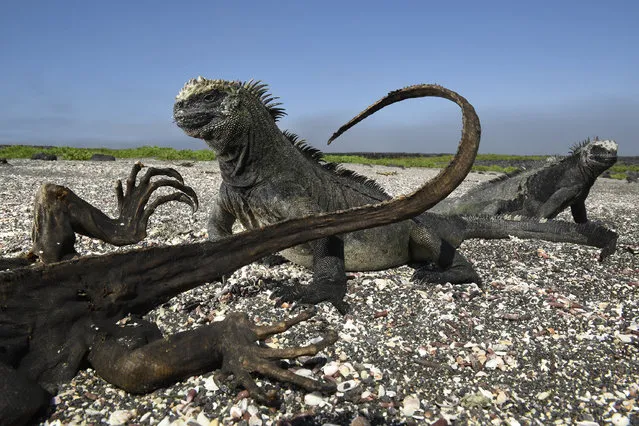
Galapagos – Rocking the Cradle: Four major ocean currents converge along the Galapagos archipelago, creating the conditions for an extraordinary diversity of animal life, April 25, 2016. The islands are home to at least 7,000 flora and fauna species, of which 97 percent of the reptiles, 80 percent of the land birds, 50 percent of the insects and 30 percent of the plants are endemic. The local ecosystem is highly sensitive to the changes in temperature, rainfall and ocean currents that characterize the climatic events known as El Niño and La Niña. These changes cause marked fluctuations in weather and food availability. Many scientists expect the frequency of El Niño and La Niña to increase as a result of climate change, making the Galapagos a possible early-warning location for its effects. (Photo by Thomas P. Peschak for National Geographic/World Press Photo)

Galapagos – Rocking the Cradle: Four major ocean currents converge along the Galapagos archipelago, creating the conditions for an extraordinary diversity of animal life, April 25, 2016. The islands are home to at least 7,000 flora and fauna species, of which 97 percent of the reptiles, 80 percent of the land birds, 50 percent of the insects and 30 percent of the plants are endemic. (Photo by Thomas P. Peschak for National Geographic/World Press Photo)
Details
16 Apr 2018 00:01:00
A Vietnamese woman, wearing the traditional “ao dai” long dress, poses for photos along peach blossom flowers ahead of the Vietnamese “Tet” (Lunar New Year festival), in a field in Hanoi, Vietnam, February 2, 2016. (Photo by Reuters/Kham)

A Vietnamese woman, wearing the traditional “ao dai” long dress, poses for photos along peach blossom flowers ahead of the Vietnamese “Tet” (Lunar New Year festival), in a field in Hanoi, Vietnam, February 2, 2016. (Photo by Reuters/Kham)
Details
03 Feb 2016 13:43:00
Revelers throw a woman to the air during the opening and the firing of the “Chupinazo” rocket which starts the 2014 Festival of the San Fermin Running of the Bulls on July 6, 2014 in Pamplona, Spain. The annual Fiesta de San Fermin, made famous by the 1926 novel of US writer Ernest Hemmingway entitled “The Sun Also Rises”, involves the daily running of the bulls through the historic heart of Pamplona to the bull ring. (Photo by Pablo Blazquez Dominguez/Getty Images)

Revelers throw a woman to the air during the opening and the firing of the “Chupinazo” rocket which starts the 2014 Festival of the San Fermin Running of the Bulls on July 6, 2014 in Pamplona, Spain. The annual Fiesta de San Fermin, made famous by the 1926 novel of US writer Ernest Hemmingway entitled “The Sun Also Rises”, involves the daily running of the bulls through the historic heart of Pamplona to the bull ring. (Photo by Pablo Blazquez Dominguez/Getty Images)
Details
12 Jul 2014 16:00:00
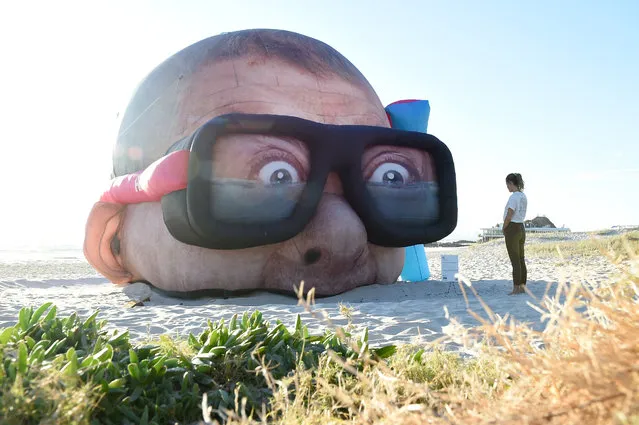
Sculpture by Danger Dave titled “Damien Hirst Looking for Sharks” is seen on September 13, 2021 in Currumbin, Australia. SWELL Sculpture Festival is an annual exhibition that features 65 large-scale sculptures installed along Currumbin Beach on the Gold Coast in Queensland. (Photo by Matt Roberts/Getty Images)

Sculpture by Danger Dave titled “Damien Hirst Looking for Sharks” is seen on September 13, 2021 in Currumbin, Australia. SWELL Sculpture Festival is an annual exhibition that features 65 large-scale sculptures installed along Currumbin Beach on the Gold Coast in Queensland. (Photo by Matt Roberts/Getty Images)
Details
18 Sep 2021 08:07:00
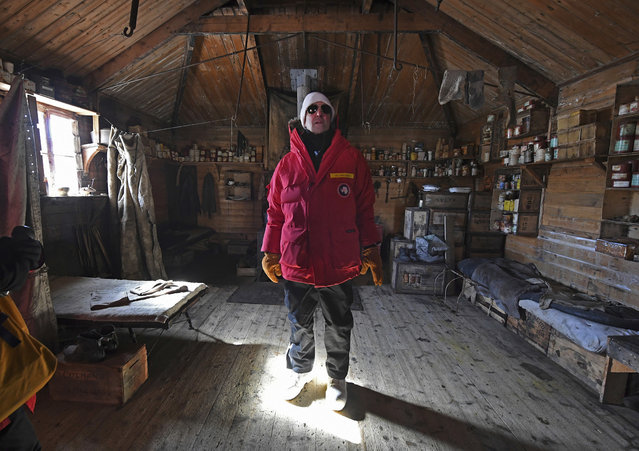
U.S. Secretary of State John Kerry stands inside the historic Shackleton hut near McMurdo Station, Antarctica, Friday, November 11, 2016. Kerry became the highest-ranking American official to visit Antarctica when he landed for a two-day trip on Friday. He's been hearing from scientists about the impact of climate change on the frozen continent. Kerry's aides described the trip as a learning opportunity for the secretary of state. He has been receiving briefings from scientists working to understand the effects of climate change on Antarctica. Kerry has made climate change an intensive focus of American diplomacy during his term, and had previously spent decades working on the issue as a U.S. senator. Trump has called climate change a hoax and said he would “cancel” U.S. involvement in the landmark Paris Agreement on global warming. (Photo by Mark Ralston/Pool Photo via AP Photo)

U.S. Secretary of State John Kerry stands inside the historic Shackleton hut near McMurdo Station, Antarctica, Friday, November 11, 2016. Kerry became the highest-ranking American official to visit Antarctica when he landed for a two-day trip on Friday. He's been hearing from scientists about the impact of climate change on the frozen continent. Kerry's aides described the trip as a learning opportunity for the secretary of state. He has been receiving briefings from scientists working to understand the effects of climate change on Antarctica. Kerry has made climate change an intensive focus of American diplomacy during his term, and had previously spent decades working on the issue as a U.S. senator. Trump has called climate change a hoax and said he would “cancel” U.S. involvement in the landmark Paris Agreement on global warming. (Photo by Mark Ralston/Pool Photo via AP Photo)
Details
12 Nov 2016 10:09:00