Loading...
Done
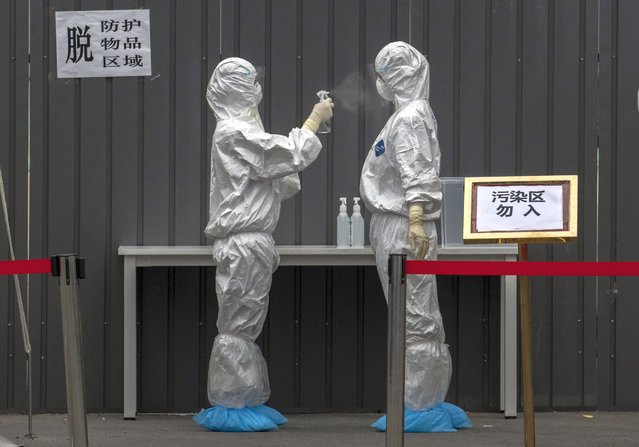
Chinese epidemic control workers wear protective suits as they disinfect each other after performing nucleic acid swab test for COVID-19 on citizens at a government testing site in Xicheng District during an organized tour on June 24, 2020 in Beijing, China. While Chinese government medical officials have said they believe they have controlled the spread, authorities are trying to contain the outbreak linked to the Xinfadi wholesale food market, Beijing's biggest supplier of produce and meat. More than 2.5 million people have undergone nucleic acid tests for COVID-19 at dozens of sites across the city in recent days, with officials using contact tracing to target high and middle risk areas and people who may have had contact with the market or food that came from there. Several neighborhoods have been locked down and a number of other food markets have been closed, The outbreak has triggered fears of a second wave of infection after 56 straight days with no domestically transmitted cases in the capital. (Photo by Kevin Frayer/Getty Images)

Chinese epidemic control workers wear protective suits as they disinfect each other after performing nucleic acid swab test for COVID-19 on citizens at a government testing site in Xicheng District during an organized tour on June 24, 2020 in Beijing, China. While Chinese government medical officials have said they believe they have controlled the spread, authorities are trying to contain the outbreak linked to the Xinfadi wholesale food market, Beijing's biggest supplier of produce and meat. (Photo by Kevin Frayer/Getty Images)
Details
26 Jun 2020 00:01:00
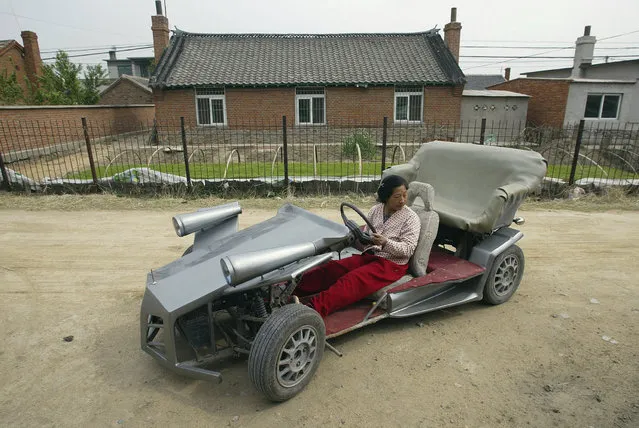
Zhang Jinduo's wife tries on a self-made racing car on the outskirts of Shenyang, Liaoning province May 10, 2008. Zhang, the 53-year-old local farmer made the racing car with the help of his son who is a car mechanic. The car is equipped with a rear-mounted motorcycle engine and can achieve 60-80 km per hour, according to local media. (Photo by Reuters/Stringer)

Zhang Jinduo's wife tries on a self-made racing car on the outskirts of Shenyang, Liaoning province May 10, 2008. Zhang, the 53-year-old local farmer made the racing car with the help of his son who is a car mechanic. The car is equipped with a rear-mounted motorcycle engine and can achieve 60-80 km per hour, according to local media. (Photo by Reuters/Stringer)
Details
17 Sep 2013 08:46:00
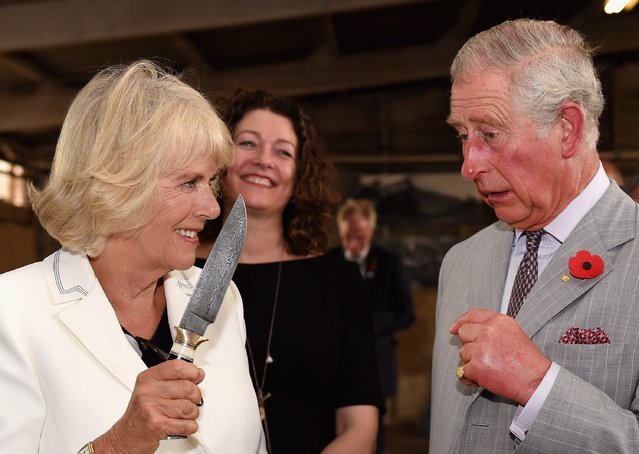
Prince Charles, Prince of Wales (R) and Camilla, Duchess of Cornwall (L) visit Seppeltsfield Winery in Barossa Valley, Australia, 10 November 2015. The royal couple are on a 12-day tour visiting seven regions in New Zealand and three states and one territory in Australia. (Photo by Daniel Kalisz/EPA)

Prince Charles, Prince of Wales (R) and Camilla, Duchess of Cornwall (L) visit Seppeltsfield Winery in Barossa Valley, Australia, 10 November 2015. The royal couple are on a 12-day tour visiting seven regions in New Zealand and three states and one territory in Australia. (Photo by Daniel Kalisz/EPA)
Details
12 Nov 2015 08:07:00
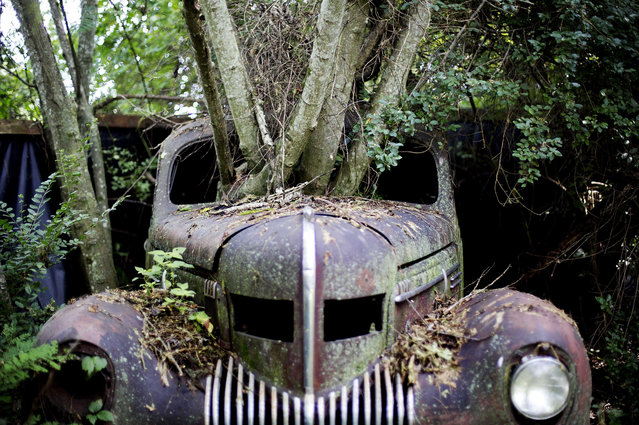
Trees grow through the windshield of a 1937 Chrysler Imperial as it sits at Old Car City, the world's largest known classic car junkyard Thursday, July 16, 2015, in White, Ga. Many of the cars have never moved in over 30 years and in some cases, trees now grow through them, even lifting some off the ground. (Photo by David Goldman/AP Photo)

Trees grow through the windshield of a 1937 Chrysler Imperial as it sits at Old Car City, the world's largest known classic car junkyard Thursday, July 16, 2015, in White, Ga. Over 4,000 classic cars decorate 32 acres of forest which have been turned into a junkyard museum by owner Walter Dean Lewis. The two grew up playing in the cars on the lot which started as a general store selling auto parts in 1931 by Lewis' parents. Lewis stopped selling parts about six years ago when he realized he could sustain the business more as a museum, charging $15 for visitors just looking, and $25 for photographers. Many of the cars have never moved in over 30 years and in some cases, trees now grow through them, even lifting some off the ground. (Photo by David Goldman/AP Photo)
Details
17 Jul 2015 13:14:00
Carriers of the Great God Power brotherhood unload Virgen del Carmen statue after its journey on July 15, 2014 at Puerto de la Cruz dock on the Canary island of Tenerife, Spain. Since 1921, the statue of the Virgen del Carmen, patron saint of fishermen, has been carried with great fanfare annually as part of July Festivities to the Puerto de la Cruz dock where, at the end of its procession, it is hoisted aboard a decorated boat. (Photo by Gonzalo Arroyo Moreno/Getty Images)

Carriers of the Great God Power brotherhood unload Virgen del Carmen statue after its journey on July 15, 2014 at Puerto de la Cruz dock on the Canary island of Tenerife, Spain. Since 1921, the statue of the Virgen del Carmen, patron saint of fishermen, has been carried with great fanfare annually as part of July Festivities to the Puerto de la Cruz dock where, at the end of its procession, it is hoisted aboard a decorated boat. Weather permitting, the boat carrying the statue, accompanied by a flotilla of other boats, makes a short journey along the island coast before returning to the harbour. In recent years, attendance at the event has numbered more than 35,000 people. (Photo by Gonzalo Arroyo Moreno/Getty Images)
Details
21 Jul 2014 11:18:00
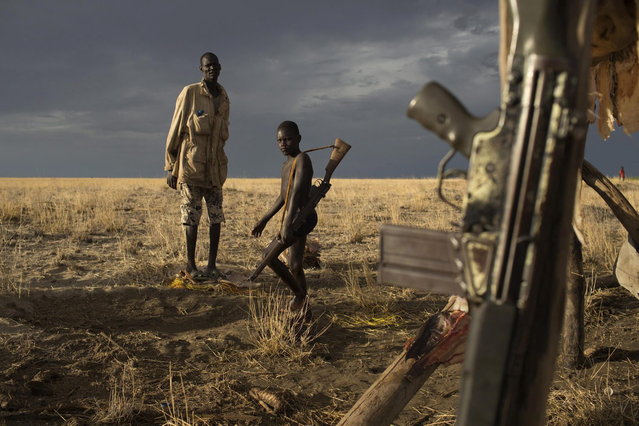
A Turkana man and a boy carrying a gun look on as a G3 battle rifle hangs from a structure used to dry fish at a fishing camp on the shores of Lake Turkana, some kilometres from Todonyang near the Kenya-Ethiopia border in northwestern Kenya October 12, 2013. (Photo by Siegfried Modola/Reuters)

A Turkana man and a boy carrying a gun look on as a G3 battle rifle hangs from a structure used to dry fish at a fishing camp on the shores of Lake Turkana, some kilometres from Todonyang near the Kenya-Ethiopia border in northwestern Kenya October 12, 2013The Turkana are traditionally nomadic pastoralists, but they have seen the pasture that they need to feed their herds suffer from recurring droughts and many have turned to fishing. However, Lake Turkana is overfished, and scarcity of food and pastureland is fuelling long-standing conflict with Ethiopian indigenous Dhaasanac, who have seen grazing grounds squeezed by large-scale government agricultural schemes in southern Ethiopia. The Dhaasanac now venture ever deeper into Kenyan territory in search of fish and grass, clashing with neighbours. Fighting between the communities has a long history, but the conflict has become ever more fatal as automatic weapons from other regional conflicts seep into the area. While the Turkana region is short of basics like grass and ground-water, it contains other resources including oil reserves and massive, newly discovered underground aquifers. (Photo by Siegfried Modola/Reuters)
Details
05 Dec 2013 12:08:00
Ocean voyage

Do you think that history is a science? Well, not exactly. First, and foremost, history is the state's “legend of wars”, it’s official regalia. Of course, public historians are not interested in scientific truth – quite the opposite. In this respect, any attempt to present a state’s history as altruistic and benevolent as possible is welcomed and encouraged – as opposed to any revisionism attempts that may be more accurate. In this matter, Chinese have surpassed us all – they revised in highly creative manner (but rather shamelessly) the technology already invented by Europeans, a process that resulted in oldest state on the planet. Here is an interesting paradox: ask any sinologist about the Middle Kingdom during second century B.C., and he will describe it to you in such a vivid manner as if he has been living there all his life – but as soon as you will ask him to describe Chinese history in the 19-20th centuries… let's say, his eagerness will be greatly diminished. However, we will discuss China in a different article, and in the meantime we will try to understand how exactly historic “legend of wars” is formed and functions – based on a specific and well-known example. A great example is Ferdinand Magellan's first voyage around the world.
Details
14 Nov 2011 09:11:00
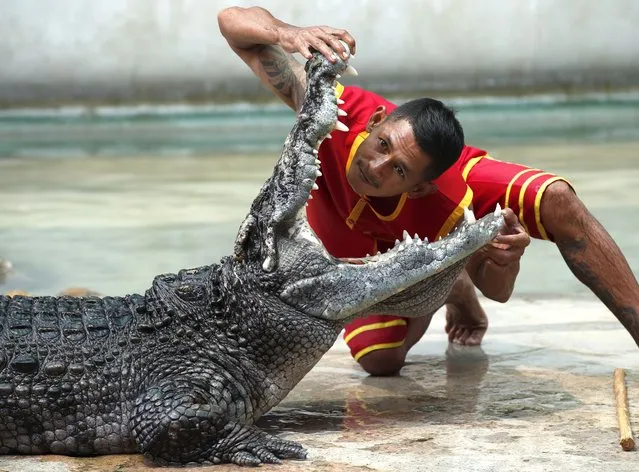
A Thai performer puts his head inside a crocodile's mouth during a media preview performance as part of preparation to reopen Samutprakarn Crocodile Farm and Zoo in Samut Prakan province, Thailand, 19 March 2024. Thailand's famous tourist attraction Samutprakan Crocodile Farm and Zoo is scheduled to reopen to welcome tourists on 01 April 2024 after a temporary closure in 2020 due to the loss of visitors caused by the COVID-19 pandemic which resulted in the zoo suffering financial loss and going into liquidation. The Samutprakan Crocodile Farm and Zoo established in 1950 claims to be Thailand's first and the world's largest crocodile farm with more than 60,000 freshwater and marine crocodiles offering crocodile shows to attract tourists as well as housing various other animal showcases including tigers, chimpanzees, elephants. (Photo by Rungroj Yongrit/EPA)

A Thai performer puts his head inside a crocodile's mouth during a media preview performance as part of preparation to reopen Samutprakarn Crocodile Farm and Zoo in Samut Prakan province, Thailand, 19 March 2024. (Photo by Rungroj Yongrit/EPA)
Details
06 Apr 2024 04:17:00