Loading...
Done
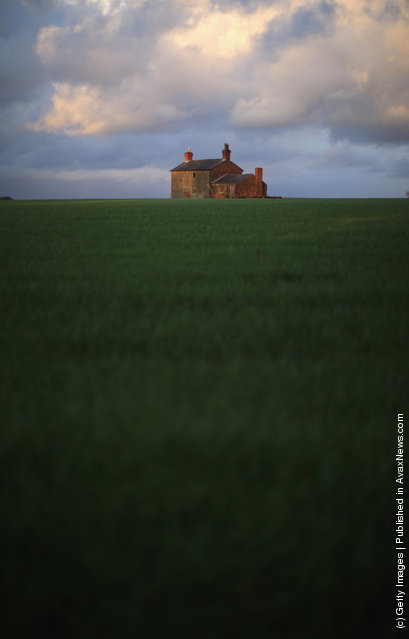
A derelict farm house adorns the horizon as it sits in a field in the Lancashire Countryside

A derelict farm house adorns the horizon as it sits in a field in the Lancashire Countryside on January 26, 2012 in Burscough, England. (Photo by Christopher Furlong/Getty Images)
Details
27 Jan 2012 11:55:00
Disguised revellers parade on the occasion of the Cortege during the Carnival in Basel, Switzerland, February 17, 2016. (Photo by Georgios Kefalas/EPA)

Disguised revellers parade on the occasion of the Cortege during the Carnival in Basel, Switzerland, February 17, 2016. (Photo by Georgios Kefalas/EPA)
Details
18 Feb 2016 13:53:00
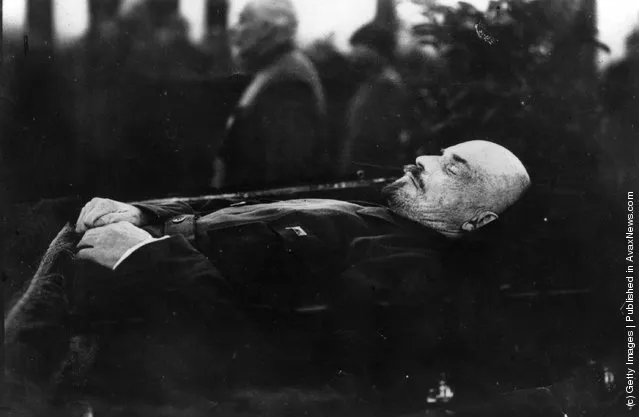
1924:  Vladimir Ilyich Lenin lying in state in the Kremlin

Photo: Vladimir Ilyich Lenin (1870 – 1924) lying in state in the Kremlin. (Photo by Hulton Archive/Getty Images). 1924

Important! For the same article in Russian language click here.

Something quite intriguing is happening within Russian-speaking internet during the last few – should you type a fully academic inquiry (at least, according to Russian academic requirements) in national search engines for "Lenin's mausoleum" – the first thing you get (even in top 10 searches) is website pages talking about black magic and occult. Website authors view this construction differently, but unconditionally agree on one thing: the mausoleum of the "leader of the world proletariat” – the essence of a magical artifact, a sort of “energy vampire”. It was built with a certain purpose: to drain the energy out of miserable Soviet citizens on one hand; and to poison the anthroposphere of one-sixth part of the earth with its vibes (the exact territory that was occupied by the former Soviet Union), depriving the Russian people of will to resist on the other hand. Complete nonsense? No doubt. Nevertheless, an intriguing one. Well, probably because some oddities do exist in mausoleum's history. These oddities are the thing we are going to discuss this time. First, let me refresh you memory on the subject.
Details
16 Oct 2011 11:27:00
Promotional models use their smartphones during their break at the Global Mobile Internet Conference in Beijing May 6, 2014. Mobile Internet industry executives, developers and investors from more than 30 countries took part in the Global Mobile Internet Conference in Beijing, the organiser said. (Photo by Kim Kyung-Hoon/Reuters)

Promotional models use their smartphones during their break at the Global Mobile Internet Conference in Beijing May 6, 2014. Mobile Internet industry executives, developers and investors from more than 30 countries took part in the Global Mobile Internet Conference in Beijing, the organiser said. (Photo by Kim Kyung-Hoon/Reuters)
Details
10 May 2014 14:12:00
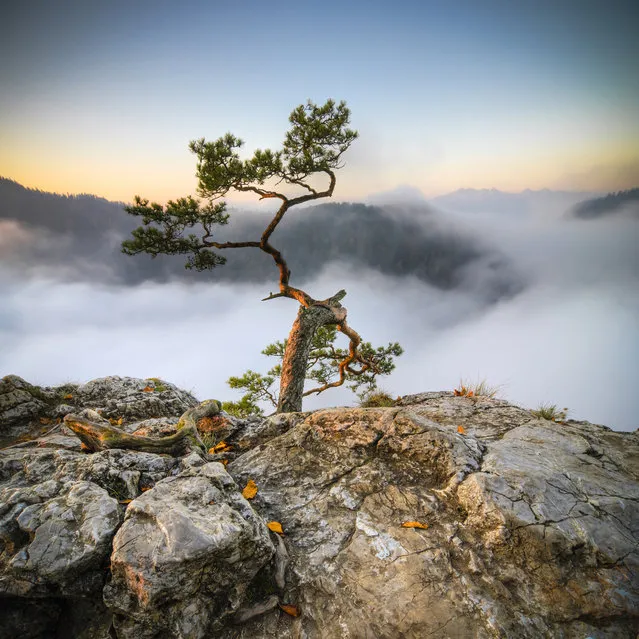
“Sokolica”. Sokolica, Poland. (Photo and caption by Marcin Kęsek/National Geographic Traveler Photo Contest)

“Sokolica”. Sokolica, Poland. (Photo and caption by Marcin Kęsek/National Geographic Traveler Photo Contest)

ATTENTION! All pictures are presented in high resolution. To see Hi-Res images – just TWICE click on any picture. In other words, click small picture – opens the BIG picture. Click BIG picture – opens VERY BIG picture.
Details
25 Jun 2013 09:13:00
Galapagos – Rocking the Cradle: Four major ocean currents converge along the Galapagos archipelago, creating the conditions for an extraordinary diversity of animal life, April 25, 2016. The islands are home to at least 7,000 flora and fauna species, of which 97 percent of the reptiles, 80 percent of the land birds, 50 percent of the insects and 30 percent of the plants are endemic. The local ecosystem is highly sensitive to the changes in temperature, rainfall and ocean currents that characterize the climatic events known as El Niño and La Niña. These changes cause marked fluctuations in weather and food availability. Many scientists expect the frequency of El Niño and La Niña to increase as a result of climate change, making the Galapagos a possible early-warning location for its effects. (Photo by Thomas P. Peschak for National Geographic/World Press Photo)

Galapagos – Rocking the Cradle: Four major ocean currents converge along the Galapagos archipelago, creating the conditions for an extraordinary diversity of animal life, April 25, 2016. The islands are home to at least 7,000 flora and fauna species, of which 97 percent of the reptiles, 80 percent of the land birds, 50 percent of the insects and 30 percent of the plants are endemic. (Photo by Thomas P. Peschak for National Geographic/World Press Photo)
Details
16 Apr 2018 00:01:00
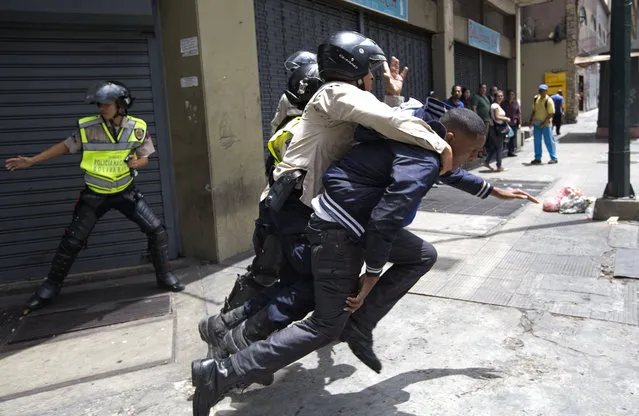
A National Bolivarian Police officer rescues a man who was being attacked by protesters, who then threw rocks at them, during a protest demanding food a few blocks from Miraflores presidential palace in Caracas, Venezuela, Thursday, June 2, 2016. (Photo by Fernando Llano/AP Photo)

A National Bolivarian Police officer rescues a man who was being attacked by protesters, who then threw rocks at them, during a protest demanding food a few blocks from Miraflores presidential palace in Caracas, Venezuela, Thursday, June 2, 2016. Venezuela is seeing rising frustration with widespread food shortages and triple-digit inflation. (Photo by Fernando Llano/AP Photo)
Details
03 Jun 2016 13:01:00
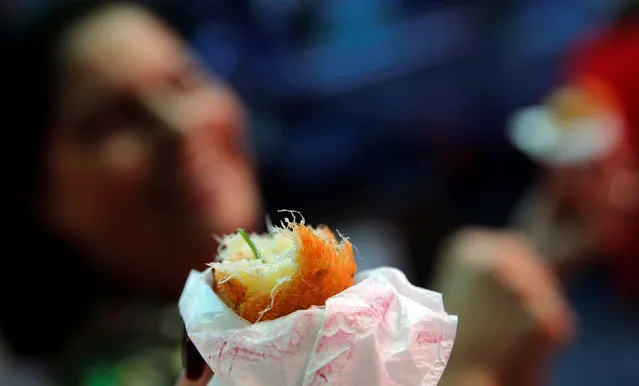
A view of traditional bolinhos de bacalhau (fried codfish balls) in Rio de Janeiro, Brazil, May 7, 2016. (Photo by Sergio Moraes/Reuters)

If the most popular foods of Rio de Janeiro have one thing in common, it is their informality. You can find fine restaurants in the city, but they do not set Rio apart from other places. What does set it apart, and what invariably brings its residents, known as "Cariocas," together is the unpretentious food they eat in bright, loud, crowded bars and restaurants, on busy street corners, or after a day at the beach. Here: A view of traditional bolinhos de bacalhau (fried codfish balls) in Rio de Janeiro, Brazil, May 7, 2016. (Photo by Sergio Moraes/Reuters)

Details
05 Aug 2016 13:20:00