Loading...
Done
Mount Lewotobi Laki-Laki erupts as seen from Pululera village in East Flores, in Nobo on May 19, 2025. A volcano in eastern Indonesia erupted on May 19, spewing an ash cloud more than a kilometre high after authorities raised the country's highest alert level. (Photo by Arnold Welianto/AFP Photo)

Mount Lewotobi Laki-Laki erupts as seen from Pululera village in East Flores, in Nobo on May 19, 2025. A volcano in eastern Indonesia erupted on May 19, spewing an ash cloud more than a kilometre high after authorities raised the country's highest alert level. (Photo by Arnold Welianto/AFP Photo)
Details
28 Jul 2025 02:53:00
The stunning coastline of South Wales in UK on July 12, 2025 was once again turned into a wild and wonderful natural playground as Love Trails Festival powered by Garmin welcomed around 5,000 people to the Gower Peninsula for a long weekend of music, trail running, adventure, movement and community. (Photo by Giulia Spadafora)

The stunning coastline of South Wales in UK on July 12, 2025 was once again turned into a wild and wonderful natural playground as Love Trails Festival powered by Garmin welcomed around 5,000 people to the Gower Peninsula for a long weekend of music, trail running, adventure, movement and community. (Photo by Giulia Spadafora)
Details
31 Jul 2025 03:05:00
Civilians, who fled the violence in Manbij city, arrive to the southeastern rural area of Manbij, in Aleppo Governorate, Syria June 19, 2016. (Photo by Rodi Said/Reuters)

Civilians, who fled the violence in Manbij city, arrive to the southeastern rural area of Manbij, in Aleppo Governorate, Syria June 19, 2016. (Photo by Rodi Said/Reuters)
Details
20 Jun 2016 12:53:00
Braless festival style of a music fan during the third day of Lollapalooza Brazil Festival at Interlagos Racetrack on March 25, 2018 in Sao Paulo, Brazil. (Photo by Mauricio Santana/Getty Images)

Braless festival style of a music fan during the third day of Lollapalooza Brazil Festival at Interlagos Racetrack on March 25, 2018 in Sao Paulo, Brazil. (Photo by Mauricio Santana/Getty Images)
Details
27 Mar 2018 08:16:00
A boy rides on a snow wagon towed by a robot dressed as a Teddy bear, which only moves forward by moving its legs, during the Ice and snow carnival at Taoranting park in Beijing February 9, 2015. (Photo by Kim Kyung-Hoon/Reuters)

A boy rides on a snow wagon towed by a robot dressed as a Teddy bear, which only moves forward by moving its legs, during the Ice and snow carnival at Taoranting park in Beijing February 9, 2015. (Photo by Kim Kyung-Hoon/Reuters)
Details
10 Feb 2015 11:31:00
Revellers ride during the 54th annual brass band festival in the Serbian village of Guca August 7, 2014. Every year Guca is swamped by thousands of people taking part in the celebration of brass band music. (Photo by Marko Djurica/Reuters)

Revellers ride during the 54th annual brass band festival in the Serbian village of Guca August 7, 2014. Every year Guca is swamped by thousands of people taking part in the celebration of brass band music. (Photo by Marko Djurica/Reuters)
Details
10 Aug 2014 10:48:00
“Red Pepperpion. (Photo by Vanessa Dualib)

“Red Pepperpion. Red Pepperpions are secretive, nocturnal arachilli which can be spotted in kitchens of arid climates all around the world.

Red Pepperpions are equipped with a delicious (and depending on the quantity...deadly!) stinger at the end of its tail. If you happen to get bitten (or if you bite him!) it will produce a burning sensation on your taste nerves.

However, there is no need to worry, since the fact is that his potent stinger is usually only used when hunting or whenever the Pepperpion feels like he might become part of someones meal...

At daylight or when encountering a larger foe, such as a Saucier Chef, they retreat into burrows inside the fridge or hide beneath the oven”. (Photo and comment by Vanessa Dualib)


Details
08 Feb 2013 09:24:00
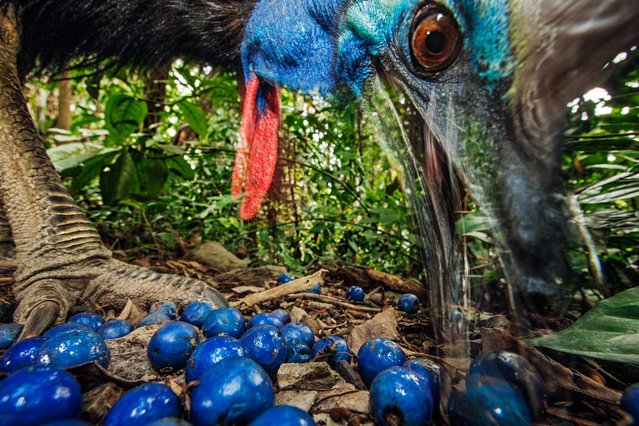
“Cassowaries are large, flightless birds related to emus and (more distantly) to ostriches, rheas, and kiwis”, writes Olivia Judson in the September issue of National Geographic magazine. (Photo by Christian Ziegler/National Geographic)

“Cassowaries are large, flightless birds related to emus and (more distantly) to ostriches, rheas, and kiwis”, writes Olivia Judson in the September issue of National Geographic magazine. How large? People-size: Adult males stand well over five foot five and top 110 pounds. Females are even taller, and can weigh more than 160 pounds. Dangerous when roused, they’re shy and peaceable when left alone. But even birds this big and tough are prey to habitat loss. The dense New Guinea and Australia rain forests where they live have dwindled. Today cassowaries might number 1,500 to 2,000. And because they help shape those same forests – by moving seeds from one place to another – “if they vanish”, Judson writes, “the structure of the forest would gradually change” too. (Photo by Christian Ziegler/National Geographic)

Details
06 Jan 2014 12:21:00