Loading...
Done
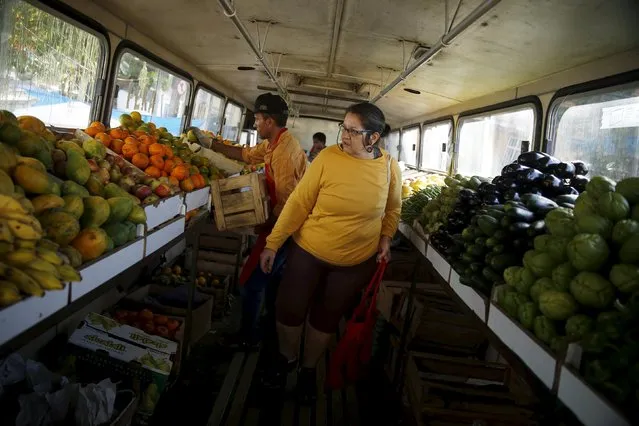
A woman looks for fruits to buy inside a bus called Sacolao in Santa Teresa neighborhood in Rio de Janeiro, Brazil, July 7, 2015. (Photo by Pilar Olivares/Reuters)

A woman looks for fruits to buy inside a bus called Sacolao in Santa Teresa neighborhood in Rio de Janeiro, Brazil, July 7, 2015. The bus, which began operating as a municipal initiative but has been taken over by a private enterprise, arrives every week in some neighborhoods to facilitate families with their grocery shopping and sells food at an affordable price, according to sellers. (Photo by Pilar Olivares/Reuters)
Details
08 Jul 2015 11:52:00
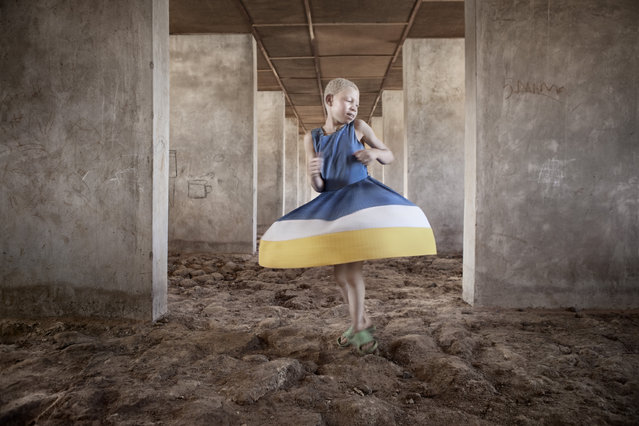
Eleven-year-old Kelen loves to dance in the half-built rooms of the centre in Kabanga Refuge Centre, Tanzania, 2012. (Photo by Ana Palacios/Barcroft Images)

Eleven-year-old Kelen loves to dance in the half-built rooms of the centre in Kabanga Refuge Centre, Tanzania, 2012. The rescue centres protect albino people from the vicious hunters who sell their body parts to witch doctors. Photojournalist Ana Palacios, 43, visited the centre in Tanzania three times between 2012 and 2016 to find out more about the plight of albino people. (Photo by Ana Palacios/Barcroft Images)
Details
01 Oct 2016 11:02:00
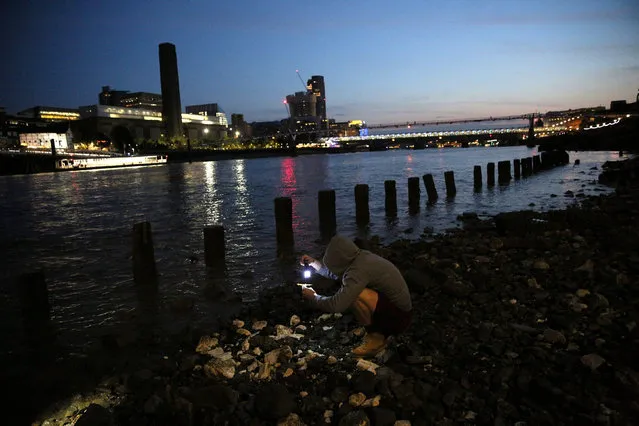
A mudlark uses a torch to look for items on the bank of the River Thames in London, Britain June 06, 2016. Mudlarking is believed to trace its origins to the 18th and 19th century, when scavengers searched the Thames' shores for items to sell. These days, history and archaeology fans are the ones hoping to find old relics such as coins, ceramics, artifacts or everyday items from across centuries. They wait for the low tide and then scour specific areas of exposed shores. "If you're in a field you could be out all day long, with the river you're restricted to about two or three hours," mudlark Nick Stevens said. While many just use the naked eye for their searches, others rely on metal detectors for which a permit from the Port of London Authority is needed. Digging also requires consent. (Photo by Neil Hall/Reuters)

A mudlark uses a torch to look for items on the bank of the River Thames in London, Britain June 06, 2016. Mudlarking is believed to trace its origins to the 18th and 19th century, when scavengers searched the Thames' shores for items to sell. These days, history and archaeology fans are the ones hoping to find old relics such as coins, ceramics, artifacts or everyday items from across centuries. their finds with the Portable Antiquities Scheme. Any item over 300 years old must be recorded. (Photo by Neil Hall/Reuters)
Details
27 Aug 2016 10:43:00
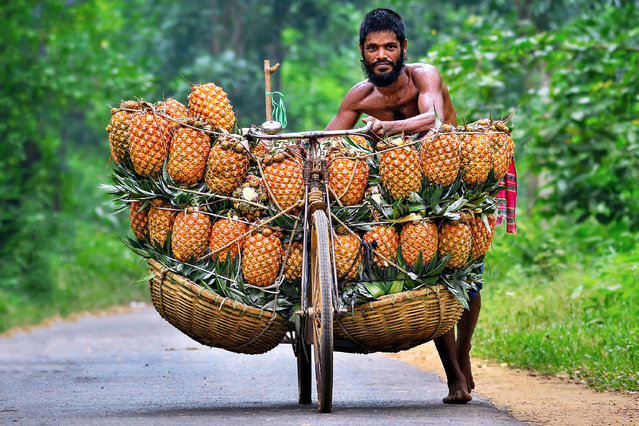
Cyclists desperately try to keep their heavily-laden bicycles upright as they arrive at a market with baskets full of pineapples on August 23, 2018. The men travel up to 12 and a half miles with two baskets tied to the sides of their bikes, carrying between 50 and 100 pineapples to sell. Each of the bicycles is so heavily laden with fruit it is impossible for the men to actually ride their bikes, instead having to walk alongside them. When they arrive at the market place in Madhupur, Bangladesh, buyers will pay up to 30 Taka for a pineapple – the equivalent of around 28 pence. (Photo by Abdul Momin/Solent News & Photo Agency UK)

Cyclists desperately try to keep their heavily-laden bicycles upright as they arrive at a market with baskets full of pineapples on August 23, 2018. The men travel up to 12 and a half miles with two baskets tied to the sides of their bikes, carrying between 50 and 100 pineapples to sell. Each of the bicycles is so heavily laden with fruit it is impossible for the men to actually ride their bikes, instead having to walk alongside them. When they arrive at the market place in Madhupur, Bangladesh, buyers will pay up to 30 Taka for a pineapple – the equivalent of around 28 pence. (Photo by Abdul Momin/Solent News & Photo Agency UK)
Details
21 Sep 2018 00:03:00
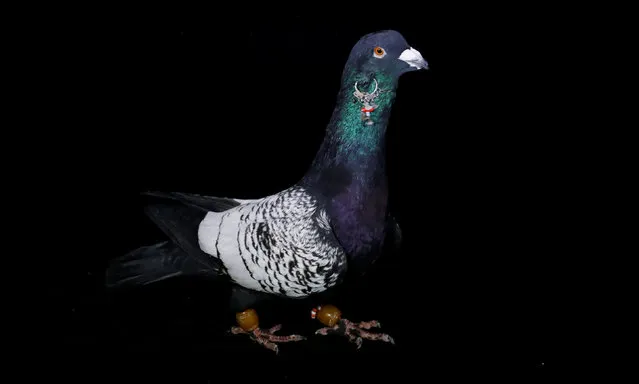
A pigeon, known as Siyah Kinifirli, with an approximate market value of 1000 Turkish Lira ($263), bred by 23-year-old Ismail Ozbek, is pictured in Sanliurfa, Turkey, December 23, 2016. As night-time approaches in Sanliurfa, southeastern Turkey, most of the alleyways of the city's old bazaar are emptying out of buyers and vendors, except for one. The bustle of daytime trading has died down, but on this little street, a stream of men carry cardboard boxes filled with pigeons to a cluster of three teahouses. Here, they sell the birds at Sanliurfa's famed auctions to a dedicated band of pigeon keepers and breeders, a pastime that has been thriving for hundreds of years across the region and over the nearby border into war-torn Syria. In a country where the minimum wage is about 1,400 Liras ($367) a month, enthusiasts regularly easily spend hundreds of dollars for one bird. “I once sold a pair of pigeons for 35,000 Turkish Lira”, says auctioneer Imam Dildas. “This is a passion, a hobby you cannot quit. I've been known to sell the fridge and my wife's gold bracelets to pay for pigeons”. (Photo by Umit Bektas/Reuters)

A pigeon, known as Siyah Kinifirli, with an approximate market value of 1000 Turkish Lira ($263), bred by 23-year-old Ismail Ozbek, is pictured in Sanliurfa, Turkey, December 23, 2016. As night-time approaches in Sanliurfa, southeastern Turkey, most of the alleyways of the city's old bazaar are emptying out of buyers and vendors, except for one. (Photo by Umit Bektas/Reuters)
Details
17 Jan 2017 12:05:00
In this photograph taken on May 20, 2014 nine year old Indian boy Lakhan Kale is tied with a cloth rope around his ankle, to a bus-stop pole in Mumbai. (Photo by Punit Paranjpe/AFP Photo)

In this photograph taken on May 20, 2014 nine year old Indian boy Lakhan Kale is tied with a cloth rope around his ankle, to a bus-stop pole in Mumbai. The nine-year-old boy dressed in blue lay listlessly on the pavement in the scorching Mumbai summer afternoon, his ankle tethered with rope to a bus stop, unheeded by pedestrians strolling past. Lakhan Kale cannot hear or speak and suffers from cerebral palsy and epilepsy, so his grandmother and carer tied him up to keep him safe while she went to work, selling toys and flower garlands on the city's roadsides. (Photo by Punit Paranjpe/AFP Photo)
Details
04 Jul 2014 09:54:00
Tin and Naing win live on a small boat which they sail throughout the Delta region in Myanmar. The former gardeners once had a home on land but it was destroyed when a powerful cyclone ravaged the area in 2008. Since then, the couple have not been able to afford to rebuild their home, so they live on the boat from which they sell fish paste to make a living. (Photo by Muse Mohammed/IOM)

The ferocity of crises worldwide is forcing a record number of people to flee their homes, seeking some form of safety within their own country or across international borders. There are 65.3 million displaced people worldwide, including 21.3 million refugees. Most have lost their homes to armed conflict or natural disasters but other factors, such as extreme poverty and climate change, also drive displacement. The International Organisation for Migration commissioned photojournalist Muse Mohammed to document the plight of the displaced. (Photo by Muse Mohammed/IOM)
Details
02 Jan 2017 12:04:00
The Lumix GX1 single lens reflex (SLR) camera with 14-42 mm powerzoom lens is displayed at the Panasonic booth at the 2012 International Consumer Electronics Show

The Lumix GX1 single lens reflex (SLR) camera with 14-42 mm powerzoom lens is displayed at the Panasonic booth at the 2012 International Consumer Electronics Show at the Las Vegas Convention Center January 10, 2012 in Las Vegas, Nevada. The new camera comes with an external viewfinder and flash and an ISO up to 12,800. The camera as shown sells for USD 949; the camera body alone is USD 799. (Photo by Ethan Miller/Getty Images)
Details
13 Jan 2012 11:07:00