Loading...
Done
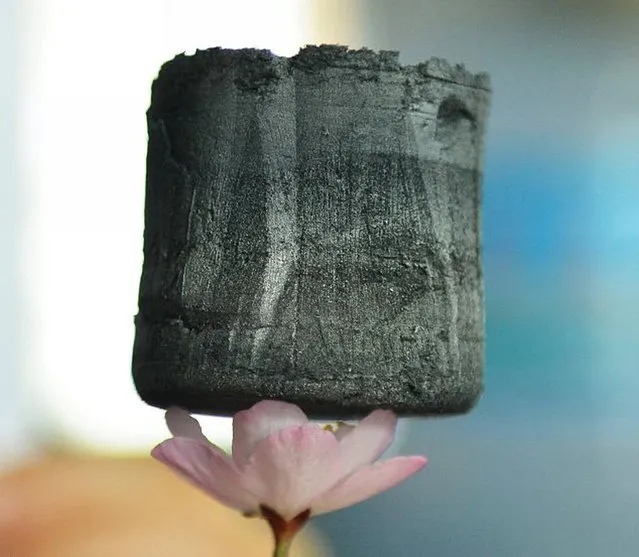
Carbon Aerogel The New Lightest Material

The lightest material ever made has been produced by a team of scientists in China, a Chinese university announced.
Details
07 Jan 2014 11:03:00
A man in a wartime uniform, poses for a photo on an abandoned tank at a beach, ahead of the 60th anniversary of Second Taiwan Straits Crisis against China, in Kinmen, Taiwan on August 19, 2018. (Photo by Tyrone Siu/Reuters)

A man in a wartime uniform, poses for a photo on an abandoned tank at a beach, ahead of the 60th anniversary of Second Taiwan Straits Crisis against China, in Kinmen, Taiwan on August 19, 2018. (Photo by Tyrone Siu/Reuters)
Details
20 Aug 2018 09:25:00
The Perseid Meteor Shower seen over The Scorhill Stone Circle in Dartmoor, Devon on August 2, 2016. (Photo by John Baker/SWNS.com)

The Perseid Meteor Shower seen over The Scorhill Stone Circle in Dartmoor, Devon on August 2, 2016. (Photo by John Baker/SWNS.com)
Details
08 Dec 2016 13:00:00
A model wears a creation as part of the Mugler Haute Couture Spring-Summer 2023 collection presented in Paris, Thursday, January 26, 2023. (Photo by Thibault Camus/AP Photo)

A model wears a creation as part of the Mugler Haute Couture Spring-Summer 2023 collection presented in Paris, Thursday, January 26, 2023. (Photo by Thibault Camus/AP Photo)
Details
09 Apr 2024 06:01:00
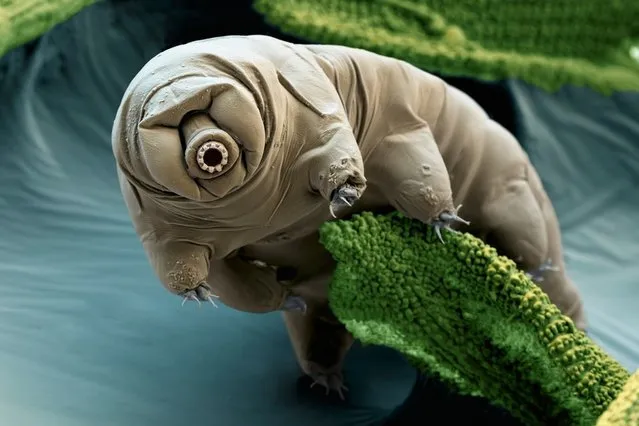
Tardigrades (commonly known as waterbears or moss piglets). (Photo by SPL/East News)

“Tardigrades (commonly known as waterbears or moss piglets) are small, water-dwelling, segmented animals with eight legs. Tardigrades were first discovered in 1773 by Johann August Ephraim Goeze, who called them kleiner Wasserbär, meaning “little water bear” in German. The name Tardigrada means “slow walker” and was given by Lazzaro Spallanzani in 1777. The name water bear comes from the way they walk, reminiscent of a bear's gait. The biggest adults may reach a body length of 1.5 millimetres (0.059 in), the smallest below 0.1 mm. Freshly hatched tardigrades may be smaller than 0.05 mm”. – Wikipedia. Photo: Tardigrades. (Photo by SPL/East News)
Details
26 Sep 2012 09:55:00
The antennas of the European Southern Observatory's Atacama Large Millimeter/Submillimeter Array, also known as ALMA, are set against the splendor of the Milky Way in this picture by Babak Tafreshi

The antennas of the European Southern Observatory's Atacama Large Millimeter/Submillimeter Array, also known as ALMA, are set against the splendor of the Milky Way in this picture by Babak Tafreshi. Construction of the full ALMA array is due to be completed in Chile's Atacama Desert in 2013, but the facility is already making scientific observations with a partial array of antennas. (Photo by ESO/B. Tafreshi/TWAN)
Details
03 Jun 2012 11:57:00
Students take part in the traditional Raisin Monday foam fight on St Salvator's Lower College Lawn at the University of St Andrews, UK in Fife on Monday, October 16, 2023. (Photo by Lesley Martin/PA Images/Profimedia)

Students take part in the traditional Raisin Monday foam fight on St Salvator's Lower College Lawn at the University of St Andrews, UK in Fife on Monday, October 16, 2023. (Photo by Lesley Martin/PA Images/Profimedia)
Details
10 Jan 2025 03:58:00
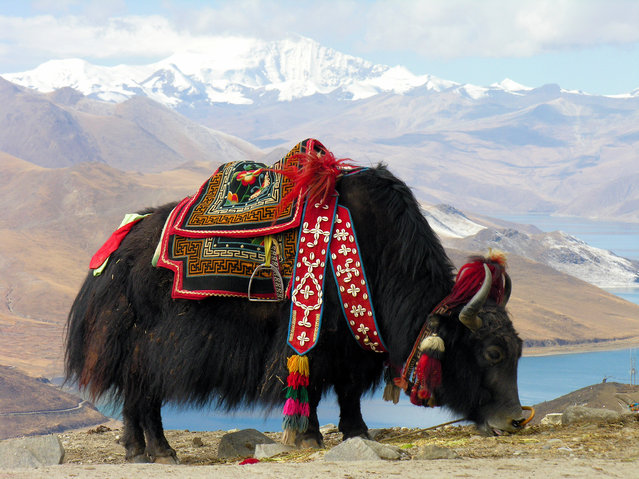
Yak near Yamdrok lake, Tibet. It is a long-haired bovinae found throughout the Himalayan region of south Central Asia, the Tibetan Plateau and as far north as Mongolia and Russia. The Tibetan economy is dominated by subsistence agriculture. Due to limited arable land, the primary occupation of the Tibetan Plateau is raising livestock, such as sheep, cattle, goats, camels, yaks, dzo, and horses. The Tibetan yak is an integral part of Tibetan life. (Photo by Dennis Jarvis)

Yak near Yamdrok lake, Tibet. It is a long-haired bovinae found throughout the Himalayan region of south Central Asia, the Tibetan Plateau and as far north as Mongolia and Russia. The Tibetan economy is dominated by subsistence agriculture. Due to limited arable land, the primary occupation of the Tibetan Plateau is raising livestock, such as sheep, cattle, goats, camels, yaks, dzo, and horses. The Tibetan yak is an integral part of Tibetan life. (Photo by Dennis Jarvis)

Details
10 Jun 2015 10:48:00