Loading...
Done
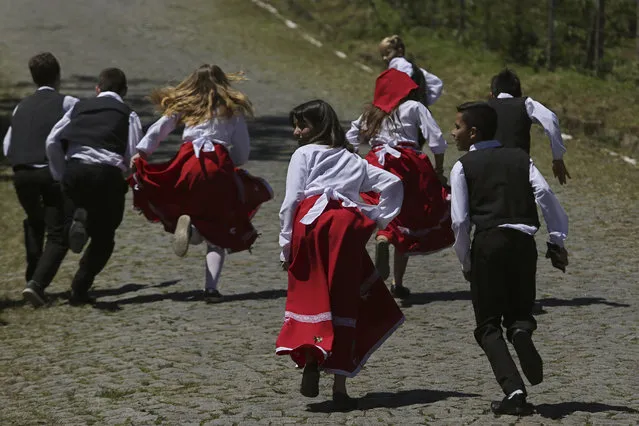
In this November 11, 2017 photo, children dressed in traditional outfits play during the Azorean Culture Festival which celebrates the culture of the Azores, the Portuguese island chain in the mid-Atlantic, in Enseada de Brito, in Brazil's Santa Catarina southern state. “We have to make sure that our culture always stays alive, not let it die”, said Andre Cordeiro, who leads one of the singing and dancing groups that performed this year. “We are able to pass it on from generation to generation”. (Photo by Eraldo Peres/AP Photo)

In this November 11, 2017 photo, children dressed in traditional outfits play during the Azorean Culture Festival which celebrates the culture of the Azores, the Portuguese island chain in the mid-Atlantic, in Enseada de Brito, in Brazil's Santa Catarina southern state. “We have to make sure that our culture always stays alive, not let it die”, said Andre Cordeiro, who leads one of the singing and dancing groups that performed this year. “We are able to pass it on from generation to generation”. (Photo by Eraldo Peres/AP Photo)
Details
04 Dec 2017 07:52:00
French performer Maud'Amour applies a makeup backstage before the Parisian transvestite cabaret show at “Madame Arthur” in Paris, on September 29, 2023. Open since 1946, Madame Arthur is the oldest transformist cabaret in Paris. Threatened with extinction the cabaret is undergoing a renaissance, attracting younger customers by returning to the fundamentals of the lie: baroque and queer performers who play with genres and conventions, and sing French hits live. (Photo by Joel Saget/AFP Photo)

French performer Maud'Amour applies a makeup backstage before the Parisian transvestite cabaret show at “Madame Arthur” in Paris, on September 29, 2023. Open since 1946, Madame Arthur is the oldest transformist cabaret in Paris. Threatened with extinction the cabaret is undergoing a renaissance, attracting younger customers by returning to the fundamentals of the lie: baroque and queer performers who play with genres and conventions, and sing French hits live. (Photo by Joel Saget/AFP Photo)
Details
30 Nov 2023 00:05:00
French performer Odile De Mainville applies a makeup backstage before the Parisian transvestite cabaret show at “Madame Arthur” in Paris, on September 29, 2023. Open since 1946, Madame Arthur is the oldest transformist cabaret in Paris. Threatened with extinction the cabaret is undergoing a renaissance, attracting younger customers by returning to the fundamentals of the lie: baroque and queer performers who play with genres and conventions, and sing French hits live. (Photo by Joel Saget/AFP Photo)

French performer Odile De Mainville applies a makeup backstage before the Parisian transvestite cabaret show at “Madame Arthur” in Paris, on September 29, 2023. Open since 1946, Madame Arthur is the oldest transformist cabaret in Paris. Threatened with extinction the cabaret is undergoing a renaissance, attracting younger customers by returning to the fundamentals of the lie: baroque and queer performers who play with genres and conventions, and sing French hits live. (Photo by Joel Saget/AFP Photo)
Details
05 Dec 2024 03:23:00
Migle Politike (left) with son Aaron and friend Goda Zubkaityte on Wednesday, June 11, 2025 stop to look at the Singing Ringing Tree, a musical sculpture designed to look like a windswept tree, at Crown Point overlooking Burnley, Lancashire, UK. The wind-powered musical sculpture emits a low, tuneful song when the wind blows. (Photo by Martin Rickett/PA Wire)

Migle Politike (left) with son Aaron and friend Goda Zubkaityte on Wednesday, June 11, 2025 stop to look at the Singing Ringing Tree, a musical sculpture designed to look like a windswept tree, at Crown Point overlooking Burnley, Lancashire, UK. The wind-powered musical sculpture emits a low, tuneful song when the wind blows. (Photo by Martin Rickett/PA Wire)
Details
24 Jul 2025 04:30:00
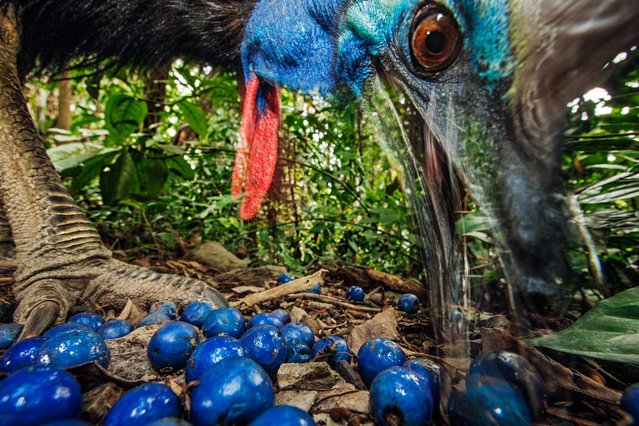
“Cassowaries are large, flightless birds related to emus and (more distantly) to ostriches, rheas, and kiwis”, writes Olivia Judson in the September issue of National Geographic magazine. (Photo by Christian Ziegler/National Geographic)

“Cassowaries are large, flightless birds related to emus and (more distantly) to ostriches, rheas, and kiwis”, writes Olivia Judson in the September issue of National Geographic magazine. How large? People-size: Adult males stand well over five foot five and top 110 pounds. Females are even taller, and can weigh more than 160 pounds. Dangerous when roused, they’re shy and peaceable when left alone. But even birds this big and tough are prey to habitat loss. The dense New Guinea and Australia rain forests where they live have dwindled. Today cassowaries might number 1,500 to 2,000. And because they help shape those same forests – by moving seeds from one place to another – “if they vanish”, Judson writes, “the structure of the forest would gradually change” too. (Photo by Christian Ziegler/National Geographic)
Details
06 Jan 2014 12:21:00
In a Holi tradition unique to Barsana and Nandgaon villages, men sing provocative songs to gain the attention of women, who then “beat” them with bamboo sticks called “lathis”. (Photo by Anindito Mukherjee/Reuters)

A woman covers her face as men throw colored powder at her during “Lathmar Holi” at the village of Barsana in the northern Indian state of Uttar Pradesh March 9, 2014. (Photo by Anindito Mukherjee/Reuters)
Details
13 Mar 2014 08:05:00
Little Bird, Arapahoe, 1899. (Photo by Frank A. Rinehart)

Frank A. Rinehart, a commercial photographer in Omaha, Nebraska, was commissioned to photograph the 1898 Indian Congress, part of the Trans-Mississippi International Exposition. More than five hundred Native Americans from thirty-five tribes attended the conference, providing the gifted photographer and artist an opportunity to create a stunning visual document of Native American life and culture at the dawn of the 20th century. Photo: Little Bird, Arapahoe, 1899. (Photo by Frank A. Rinehart)
Details
25 Apr 2013 11:30:00
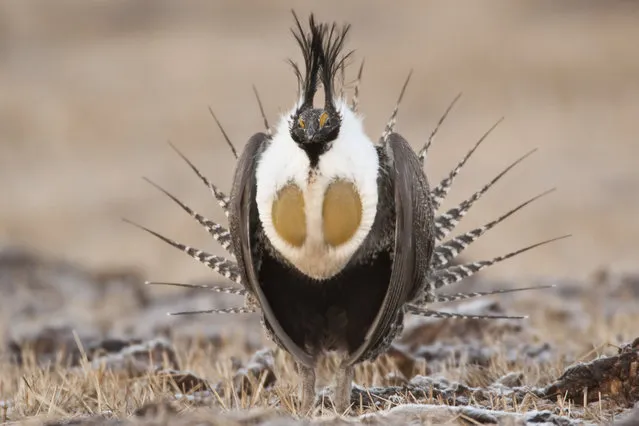
Greater Sage-Grouse

The Greater Sage-Grouse is certainly a formidable-looking bird. Being the largest grouse in North America and having tail feathers, which look like giant spikes, make for a ferocious sight. These birds are well known for their complicated courtship rituals, in which the males perform a special “strutting display” to attract the females. Another distinct feature of the Greater Sage-Grouse is two large yellow throat sacs (gular sacs), which are inflated by the males during the courtship display. Unlike pelicans, whose gular sacs are used to store fish while hunting, the throat sacks of the Greater Sage-Grouse are merely for display.
Details
21 Nov 2014 12:25:00