Loading...
Done
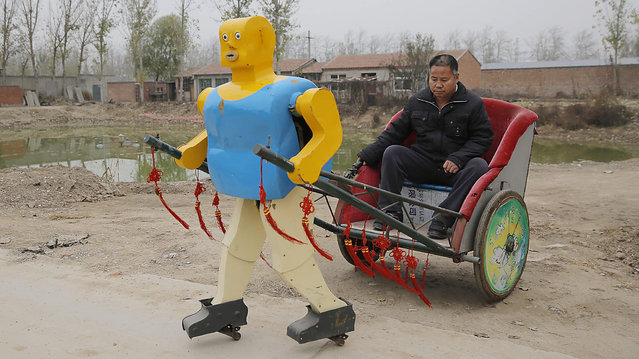
Robot inventor Wu Yulu sits on a rickshaw driven by a robot which he invented in his village in rural Beijing's Tongzhou district, China, 17 November 2016. The 54-year-old Chinese farmer living in rural Beijing's Tongzhou district invented 63 robots in the past 30 years. Wu, who only received primary school education, plans to give up the agricultural work for his robot products. He regularly participates in exhibitions, transfers patent rights and teaches at the university to earn money. (Photo by Wu Hong/EPA)

Robot inventor Wu Yulu sits on a rickshaw driven by a robot which he invented in his village in rural Beijing's Tongzhou district, China, 17 November 2016. The 54-year-old Chinese farmer living in rural Beijing's Tongzhou district invented 63 robots in the past 30 years. Wu, who only received primary school education, plans to give up the agricultural work for his robot products. He regularly participates in exhibitions, transfers patent rights and teaches at the university to earn money. (Photo by Wu Hong/EPA)
Details
21 Nov 2016 10:41:00
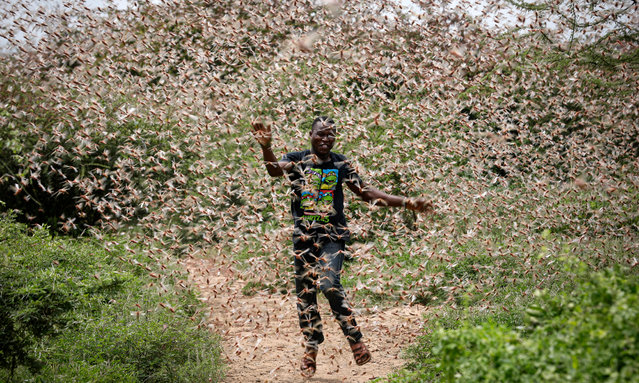
A local farmer Theophilus Mwendwa runs through a swarm of desert locusts to chase them away in the bush near Enziu, Kitui County, some 200km east of the capital Nairobi, Kenya, 24 January 2020. Large swarms of desert locusts have been invading Kenya for weeks, after having infested some 70 thousand hectares of land in Somalia which the United Nations Food and Agriculture Organisation (FAO) has termed the “worst situation in 25 years” in the Horn of Africa. FAO cautioned that it poses an “unprecedented threat” to food security and livelihoods in the region. (Photo by Dai Kurokawa/EPA/EFE)

A local farmer Theophilus Mwendwa runs through a swarm of desert locusts to chase them away in the bush near Enziu, Kitui County, some 200km east of the capital Nairobi, Kenya, 24 January 2020. Large swarms of desert locusts have been invading Kenya for weeks, after having infested some 70 thousand hectares of land in Somalia which the United Nations Food and Agriculture Organisation (FAO) has termed the “worst situation in 25 years” in the Horn of Africa. FAO cautioned that it poses an “unprecedented threat” to food security and livelihoods in the region. (Photo by Dai Kurokawa/EPA/EFE)
Details
22 Feb 2020 00:01:00
In this February 22, 2021, file photo, climate activist Disha Ravi, 22, travels in a car as she is taken to a court in New Delhi, India. To her friends, Ravi, was most concerned about her future in a world where temperatures are rising. But her life changed last month as she became a household name in the country, dominating news coverage after police charged her with sedition, a colonial-era law which carries a sentence up to life. Her alleged crime: sharing an online document to help amplify months-long farmer protests in India on Twitter. She was released after 10 days in custody. (Photo by Dinesh Joshi/AP Photo/File)

In this February 22, 2021, file photo, climate activist Disha Ravi, 22, travels in a car as she is taken to a court in New Delhi, India. To her friends, Ravi, was most concerned about her future in a world where temperatures are rising. But her life changed last month as she became a household name in the country, dominating news coverage after police charged her with sedition, a colonial-era law which carries a sentence up to life. Her alleged crime: sharing an online document to help amplify months-long farmer protests in India on Twitter. She was released after 10 days in custody. (Photo by Dinesh Joshi/AP Photo/File)
Details
12 Mar 2021 09:56:00
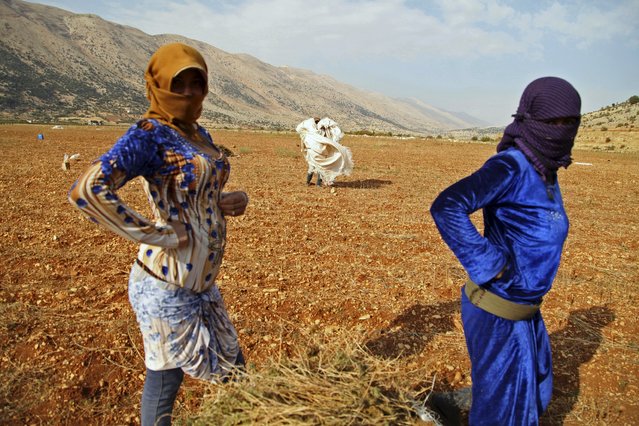
Aisha, 15, (L) (who asked to withhold her last name), a Syrian refugee from Raqqa, waits with a fellow refugee while harvesting cannabis in the Bekaa valley, Lebanon October 19, 2015. Syrian refugees work to harvest and process spiky-leafed cannabis plants in neighbouring Lebanon’s Bekaa Valley. (Photo by Alia Haju/Reuters)

Aisha, 15, (L) (who asked to withhold her last name), a Syrian refugee from Raqqa, waits with a fellow refugee while harvesting cannabis in the Bekaa valley, Lebanon October 19, 2015. Syrian refugees work to harvest and process spiky-leafed cannabis plants in neighbouring Lebanon’s Bekaa Valley. Often farmers of cotton and wheat back home in Raqqa province – now the de facto capital of Islamic State – the conflict in Syria drove them to seek safety in a region where Syrian migrant workers used to spend a few months a year before returning home. (Photo by Alia Haju/Reuters)
Details
24 Dec 2015 08:03:00
Aymara dolls are seen during the “Alasitas” fair, where people buy miniature versions of goods they hope to acquire in real life, in La Paz, Bolivia, January 24, 2017. Shoppers fill their baskets with miniature versions of things they desire – everything from cars, houses computers – to give to Ekeko the God of abundance, in the hope he will being therm good fortune. And it is all carried out with a priest’s blessing. Originally, the Festival of Alasitas was a celebration by farmers praying for plentiful crops.Today, the meaning amounts to the same only locals hope for more material goods. (Photo by David Mercado/Reuters)

Aymara dolls are seen during the “Alasitas” fair, where people buy miniature versions of goods they hope to acquire in real life, in La Paz, Bolivia, January 24, 2017. Shoppers fill their baskets with miniature versions of things they desire – everything from cars, houses computers – to give to Ekeko the God of abundance, in the hope he will being therm good fortune. (Photo by David Mercado/Reuters)
Details
26 Jan 2017 12:56:00
Nepalese students of Himalayan agriculture college play in mud water in a paddy field to celebrate the National Paddy Day in Badegaun village, Lalitpur, Nepal, 29 June 2016. More than 100 students and teachers of Himalayan agriculture college participated in the National paddy day by planting rice and playing in mud water as Nepal is celebrating National Paddy Day with various event. On this day, known as Asar Pandra, farmers begin the annual rice planting season and mark the day with various festivities such as preparing rice meals with muddy water, mud being a symbol for a prosperous season. (Photo by Narendra Shrestha/EPA)

Nepalese students of Himalayan agriculture college play in mud water in a paddy field to celebrate the National Paddy Day in Badegaun village, Lalitpur, Nepal, 29 June 2016. More than 100 students and teachers of Himalayan agriculture college participated in the National paddy day by planting rice and playing in mud water as Nepal is celebrating National Paddy Day with various event. (Photo by Narendra Shrestha/EPA)
Details
30 Jun 2016 11:17:00
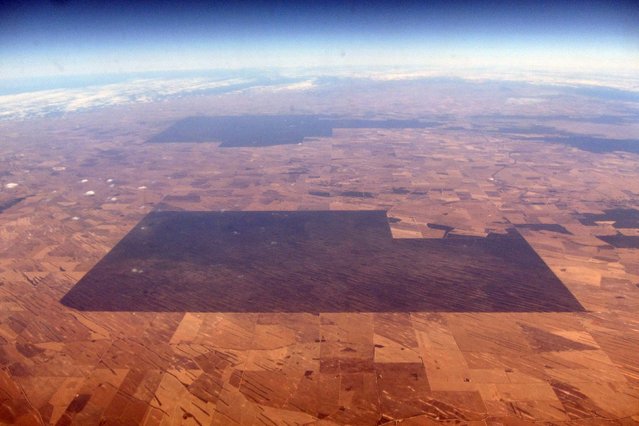
An area of vegetation can be seen amongst drought effected farmland in South Australia, November 12, 2015. (Photo by David Gray/Reuters)

An area of vegetation can be seen amongst drought effected farmland in South Australia, November 12, 2015. A pioneering Australian scheme to improve the management of water in the world's driest inhabited continent is facing its first real test as an intensifying El Nino threatens crops and builds tensions between farmers and environmentalists. An El Nino, a warming of sea-surface temperatures in the Pacific, is already causing drought and other extreme weather, affecting millions of people across parts of the world, and experts warn that the intensifying weather pattern could emerge as one of the strongest on record. (Photo by David Gray/Reuters)
Details
15 Nov 2015 08:01:00
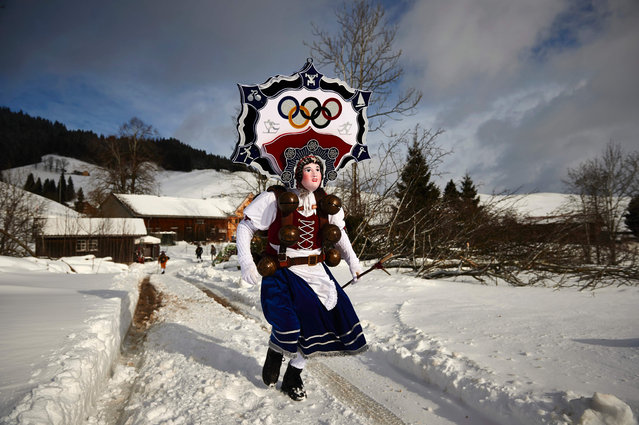
A leader “Rolli” of a yodel group “Schuppel” runs in the snow in front of a farmstead during the “Silvesterchlausen” in the early morning in Urnaesch in the Swiss canton Appenzell Ausserroden on January 13, 2017. The “Silvesterchlausen” is a tradition of the Swiss canton Appenzell, where colorfull characters organized in groups called “Schuppel”, chase out the old year and welcome the new one. They run all day long from farmstead to farmstead, gather together to sing a jodel and great the farmers. A “Schuppel” consists of some “Schelli” and two “Rolli”, sometimes with female dresses and nice scenes over the head, despite the dress all participants are males. The Silversterchlausen run twice a year, first for the new Silvester on December 31, and then again on January 13, for the old Silvester following the Julian calendar. (Photo by Michael Buholzer/AFP Photo)

A leader “Rolli” of a yodel group “Schuppel” runs in the snow in front of a farmstead during the “Silvesterchlausen” in the early morning in Urnaesch in the Swiss canton Appenzell Ausserroden on January 13, 2017. (Photo by Michael Buholzer/AFP Photo)
Details
14 Jan 2017 12:41:00