Loading...
Done
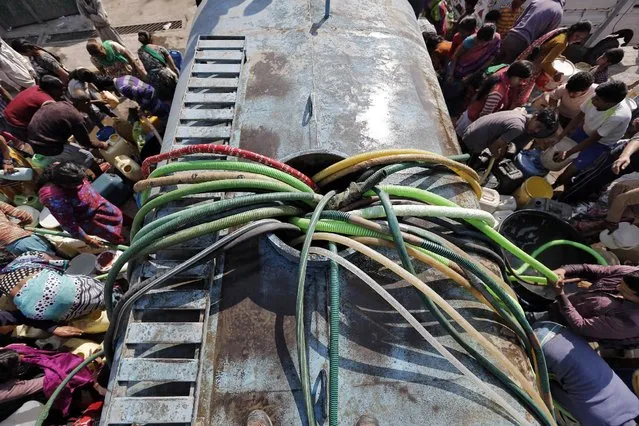
Residents with their empty containers crowd around a municipal tanker to fetch water in New Delhi, India, February 22, 2016. (Photo by Anindito Mukherjee/Reuters)

Residents with their empty containers crowd around a municipal tanker to fetch water in New Delhi, India, February 22, 2016. The Indian army has taken control of a canal that supplies three-fifths of Delhi's water, the state's chief minister said on Monday, raising hope that a water crisis in the metropolis of more than 20 million people can be averted. (Photo by Anindito Mukherjee/Reuters)
Details
22 Feb 2016 10:08:00
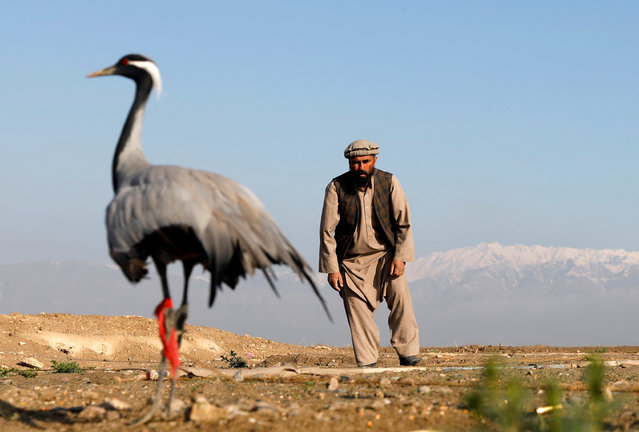
Jan Agha, 49, an Afghan hunter, tries to catch his crane at a field in Bagram, Parwan province, Afghanistan on April 10, 2019. (Photo by Mohammad Ismail/Reuters)

Jan Agha, 49, an Afghan hunter, tries to catch his crane at a field in Bagram, Parwan province, Afghanistan on April 10, 2019. As the early morning light breaks over the plain north of Kabul, bird hunter Jan Agha checks his snares as he has done for the past 30 years, hoping to catch a crane, using a tethered bird to lure others down to the nets. (Photo by Mohammad Ismail/Reuters)
Details
17 Apr 2019 00:05:00
A man wearing a hazmat suit and a mask holds a sign reading “The end is near – call grandma” at Times Square on March 14, 2020 in New York City. The World Health Organization said March 13, 2020 it was not yet possible to say when the COVID-19 pandemic, which has killed more than 5,000 people worldwide, will peak. “It's impossible for us to say when this will peak globally”, Maria Van Kerkhove, who heads the WHO's emerging diseases unit, told a virtual press conference, adding that “we hope that it is sooner rather than later”. (Photo by Johannes Eisele/AFP Photo)

A man wearing a hazmat suit and a mask holds a sign reading “The end is near – call grandma” at Times Square on March 14, 2020 in New York City. The World Health Organization said March 13, 2020 it was not yet possible to say when the COVID-19 pandemic, which has killed more than 5,000 people worldwide, will peak. “It's impossible for us to say when this will peak globally”, Maria Van Kerkhove, who heads the WHO's emerging diseases unit, told a virtual press conference, adding that “we hope that it is sooner rather than later”. (Photo by Johannes Eisele/AFP Photo)
Details
16 Mar 2020 00:07:00
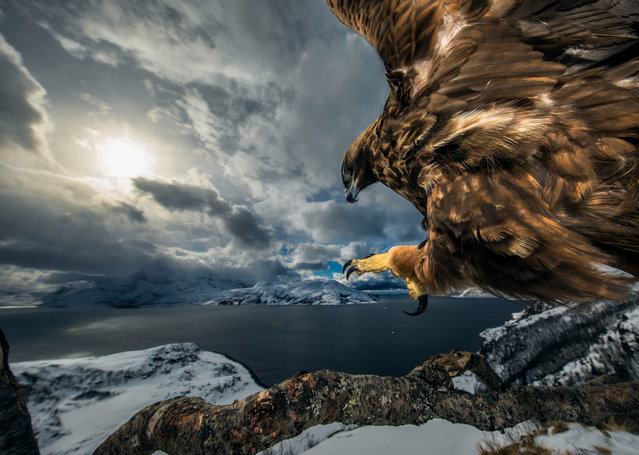
Birds behaviour winner: Land of the Eagle by Audun Rikardsen, Norway. High on a ledge, on the coast near his home in northern Norway, Rikardsen carefully positioned an old tree branch that he hoped would make a perfect golden eagle lookout. To this, he bolted a tripod head with a camera, flashes and motion sensor attached, and built himself a hide a short distance away. From time to time, he left road‑kill carrion nearby. Very gradually – over the next three years – a golden eagle got used to the camera and started to use the branch regularly to survey the coast below. (Photo by Audun Rikardsen/2019 Wildlife Photographer of the Year)

Birds behaviour winner: Land of the Eagle by Audun Rikardsen, Norway. High on a ledge, on the coast near his home in northern Norway, Rikardsen carefully positioned an old tree branch that he hoped would make a perfect golden eagle lookout. To this, he bolted a tripod head with a camera, flashes and motion sensor attached, and built himself a hide a short distance away. From time to time, he left road‑kill carrion nearby. Very gradually – over the next three years – a golden eagle got used to the camera and started to use the branch regularly to survey the coast below. (Photo by Audun Rikardsen/2019 Wildlife Photographer of the Year)
Details
17 Oct 2019 00:03:00
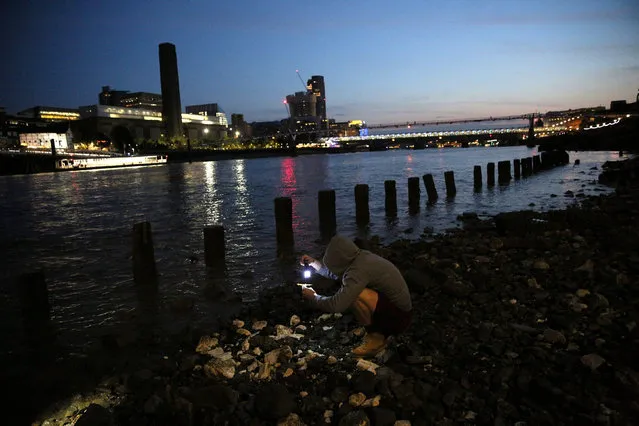
A mudlark uses a torch to look for items on the bank of the River Thames in London, Britain June 06, 2016. Mudlarking is believed to trace its origins to the 18th and 19th century, when scavengers searched the Thames' shores for items to sell. These days, history and archaeology fans are the ones hoping to find old relics such as coins, ceramics, artifacts or everyday items from across centuries. They wait for the low tide and then scour specific areas of exposed shores. "If you're in a field you could be out all day long, with the river you're restricted to about two or three hours," mudlark Nick Stevens said. While many just use the naked eye for their searches, others rely on metal detectors for which a permit from the Port of London Authority is needed. Digging also requires consent. (Photo by Neil Hall/Reuters)

A mudlark uses a torch to look for items on the bank of the River Thames in London, Britain June 06, 2016. Mudlarking is believed to trace its origins to the 18th and 19th century, when scavengers searched the Thames' shores for items to sell. These days, history and archaeology fans are the ones hoping to find old relics such as coins, ceramics, artifacts or everyday items from across centuries. their finds with the Portable Antiquities Scheme. Any item over 300 years old must be recorded. (Photo by Neil Hall/Reuters)
Details
27 Aug 2016 10:43:00
A woman applies lipstick in a car that is parked at a beach facing a volcanic rock called Devil's Finger outside Yuzhno-Kurilsk, the main settlement on the Southern Kurile island of Kunashir September 15, 2015. (Photo by Thomas Peter/Reuters)

A woman applies lipstick in a car that is parked at a beach facing a volcanic rock called Devil's Finger outside Yuzhno-Kurilsk, the main settlement on the Southern Kurile island of Kunashir September 15, 2015. Russian residents of the island chain at the centre of a dispute between Japan and Russia that has held up a treaty to formally end World War Two hope a diplomatic solution will lure tourists and investment to help refurbish rickety infrastructure. The Southern Kuriles are referred to in Japan as the Northern Territories. (Photo by Thomas Peter/Reuters)
Details
28 Sep 2015 08:03:00
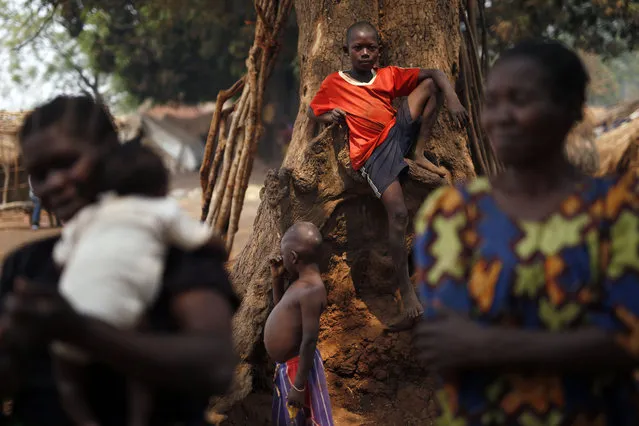
Christian families living in a refugee camp stand under a tree in Kaga-Bandoro, Central African Republic, Tuesday February 16,  2016. (Photo by Jerome Delay/AP Photo)

Christian families living in a refugee camp stand under a tree in Kaga-Bandoro, Central African Republic, Tuesday February 16, 2016. Refugees in the north of Central African Republic say they hope the new president will bring peace but no one is heading home just yet. Thousands are still living in displacement camps in Kaga-Bandoro, a stronghold of the former Muslim rebel group known as Seleka that was in power for nearly a year. The one-time rebels say they are waiting to see how the election turns out before taking any action. (Photo by Jerome Delay/AP Photo)
Details
20 Feb 2016 10:13:00
Squirrel Humour By Nancy Rose

My backyard squirrels are so entertaining that this set gradually emerged and has given me so much fun. Most recent ones are of "Mr. Peanuts" who lives on the left of my backyard. Mrs P. lives in ten neighbours backyard. Making props, or buying cheapy things to use as props is just as fun. Mr. Peanuts will explore and examine them in his search for peanuts and with somepatience and time I usually manage to get several shots I like. I sure hop nothing ever happens to them because I have grown so fond of them. Thanks for looking and hope they give you as many smiles as they give me.

Nancy Rose
Details
19 Jan 2013 12:12:00