Loading...
Done
En attendant davoir des balles..... Photo Art by Pierre Beteille

Talented French artist, Pierre Beteille, is skillful in manipulation of portraits (specially his own self portraits) using Photoshop. This is how he describes himself: “I am not a photographer or an artist, I just make images… I shoot very average or even bad photos that I try to improve thanks to Photoshop”…

Photo: “En attendant d'avoir des balles”...., 2007 (Photo by Pierre Beteille)

Details
23 Jul 2012 08:52:00
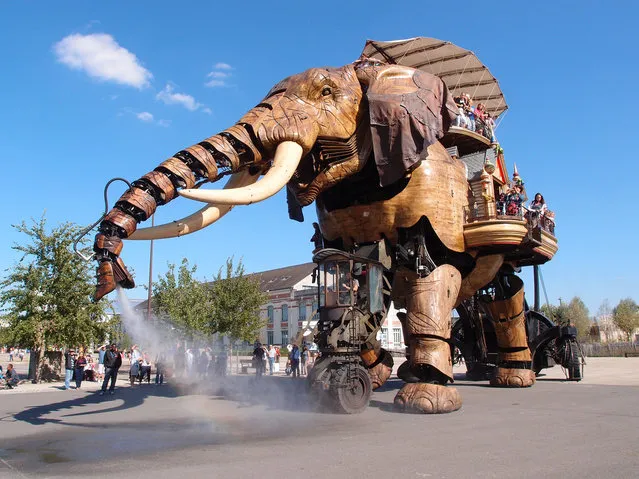
The Machines Of The Isle Of Nantes

Due to the influence of Sci-Fi movies, many of us have an obsession with giant robots. How cool would it be to ride a gigantic robotic dinosaur or elephant? It would be even cooler to control one! Regretfully, the modern technologies are not yet sophisticated enough to fulfill this dream. Pierre Orefice and François Delarozière, however, came very close. These two artists have made it their goal to turn Nantes, France, into a hot tourist destination spot for people who love robots. In their project of Machines de l'île in Nantes, they have created a whole park of robotic monstrosities, ranging from a giant 3 story high elephant to a 2 meter long centipede crawling on a rail track.
Details
05 Jan 2015 13:21:00
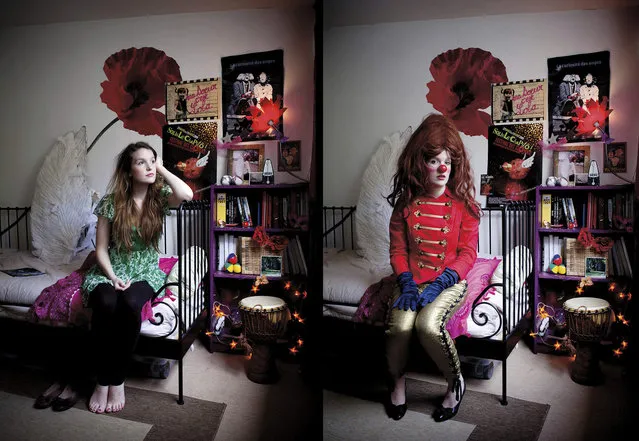
Lola is seen at left in everyday clothes – and then at right in her work clothes. She works as a clown in Paris. (Photo by Bruno Fert/Picturetank)

“The series of photos called Workwears, by French photographer Bruno Fert, visually juxtaposes people’s private lives with their lives at work. A firefighter, a fisherman, a nurse, a diver, a judge. One by one, Fert’s photos show people in their homes wearing everyday clothing – followed by another photo showing them dressed in the clothing of their chosen professions. Our reaction, Fert said, reminds us how tightly humans hold on to certain stereotypes about some professions. “I like to break those stereotypes”, he said”. – Thom Patterson via CNN. Here: Lola is seen at left in everyday clothes – and then at right in her work clothes. She works as a clown in Paris. (Photo by Bruno Fert/Picturetank)
Details
29 Oct 2014 12:40:00
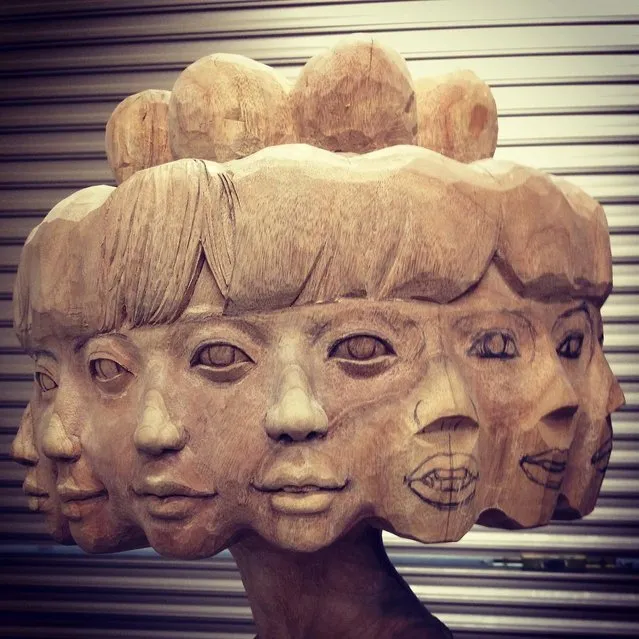
Sculpture By Yoshitoshi Kanemaki

There are many ways to interpret the creations of Yoshitoshi Kanemaki, whose works usually involve sculptures of people where two or more characters have merged into a single being. Possibly, Yoshitoshi Kanemaki is trying to express through his sculptures that everyone’s soul is multifaceted. Good emotions are mixed with the bad, love is mixed with hate, contempt with admiration. How often do you hear that a person loves someone deeply, while doing completely horrendous things, unable to see that he or she is destroying their object of love? Nevertheless, we should be thankful to the nature for all the different emotions that we are able to feel. Unlike animals, who only show simple forms of emotions, such as anger, happiness, and a few others, human soul is much deeper, allowing us to feel a full plethora of emotions. (Photo by Yoshitoshi Kanemaki)
Details
20 Nov 2014 12:26:00
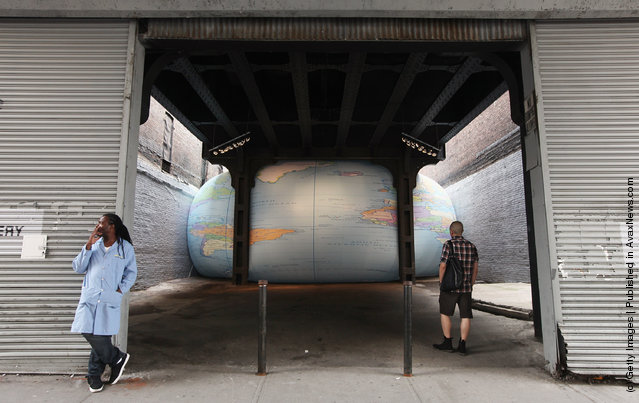
David Byrne's installation Tight Spot

People view artist David Byrne's installation "Tight Spot" beneath Manhattan's High Line park on September 27, 2011 in New York City. The 48-foot by 20-foot inflatable globe is squeezed beneath the steel support framework of the High Line and is accompanied with a rumbling audio soundtrack created by distorting Byrne's voice. (Photo by Mario Tama/Getty Images)
Details
28 Sep 2011 11:01:00
Palestinian barber Ramadan Odwan styles and straightens the hair of a customer with fire at his salon in Rafah, in the southern Gaza Strip February 2, 2017. In Ramadan Odwan's barbershop in Gaza, hair isn't just blow-dried, it's blowtorch-dried. “People have gone crazy about it, many people are curious to go through the experience and they are not afraid”, he told Reuters. “People here love adventures”. Odwan, 37, is not the first stylist in the world to use flame to straighten hair, but his craft is unique in the Gaza Strip. In his salon in the southern Gaza town of Rafah, Odwan applied what he described as a protective liquid coating to a customer's hair – he declined to disclose its contents – before aiming for the head and pressing the button on a small blowtorch. “I control how long I apply fire, I keep it on and off for 10 seconds or 15 seconds. It is completely safe and I have not encountered any accident since I started it two months ago”, Odwan added. Odwan charges 20 shekels ($5.20) for a haircut and fire-straightening. A barber for the past 18 years, he said part of the reason he uses the technique is to show that Palestinian barbers are as “professional as those out there around the world”. (Photo by Ibraheem Abu Mustafa/Reuters)

Palestinian barber Ramadan Odwan styles and straightens the hair of a customer with fire at his salon in Rafah, in the southern Gaza Strip February 2, 2017. In Ramadan Odwan's barbershop in Gaza, hair isn't just blow-dried, it's blowtorch-dried. “People have gone crazy about it, many people are curious to go through the experience and they are not afraid”, he told Reuters. “People here love adventures”. (Photo by Ibraheem Abu Mustafa/Reuters)
Details
11 Feb 2017 00:05:00
Concept Design Home Reversible Destiny Lofts MITAKA: In Memory Of Helen Keller By Reversible Destiny Foundation and Shusaku Arakawa

“The Reversible Destiny Lofts – Mitaka (In Memory of Helen Keller) is a nine-unit multiple dwelling. It was first completed example of procedural architecture put to residential use. These lofts reflexively articulate the residents’ operative tendencies and coordinating skills essential to and determinative of human thought and behavior; which means to say, the lofts manage, by virtue of how they are constructed, to reveal to their residents the ins and outs of what makes a person, in this case the resident. This is the same set of tendencies and skills to which Arakawa and Madeline Gins gave diagrammatic form in their decades-long research project The Mechanism of Meaning”. – Wikipedia

Photo: The exterior of the concept design home “Reversible Destiny Lofts MITAKA: In Memory of Helen Keller” is seen on October 27, 2005 in Tokyo, Japan. (Photo by Koichi Kamoshida/Getty Images)
Details
30 Nov 2011 11:58:00
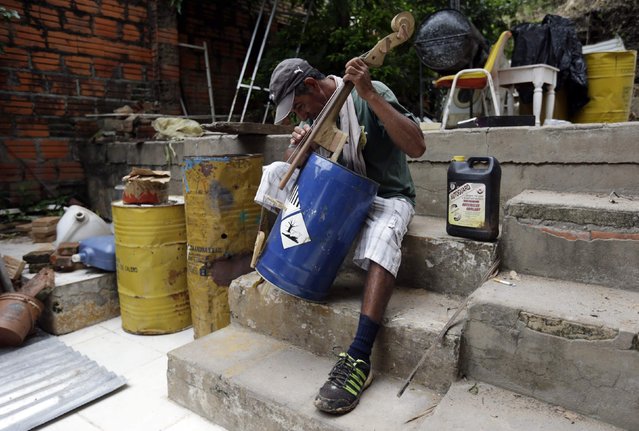
Recycling artist Nicolas Gomez checks the strings of a cello he has made out of an oil barrel for the Orchestra of Recycled Instruments of Cateura, in Cateura, Paraguay February 13, 2015. (Photo by Jorge Adorno/Reuters)

Recycling artist Nicolas Gomez checks the strings of a cello he has made out of an oil barrel for the Orchestra of Recycled Instruments of Cateura, in Cateura, Paraguay February 13, 2015. Saudi Arabia's oil exports have risen in February in response to stronger demand from customers. As OPEC's top producer battles for market share Reuters photographers around the globe have been photographing oil barrels to document how they are utilised once the fuel has been used. (Photo by Jorge Adorno/Reuters)
Details
21 Feb 2015 10:39:00