Loading...
Done


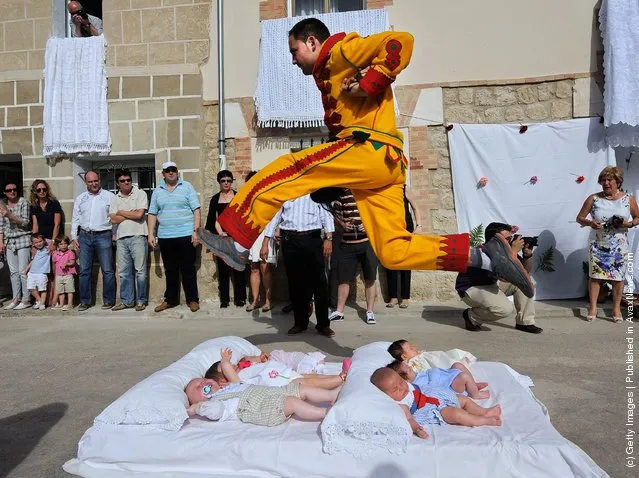
“Baby jumping (El Colacho) is a traditional Spanish practice dating back to 1620 that takes place annually to celebrate the Catholic feast of Corpus Christi in the village of Castrillo de Murcia near Burgos. During the act – known as El Salto del Colacho (the devil's jump) or simply El Colacho – men dressed as the Devil (known as the Colacho) jump over babies born during the previous twelve months of the year who lie on mattresses in the street. ... The festival has been rated as one of the most dangerous in the world”. – Wikipedia

Photo: A man representing the devil leaps over babies during the festival of El Colacho on June 26, 2011 in Castrillo de Murcia near Burgos, Spain. The festival, held on the first Sunday after Corpus Cristi, represents the devil taking away original sin from the newly born babies by leaping over them. (Photo by Denis Doyle/Getty Images)
Details
27 Jun 2011 09:20:00
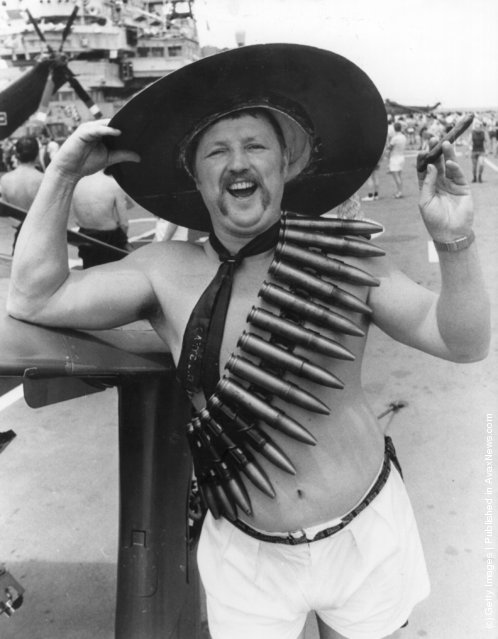
1982: Kenneth 'Rocky' Hudson, a Petty Officer from Gosport aboard HMS Hermes, the flagship of the Royal Navy, heading for the Falkland Islands. The troops are waging a Mexican moustache growing contest and Kenneth is wearing 30mm cannon shells slung around his body and sporting a fat cigar

“The Falklands War, also known as the Falklands Conflict or Falklands Crisis, was a 1982 limited war between Argentina and the United Kingdom. The conflict resulted from the long-standing dispute over the sovereignty of the Falkland Islands and South Georgia and the South Sandwich Islands, which lie in the South Atlantic east of Argentina”. – Wikipedia

Photo: Kenneth “Rocky” Hudson, a Petty Officer from Gosport aboard HMS Hermes, the flagship of the Royal Navy, heading for the Falkland Islands. The troops are waging a Mexican moustache growing contest and Kenneth is wearing 30mm cannon shells slung around his body and sporting a fat cigar. (Photo by Fox Photos/Getty Images). 18th April 1982
Details
03 Feb 2012 12:09:00
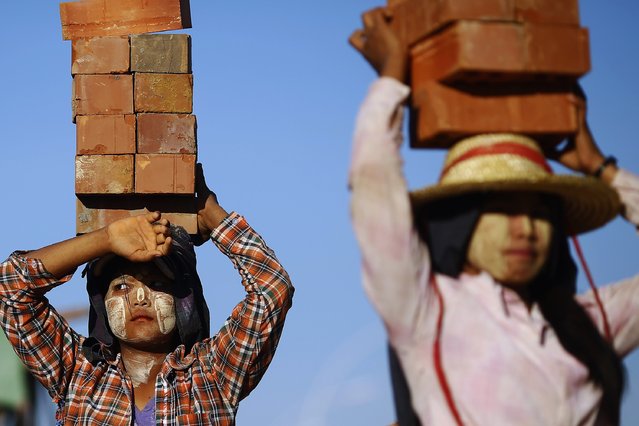
Construction workers carry bricks on their heads near the country's parliament building in Naypyitaw November 11, 2014. Yangon lost its status as Myanmar's capital in 2005, after the former military junta carved a new seat of government from a parched wilderness some 380 km (236 miles) to the north and called it Naypyitaw (“Abode of Kings”). (Photo by Damir Sagolj/Reuters)

Construction workers carry bricks on their heads near the country's parliament building in Naypyitaw November 11, 2014. Yangon lost its status as Myanmar's capital in 2005, after the former military junta carved a new seat of government from a parched wilderness some 380 km (236 miles) to the north and called it Naypyitaw (“Abode of Kings”). (Photo by Damir Sagolj/Reuters)
Details
15 Nov 2014 12:29:00
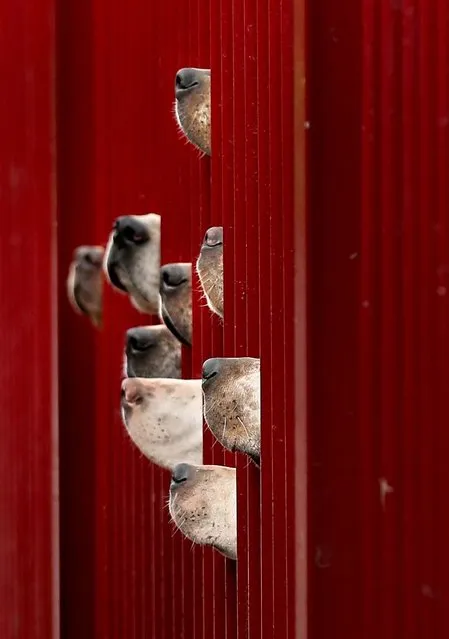
Hounds of The Cheshire Forest Hunt push their snouts through the bars of their kennels as they eagerly await their morning walk in preparation for the start of the new hunting season, in Knutsford, England, on Oktober 31, 2013. The hunting season traditionally starts around November 1st. Although a ban on hunting has been in force since February 2005, many supporters of fox hunting are continuing to call for a repeal of the ban, saying the current law is hard to interpret and enforce.  (Photo by Christopher Furlong/Getty Images)

Hounds of The Cheshire Forest Hunt push their snouts through the bars of their kennels as they eagerly await their morning walk in preparation for the start of the new hunting season, in Knutsford, England, on Oktober 31, 2013. The hunting season traditionally starts around November 1st. Although a ban on hunting has been in force since February 2005, many supporters of fox hunting are continuing to call for a repeal of the ban, saying the current law is hard to interpret and enforce. (Photo by Christopher Furlong/Getty Images)
Details
02 Nov 2013 12:34:00
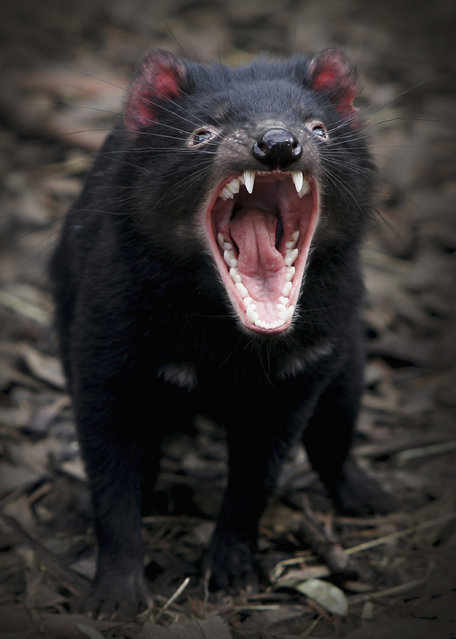
A Tasmanian Devil bears it's teeth at a quarantine facility August 31, 2005 in Hobart, Australia. The Devil, a native marsupial unique to Tasmania, is under threat from Devil Facial Tumor Disease (DFTD) which is decimating numbers throughout Tasmania. (Photo by Ian Waldie/Getty Images)

“The Tasmanian devil (Sarcophilus harrisii) is a carnivorous marsupial of the family Dasyuridae now found in the wild only in the Australian island state of Tasmania. The size of a small dog, it became the largest carnivorous marsupial in the world following the extinction of the thylacine in 1936. It is characterised by its stocky and muscular build, black fur, pungent odour, extremely loud and disturbing screech, keen sense of smell, and ferocity when feeding”. – Wikipedia. Photo: A Tasmanian Devil bears it's teeth at a quarantine facility August 31, 2005 in Hobart, Australia. (Photo by Ian Waldie/Getty Images)
Details
27 Jan 2014 09:45:00
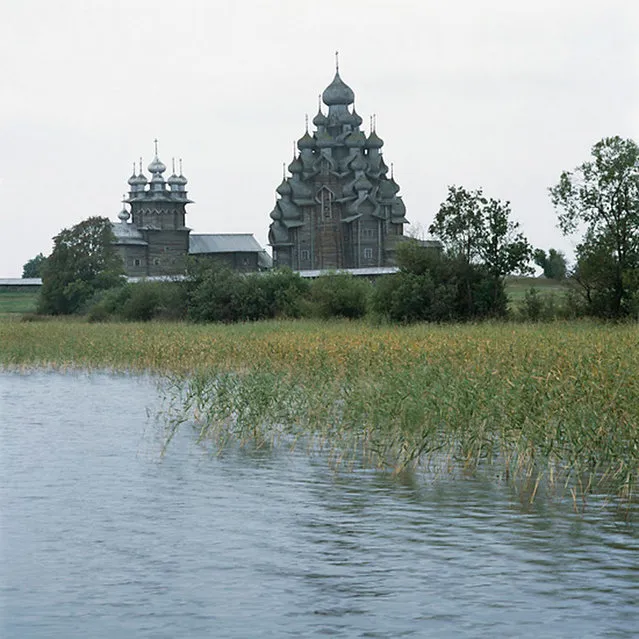
Wooden Churches - Travelling In The Russian North By Richard Davies Part 1

While communism, collectivism, worms, dry rot and casual looting failed to destroy the majestic wooden churches of Russia, it may be ordinary neglect that finally does them in. Dwindled now to several hundred remaining examples, these glories of vernacular architecture lie scattered amid the vastness of the world’s largest country. Just over a decade ago, Richard Davies, a British architectural photographer, struck out on a mission to record the fragile and poetic structures. Austerely beautiful and haunting, “Wooden Churches: Traveling in the Russian North” (White Sea Publishing; $132) is the result. Covering thousands of miles, Mr. Davies described how he and the writer Matilda Moreton tracked down the survivors from among the thousands of onion-domed structures built after Prince Vladimir converted to Christianity in 988.
Details
25 Nov 2013 12:47:00
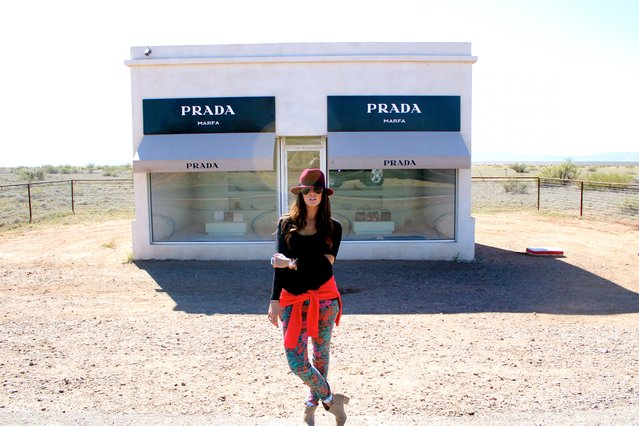
Prada Marfa Is IIlegal Roadside Ad

Prada Marfa is a permanently installed sculpture by artists Elmgreen and Dragset, situated 1.4 miles (2.3 km) northwest of Valentine, Texas, just off U.S. Highway 90 (US 90), and about 26 miles (42 km) northwest of the city of Marfa. The installation was inaugurated on October 1, 2005. The artists called the work a "pop architectural land art project."
Details
22 Sep 2014 09:42:00
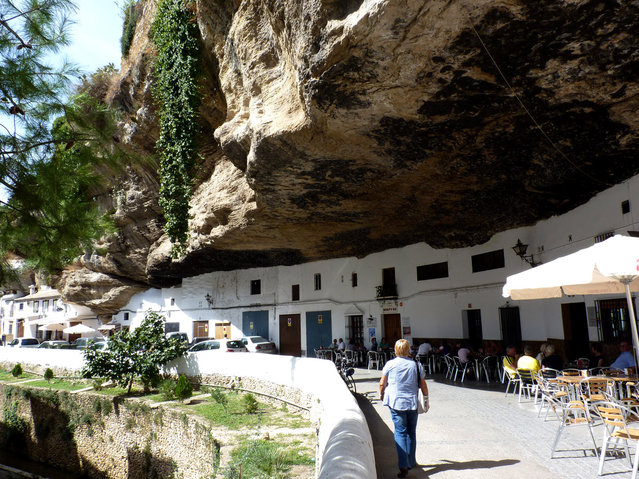
Setenil De Las Bodegas

Setenil de las Bodegas is a town (pueblo) in the province of Cádiz, Spain, famous for its dwellings built into rock overhangs above the Rio Trejo. According to the 2005 census, the city has a population of 3,016 inhabitants. It has an exact antipodal city: Auckland, New Zealand.
Details
27 Sep 2012 10:02:00