Loading...
Done
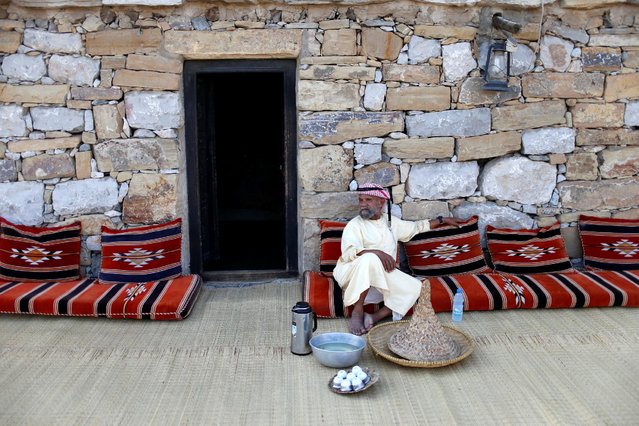
An Emirati man sits outside an old house at the Heritage Village in Dubai, UAE March 13, 2016. (Photo by Ahmed Jadallah/Reuters)

An Emirati man sits outside an old house at the Heritage Village in Dubai, UAE March 13, 2016. The Heritage Village was created in 1997 in Al Shindagha Historical Neighborhood in Dubai, close to the Diving Village, to embrace the heritage events and to display a live image of the old traditional life in UAE. It represents the components of wild, marine, and mountain life, where the visitor can identify closely the old traditional customs of the country and the special characteristics of old houses, handicrafts, patterns, and forms of living. It is owned and managed by Dubai Culture & Arts Authority. (Photo by Ahmed Jadallah/Reuters)
Details
29 Apr 2016 11:26:00
Skoda Fabia vRS Mean Green

Skoda is promoting the Fabia vRS with “Mean Green”, a television commercial filmed at the factory in the Czech Republic, showing a meaner side to the 180hp 1.4L TSI turbo and supercharged Fabia hatchback. The commercial begins with the brutal destruction of the Fabia cake commercial from 2007, with the Sound of Music “Favourite Things” track providing an ongoing sense of irony. The online campaign in the UK invites visitors to decide between lovely and mean, choosing between gingerbread and venom.
Details
15 Feb 2014 13:36:00
How Snakeskin Handbags Are Made

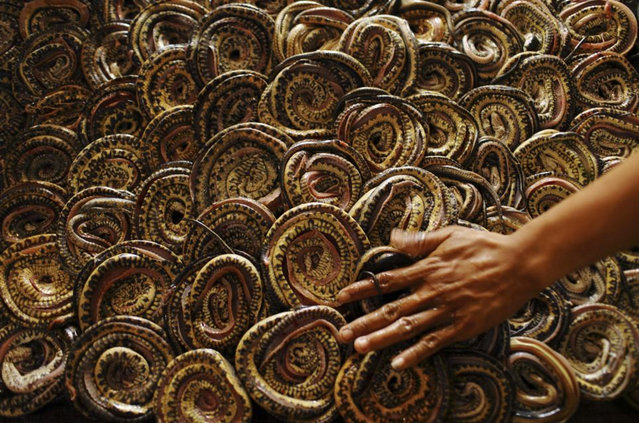
Images from a snake slaughterhouse at Kapetakan village in Indonesia’s West Java province. Wakira, who is known as “Boss Cobra”, owns the slaughterhouse that produces snake meat and skin. Snake meat is believed by some to be a remedy for skin diseases and asthma, as well as an aid to increase virility. The snake skins, measuring in the hundreds of metres, are sold to bag factories in the West and Central Java provinces on a monthly basis. The price of a bag made from snake skin costs between 150,000 rupiah ($ 15.60) and 300,000 rupiah ($31.20), depending on its size. That snakeskin handbag you’ll buy is costing a hell of a lot more.
Details
20 Feb 2013 12:00:00
In this undated photo provided by the North Korean government, North Korean leader Kim Jong Un tries a weapon during his three-day inspection from Aug. 3 until August 5, 2023 at major munitions factories in North Korea. Independent journalists were not given access to cover the event depicted in this image distributed by the North Korean government. The content of this image is as provided and cannot be independently verified. Korean language watermark on image as provided by source reads: “KCNA” which is the abbreviation for Korean Central News Agency. (Photo by Korean Central News Agency/Korea News Service via AP Photo)

In this undated photo provided by the North Korean government, North Korean leader Kim Jong Un tries a weapon during his three-day inspection from Aug. 3 until August 5, 2023 at major munitions factories in North Korea. Independent journalists were not given access to cover the event depicted in this image distributed by the North Korean government. The content of this image is as provided and cannot be independently verified. Korean language watermark on image as provided by source reads: “KCNA” which is the abbreviation for Korean Central News Agency. (Photo by Korean Central News Agency/Korea News Service via AP Photo)
Details
01 Dec 2023 03:42:00
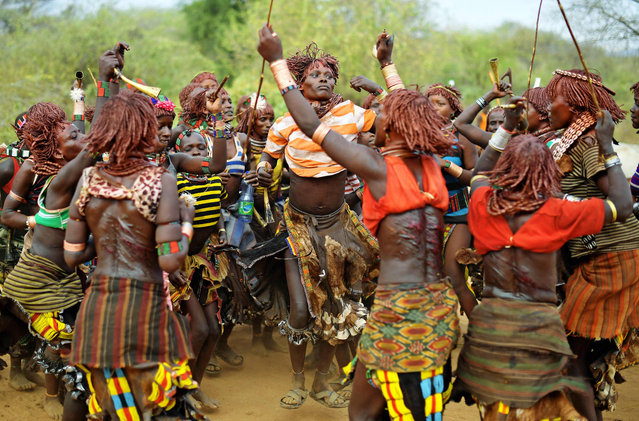
Hamar women dance before a bull jumping ceremony in Ethiopia's southern Omo Valley region near Turmi on September 19, 2016. The Hamar are a Nilotic ethnic group in Ethiopia. The construction of the Gibe III dam, the third largest hydroelectric plant in Africa, and large areas of very “thirsty” cotton and sugar plantations and factories along the Omo river are impacting heavily on the lives of tribes living in the Omo Valley who depend on the river for their survival and way of life. Human rights groups fear for the future of the tribes if they are forced to scatter, give up traditional ways through loss of land or ability to keep cattle as globalisation and development increases. (Photo by Carl De Souza/AFP Photo)

Hamar women dance before a bull jumping ceremony in Ethiopia's southern Omo Valley region near Turmi on September 19, 2016. The Hamar are a Nilotic ethnic group in Ethiopia. The construction of the Gibe III dam, the third largest hydroelectric plant in Africa, and large areas of very “thirsty” cotton and sugar plantations and factories along the Omo river are impacting heavily on the lives of tribes living in the Omo Valley who depend on the river for their survival and way of life. (Photo by Carl De Souza/AFP Photo)
Details
02 Oct 2016 08:45:00
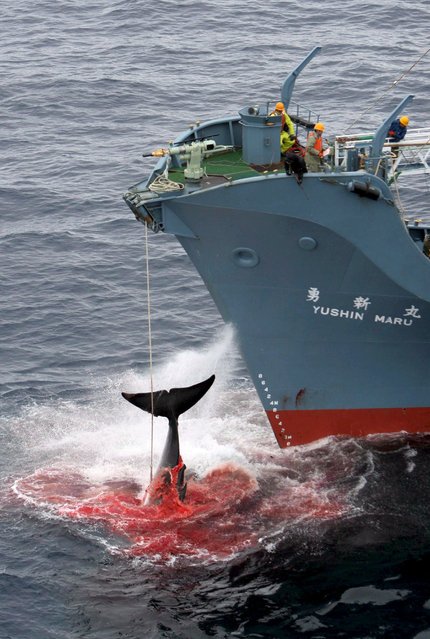
A file photograph dated 07 January 2006 and released by Greenpeace, showing the Yushin Maru, a factory ship in a Japanese whaling fleet, injuring a whale with it's first harpoon attempt. A UN court in The Hague on 31 March 2014 halted Japan's much-criticized whaling programme, ruling that it contravenes a 1986 moratorium on whale hunting. Japan must end its 'research whaling' programme, the International Court of Justice (ICJ) said. (Photo by Kate Davison/EPA)

A file photograph dated 07 January 2006 and released by Greenpeace, showing the Yushin Maru, a factory ship in a Japanese whaling fleet, injuring a whale with it's first harpoon attempt. A UN court in The Hague on 31 March 2014 halted Japan's much-criticized whaling programme, ruling that it contravenes a 1986 moratorium on whale hunting. Japan must end its 'research whaling' programme, the International Court of Justice (ICJ) said. Japan said the programme was for scientific research and permitted under international conventions. Australia had brought the case to the ICJ in 2010, charging that Japan was breaching international law by killing hundreds of whales every year for commercial purposes. Japan was “deeply disappointed” by the ruling, an unnamed government official was quoted by the Kyodo News agency as saying. But the official said Japan would stand by the ruling. (Photo by Kate Davison/EPA)
Details
01 Apr 2014 08:38:00
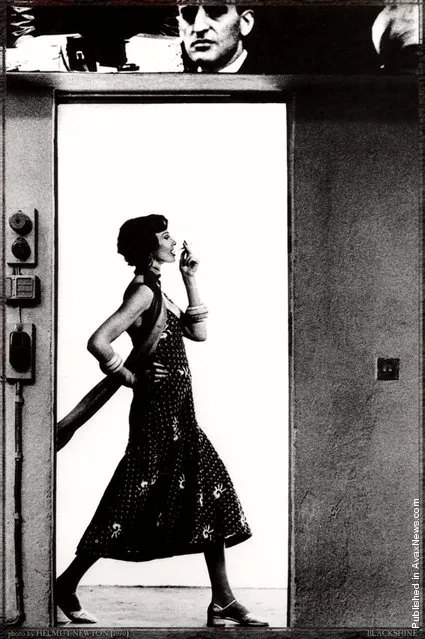
Photographers: Helmut Newton

“Newton was born in Berlin, the son of Klara “Claire” (Marquis) and Max Neustädter, a button factory owner. His family was Jewish. Newton attended the Heinrich-von-Treitschke-Realgymnasium and the American School in Berlin. Interested in photography from the age of 12 when he purchased his first camera, he worked for the German photographer Yva (Elsie Neulander Simon) from 1936. The increasingly oppressive restrictions placed on Jews by the Nuremberg laws meant that his father lost control of the factory in which he manufactured buttons and buckles; he was briefly interned in a concentration camp on “Kristallnacht”, November 9, 1938, which finally compelled the family to leave Germany. Newton's parents fled to South America. He was issued with a passport just after turning 18, and left Germany on December 5, 1938. At Trieste he boarded the “Conte Rosso” (along with about 200 others escaping the Nazis) intending to journey to China. After arriving in Singapore he found he was able to remain there, first and briefly as a photographer for the Straits Times and then as a portrait photographer”. – Wikipedia

Photo: Sigourney Weaver by Helmut Newton, 1995.
Details
08 Apr 2012 13:49:00
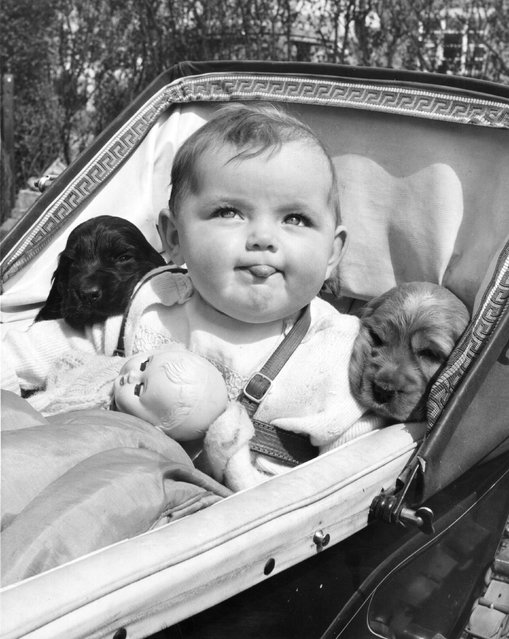
Seven month old Christine Joy shares her pram with two 5 week old Gunsure Golden Cherry's cocker spaniel pups from Gunsure Kennels in Ashford, Middlesex. 22nd May 1953. (Photo by Fred Morley/Fox Photos)

Seven month old Christine Joy shares her pram with two 5 week old Gunsure Golden Cherry's cocker spaniel pups from Gunsure Kennels in Ashford, Middlesex. 22nd May 1953. (Photo by Fred Morley/Fox Photos)
Details
08 Oct 2012 09:00:00