Loading...
Done
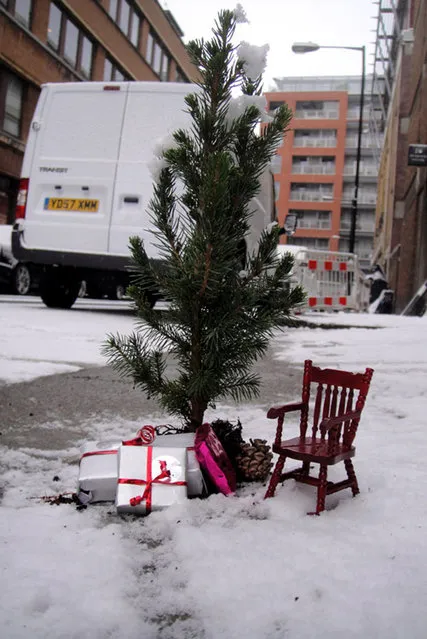
The Pothole Gardener

Steve Wheen understands that nobody likes to pay a pile of taxes only to hit potholes on their way to work every day, so he started filling up the pesky cracks in East London with mini living worlds comprised of soil, plants, and adorable props. The guerrilla gardener creates these mini (mostly domestic) scenes on quiet streets, dead end lanes, and foot paths, snaps photographs of his work, and then removes the props so that nobody gets a chair in their tire! When he's satisfied with his projects, he documents them over at The Pothole Gardener.
Details
17 Nov 2012 10:02:00
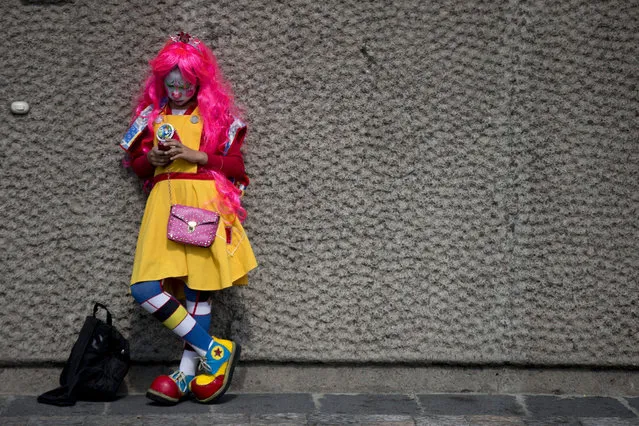
A clown checks her phone as she waits outside the Basilica of Our Lady of Guadalupe, in Mexico City, Monday, December 14, 2015. (Photo by Rebecca Blackwell/AP Photo)

A clown checks her phone as she waits outside the Basilica of Our Lady of Guadalupe, in Mexico City, Monday, December 14, 2015. Hundreds of clowns belonging to various clown associations made their annual pilgrimage to the Basilica on Monday to pay their respects to the Virgin of Guadalupe, Mexico's patron saint. (Photo by Rebecca Blackwell/AP Photo)
Details
16 Dec 2015 08:05:00
Lola is seen at left in everyday clothes – and then at right in her work clothes. She works as a clown in Paris. (Photo by Bruno Fert/Picturetank)

“The series of photos called Workwears, by French photographer Bruno Fert, visually juxtaposes people’s private lives with their lives at work. A firefighter, a fisherman, a nurse, a diver, a judge. One by one, Fert’s photos show people in their homes wearing everyday clothing – followed by another photo showing them dressed in the clothing of their chosen professions. Our reaction, Fert said, reminds us how tightly humans hold on to certain stereotypes about some professions. “I like to break those stereotypes”, he said”. – Thom Patterson via CNN. Here: Lola is seen at left in everyday clothes – and then at right in her work clothes. She works as a clown in Paris. (Photo by Bruno Fert/Picturetank)
Details
29 Oct 2014 12:40:00
A harp seal pup

“The harp seal or saddleback seal is a species of earless seal native to the northernmost Atlantic Ocean and adjacent parts of the Arctic Ocean. Newborn pups weigh around 11 kilograms (24 lb) and are 80–85 centimetres (31–33 in) long. After birth, the mother only feeds that pup. During the 12 day nursing period, the mother does not eat, losing up to 3 kilograms (7 lb) per day. Harp seal milk contains up to 48% fat, so pups gain over 2.2 kilograms (4.9 lb) per day. During this time, the juvenile's “greycoat” grows in beneath the white neonatal coat, and it weighs 80 pounds (36 kg)”. – Wikipedia

Photo: A harp seal pup lies on an ice floe in the Gulf of Saint Lawrence March 24, 2008 in Charlottetown, Canada. (Photo by Joe Raedle/Getty Images)
Details
19 Sep 2011 15:49:00


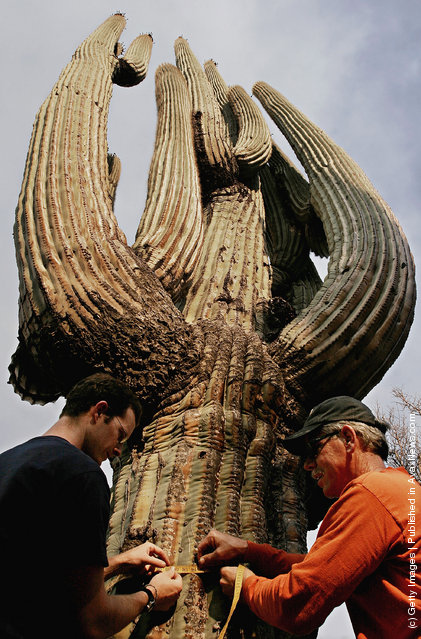
“The saguaro (scientific name Carnegiea gigantea) is a large, tree-sized cactus species in the monotypic genus Carnegiea. It is native to the Sonoran Desert in the U.S. state of Arizona, the Mexican state of Sonora, a small part of Baja California in the San Felipe Desert and an extremely small area of California, U.S. The saguaro blossom is the State Wildflower of Arizona”. – Wikipedia

Photo: Daniel Appel (L), a firefighter with Engine 84 from the Lassen National Forest in California and Mike Hallen, (R), Arizona representative of the National Register of Big Trees, measure the circumference of this Saguaro cactus called the "Grand One," in the Tonto National Forest on July 1, 2005 35 miles north of Phoenix, near Carefree, Arizona. The cactus, estimated to be more than 200 years old, measures a circumference of 7 feet, 10 inches (2.4 meters) and stands 46 feet high (14 meters). The cactus was burned in the Cave Creek Complex fire and may not survive. It was once the largest Saguaro in the world, two others have been found recently that have tied it's measurements. The fire has burned more than 214,000 acres of the Sonoran desert. (Photo by Jeff Topping/Getty Images)
Details
26 Jul 2011 12:27:00
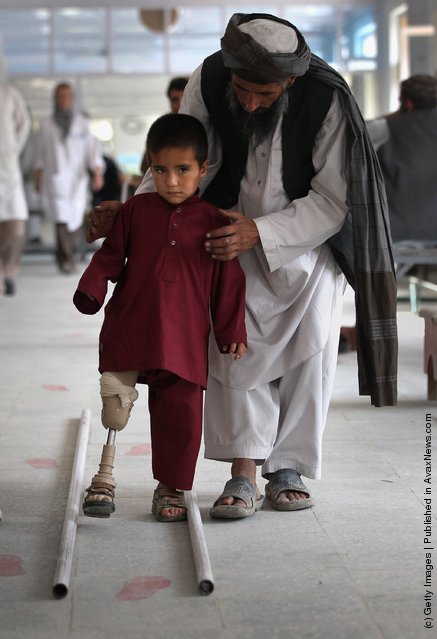
Afghan war amputees

An Afghan child practices walking with his new prosthesis at the International Committee of the Red Cross (ICRC), orthopedic center on September 10, 2011 in Kabul, Afghanistan. After more than 30 years of war and a decade since the 9/11 attacks in the United States, thousands of Afghans, both military and civilian, continue to pay a heavy price from the conflict. The ICRC center makes prosthetics for amputees and helps them, as well as Afghans with spinal injuries and children with congenital birth defects, to learn to walk. (Photo by John Moore/Getty Images)
Details
11 Sep 2011 09:56:00
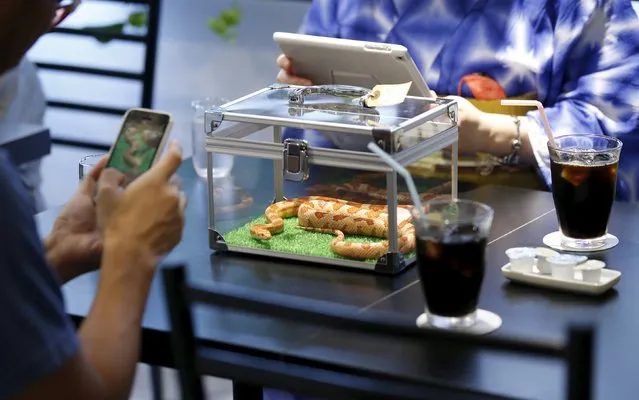
Customers take photos of a snake at the Tokyo Snake Center, a snake cafe, in Tokyo's Harajuku shopping district  August 14, 2015. (Photo by Toru Hanai/Reuters)

Customers take photos of a snake at the Tokyo Snake Center, a snake cafe, in Tokyo's Harajuku shopping district August 14, 2015. The cafe has on display 35 non-venomous snakes of 20 different breeds. Open six days a week, the cafe allows customers to enjoy food and beverages while watching a small snake slither around in a cage on their table for a 1,000 yen (8.04 dollars). By paying an additional fee, customers get to hold and pet the snake. (Photo by Toru Hanai/Reuters)
Details
15 Aug 2015 11:42:00
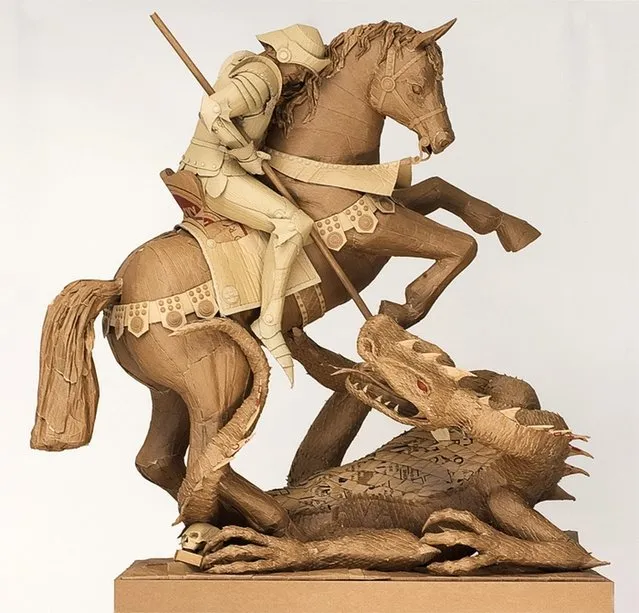
Cardboard Sculptures By Chris Gilmour

Chris Gilmour is one of those people that can turn unexpected things, which most of us would simply discard as trash, into astounding works of art. By taking simple cardboard packaging and other recycled items, he was able to create intricate replicates of various large items, paying close attention to even the smallest details. His cardboard sculptures include everything from vehicles (motorbikes, cars, bicycles) to religious symbols. Some people may find it sacrilege to create religious icons out of trash, which includes toothpaste, condoms, etc.; however, art should not be bound by prejudice and bigotry of close-minded individuals. (Photo by Chris Gilmour)
Details
27 Jan 2015 11:59:00