Loading...
Done
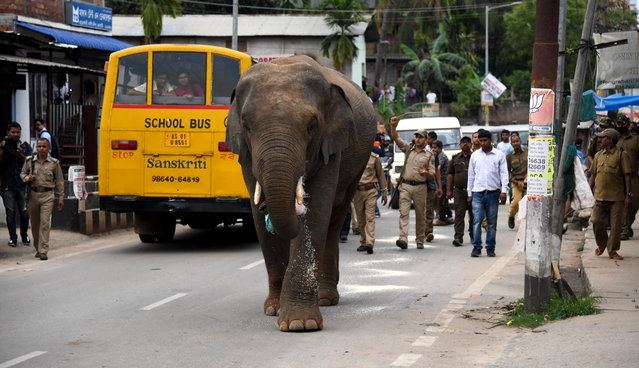
Indian forest officials and police personnel try to chase away a wild male elephant at Hengrabari area in Guwahati on April 30, 2019. The elephant came down from Amchang Wildlife Sanctuary in search of food and later forest official tranquillized it, local media reported. As the pressure of population pushes human habitation closer to forests incidents of wild animals straying into cities is increasingly reported. (Photo by Biju Boro/AFP Photo)

Indian forest officials and police personnel try to chase away a wild male elephant at Hengrabari area in Guwahati on April 30, 2019. The elephant came down from Amchang Wildlife Sanctuary in search of food and later forest official tranquillized it, local media reported. As the pressure of population pushes human habitation closer to forests incidents of wild animals straying into cities is increasingly reported. (Photo by Biju Boro/AFP Photo)
Details
02 May 2019 00:07:00
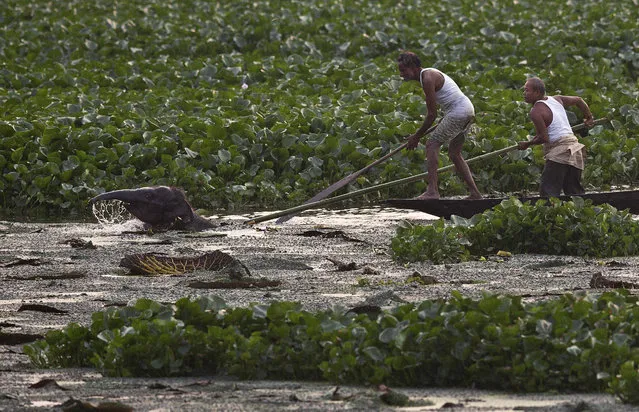
In this Friday, May 10, 2019, file photo, rescuers help a baby wild elephant cross the wetland to return to the forest at Deepor Beel wildlife sanctuary in Gauhati, India. The elephant had gotten stuck in the waters of Deepor Beel after it was separated from a herd of wild elephant that came down in search of food last night. (Photo by Anupam Nath/AP Photo)

In this Friday, May 10, 2019, file photo, rescuers help a baby wild elephant cross the wetland to return to the forest at Deepor Beel wildlife sanctuary in Gauhati, India. The elephant had gotten stuck in the waters of Deepor Beel after it was separated from a herd of wild elephant that came down in search of food last night. (Photo by Anupam Nath/AP Photo)
Details
23 May 2019 00:05:00
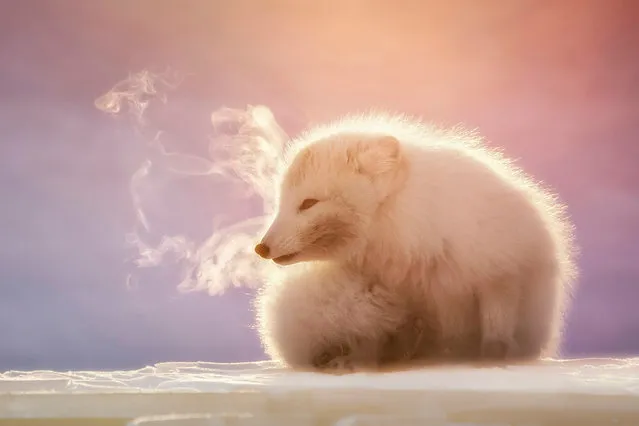
Breath of an Arctic fox by Marco Gaiotti, Italy. Marco was watching this little Arctic fox as it incessantly called another nearby. Gradually he noticed the fox’s wet breath was quickly freezing in the air after each call. It was late winter in Spitsbergen, Svalbard, and the air was -35C (-31F). Photographing Arctic foxes is often frustrating, as they are normally running around fast in search of food, but this one was very relaxed and let Marco get close enough to focus on it, with the light glowing perfectly in the background. (Photo by Marco Gaiotti/Wildlife Photographer of the Year 2021)

Breath of an Arctic fox by Marco Gaiotti, Italy. Marco was watching this little Arctic fox as it incessantly called another nearby. Gradually he noticed the fox’s wet breath was quickly freezing in the air after each call. It was late winter in Spitsbergen, Svalbard, and the air was -35C (-31F). Photographing Arctic foxes is often frustrating, as they are normally running around fast in search of food, but this one was very relaxed and let Marco get close enough to focus on it, with the light glowing perfectly in the background. (Photo by Marco Gaiotti/Wildlife Photographer of the Year 2021)
Details
05 Dec 2021 06:36:00
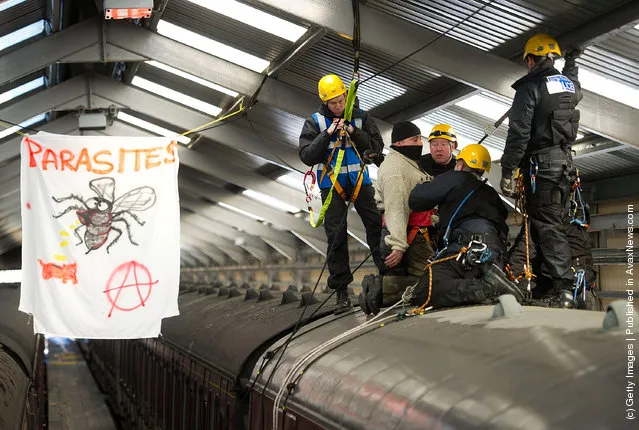
Police take part in a role play exercise as they clear a protest on top of a train during training in Oxenhope, England

Police take part in a role play exercise as they clear a protest on top of a train during training on March 6, 2012 in Oxenhope, England. A new team of specialist officers set up to deal with searches and policing at a height, such as on top of a train, undergo training exercise in Oxenhope, West Yorkshire. (Photo by Bethany Clarke/Getty Images)
Details
07 Mar 2012 12:02:00
Key Monastery illuminated on a mountain in the Spiti Valley, Himachal Pradesh, northern India with an amazing nights sky illuminated beyond. (Photo by Grey Chow/Caters News Agency)

The Tibetan night sky was captured in these beautiful images showing the stunning buildings and statues in the Himalayan mountains. Grey Chow, 33, traveled for two hours to get to the Spiti Valley to capture the starry backdrop along the isolated, deserted roads. The senior project engineer was able to take amazingly clear images thanks to the limited amount of pollution at the 4,500-foot (1371m) altitude. (Photo by Grey Chow/Caters News Agency)
Details
06 Aug 2018 00:05:00
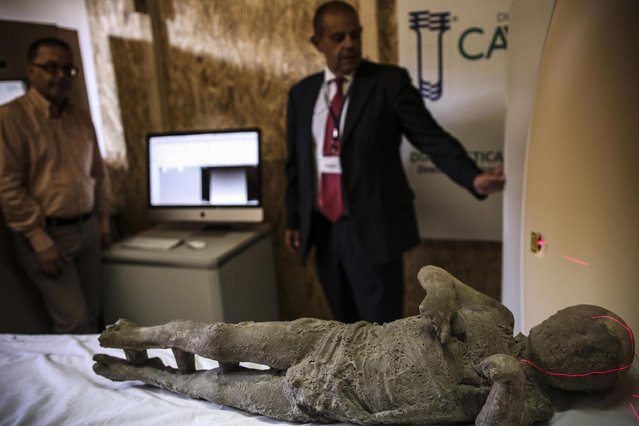
A working team appointed by the Archaeological Superintendence of Pompeii performs a Cat scan (Computerized axial tomography) one out of thirty casts of victims of the eruption of Vesuvius in 79 AD in Pompeii, in Napoli, Italy, 29 September 2015. (Photo by Cesare Abbate/EPA)

A working team appointed by the Archaeological Superintendence of Pompeii performs a Cat scan (Computerized axial tomography) one out of thirty casts of victims of the eruption of Vesuvius in 79 AD in Pompeii, in Napoli, Italy, 29 September 2015. The project which aims to trace the habits of life, employment and social class of the victims, involves a working team of archeologists, anthropologists, radiologists, dentists and engineers to obtain results from the scan. (Photo by Cesare Abbate/EPA)
Details
02 Oct 2015 08:04:00
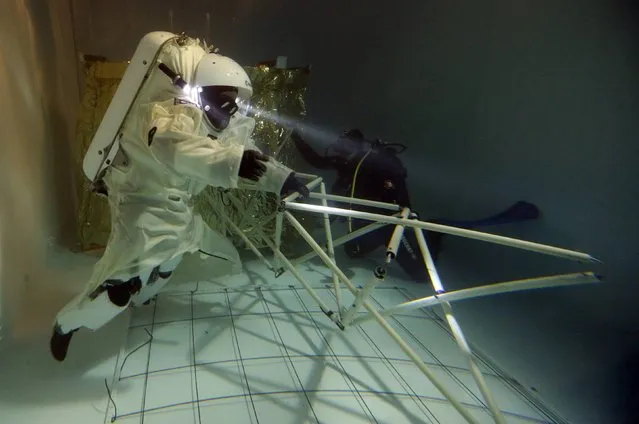
National Diving School director Jerome Vincent, wearing a Gandolfi space suit, executes training procedures in a swimming pool in Marseille October 22, 2014. (Photo by Jean-Paul Pelissier/Reuters)

National Diving School director Jerome Vincent, wearing a Gandolfi space suit, executes training procedures in a swimming pool in Marseille October 22, 2014. The underwater test session develops European expertise in spacewalk simulations under partial gravity for exploring the Moon, asteroids and Mars.The training is organised by Comex, a French company specializing in engineering and deep sea diving operations, in collaboration with the European Space Agency (ESA) and with Apollo XI “Under the sea”. (Photo by Jean-Paul Pelissier/Reuters)
Details
26 Oct 2014 12:47:00
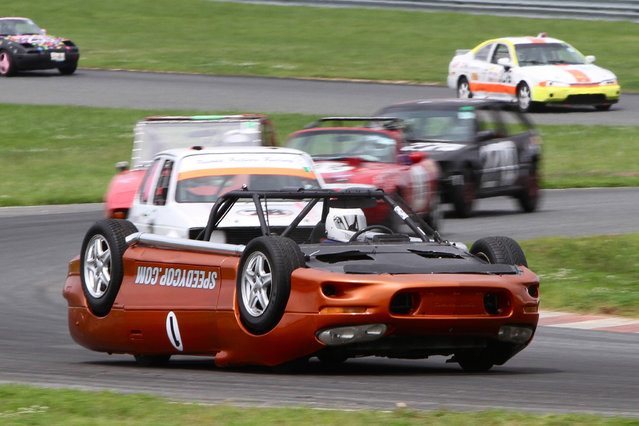
Upside Down Race Car By Jeff Bloch Aka SpeedyCop

An American inventor has built a unique upside-down racecar – and successfully taken it on a 24-hour spin around the LeMons track. Jeff Bloch – also known as SpeedyCop – built his upside down 1999 Chevrolet Camaro by combining it with a decrepit 1990 Ford Festiva. To enter the latest LeMons race the car had to cost less than $500, which Bloch achieved by picking a Festiva model with a worn-out 1.3-litre engine and more than 300,000 kilometres on the clock.
Details
03 Dec 2013 09:47:00