Loading...
Done
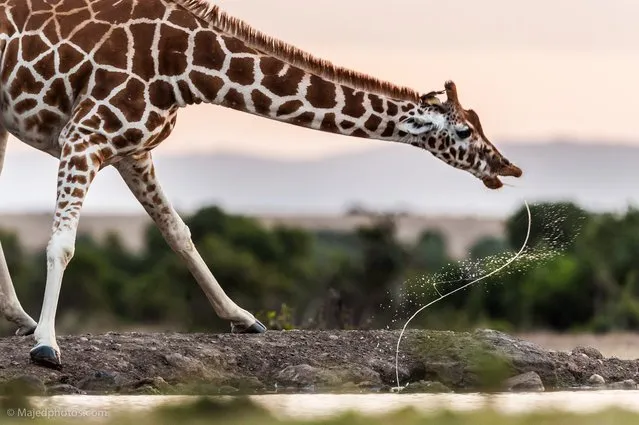
“We just want to move to search to the Leopard at that morning but we found a group of giraffes come toward a small lake and start drinking it was a nice moment when the Giraffe finish from drinking and leave a letters S with motion in the air”. (Photo and caption by Majed Ali)

National Geographic invites photographers from around the world to enter the 2013 National Geographic Photography Contest. The grand-prize winner will receive $10,000 (USD) and a trip to National Geographic headquarters in Washington, D.C., to participate in the annual National Geographic Photography Seminar in January 2014. Photo: “We just want to move to search to the Leopard at that morning but we found a group of giraffes come toward a small lake and start drinking it was a nice moment when the Giraffe finish from drinking and leave a letters “S” with motion in the air”. (Photo and caption by Majed Ali/National Geographic Photography Contest)
Details
15 Nov 2013 14:34:00
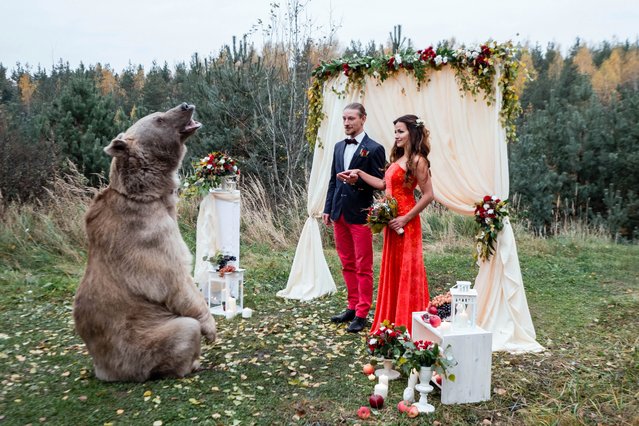
Denis and Nelya, both 30, from Moscow, Russia invited brown bear Stepan along to their very special ceremony. As well as witnessing the couple exchange vows, the bear also played the role of registrar at one point. Denis said: “We both knew Stepan is a very kind bear but still it is a huge, unpredictable animal so we were a bit scared, but still happy to be able to make our dream come true. It was a fantastic experience to have this photoshoot with Stepan”. (Photo by Olga Barantseva/Caters News)

Denis and Nelya, both 30, from Moscow, Russia invited brown bear Stepan along to their very special ceremony. As well as witnessing the couple exchange vows, the bear also played the role of registrar at one point. Denis said: “We both knew Stepan is a very kind bear but still it is a huge, unpredictable animal so we were a bit scared, but still happy to be able to make our dream come true. It was a fantastic experience to have this photoshoot with Stepan”. (Photo by Olga Barantseva/Caters News)
Details
01 Nov 2016 12:14:00
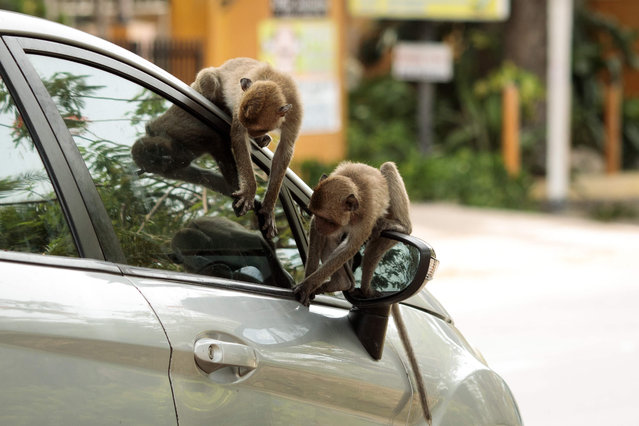
Macaque monkeys sit on a car in Hua Hin on May 29, 2020, as low tourist numbers due to the ongoing COVID-19 novel coronavirus situation have resulted in a decrease in the number of people feeding them. The monkeys in the town are going hungry as a consequence of the drop in tourism as a result of the COVID-19 coronavirus pandemic. (Photo by Jack Taylor/AFP Photo)

Macaque monkeys sit on a car in Hua Hin on May 29, 2020, as low tourist numbers due to the ongoing COVID-19 novel coronavirus situation have resulted in a decrease in the number of people feeding them. The monkeys in the town are going hungry as a consequence of the drop in tourism as a result of the COVID-19 coronavirus pandemic. (Photo by Jack Taylor/AFP Photo)
Details
22 Jun 2020 00:05:00
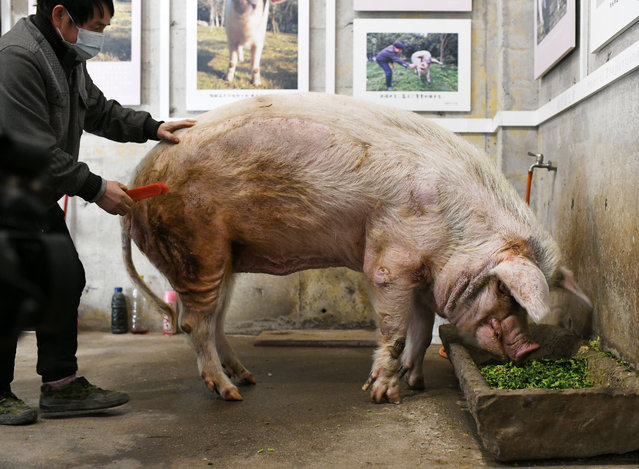
Zhu Jianqiang, or “strong-willed pig”, famous for surviving more than a month buried in the ruins after the magnitude-8.0 Wenchuan earthquake in 2008, feeds on food sent by admirers wishing it a safe winter in Jianchuan Museum, Chengdu city, southwest China's Sichuan province, 11 January 2021. (Photo by Rex Features/Shutterstock)

Zhu Jianqiang, or “strong-willed pig”, famous for surviving more than a month buried in the ruins after the magnitude-8.0 Wenchuan earthquake in 2008, feeds on food sent by admirers wishing it a safe winter in Jianchuan Museum, Chengdu city, southwest China's Sichuan province, 11 January 2021. (Photo by Rex Features/Shutterstock)
Details
19 Jan 2021 00:01:00
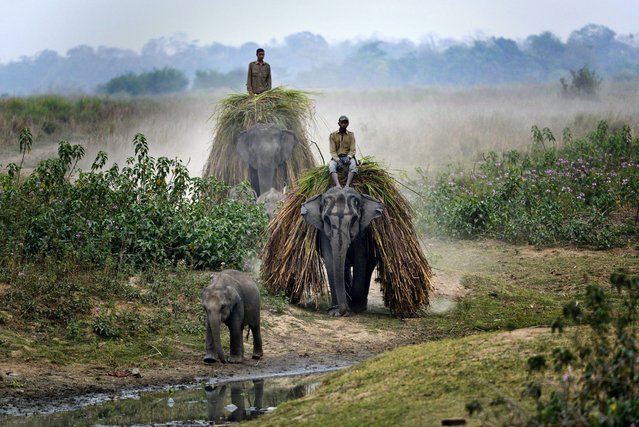
Mahouts return home with their elephants carrying grass to feed them on the eve of the rhino census in Kaziranga National Park in Assam state, India, 24 March 2015. Kaziranga will be closed to visitors for the next two days for a census of the rhinos commencing 25 March, in a previous census in 2013 in the park the population of the Indian rhinos was 2329. (Photo by EPA/Stringer)

Mahouts return home with their elephants carrying grass to feed them on the eve of the rhino census in Kaziranga National Park in Assam state, India, 24 March 2015. Kaziranga will be closed to visitors for the next two days for a census of the rhinos commencing 25 March, in a previous census in 2013 in the park the population of the Indian rhinos was 2329. (Photo by EPA/Stringer)
Details
28 Mar 2015 11:46:00
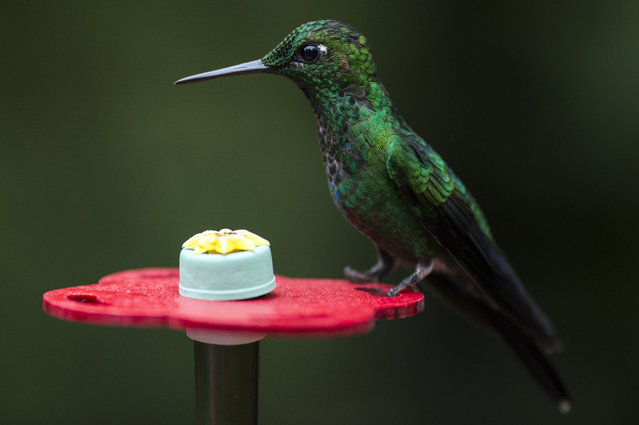
A Green Crowned Brilliant is pictured at a Hummingbird feeding station on January 15, 2016 in Alajuela Costa Rica. (Photo by Dan Kitwood/Getty Images)

A Green Crowned Brilliant is pictured at a Hummingbird feeding station on January 15, 2016 in Alajuela Costa Rica. Of the 338 known species of Hummingbird worldwide there are around 50 in Costa Rica. Hummingbirds are named for the distinctive sound made by their tiny beating wings, and are admired for their vibrantly coloured iridescent plumage. Their ability to hover, with wings beating between 12 and 90 times a second, and to fly backwards makes them different from all other birds. (Photo by Dan Kitwood/Getty Images)
Details
05 Feb 2016 10:45:00
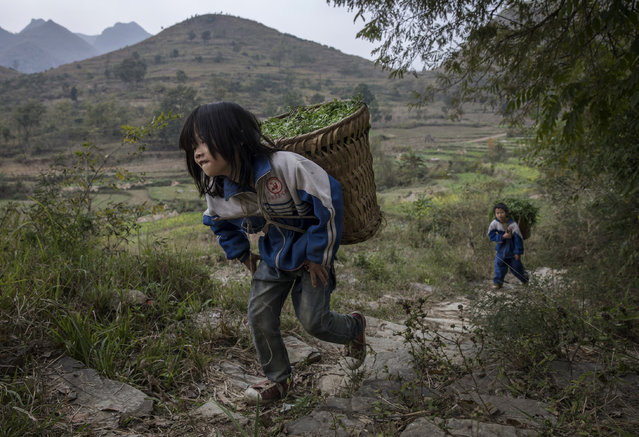
“Left behind” children Luo Hongni, 11 (L) and brother  Luo Gan,10, carry flowers to be used as feed while doing chores in the fields on December 18, 2016 in Anshun, China. (Photo by Kevin Frayer/Getty Images)

“Left behind” children Luo Hongni, 11 (L) and brother Luo Gan,10, carry flowers to be used as feed while doing chores in the fields on December 18, 2016 in Anshun, China. Like millions of Chinese children, the four Luo siblings are being raised by their grandparents in rural China as their parents left to find work in urban areas. (Photo by Kevin Frayer/Getty Images)
Details
18 Feb 2017 00:03:00
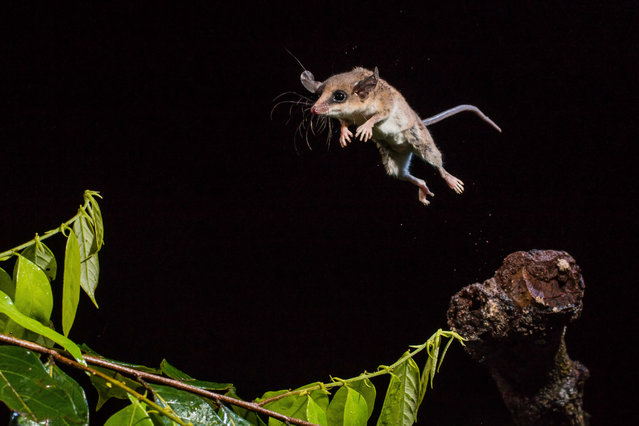
Tropical acrobatics by Adrià López Baucells in Manaus, Brazil. An unidentified South American marsupial, although the characteristic black markings on its face indicate it may be a mouse opossum. These small creatures are nocturnal and feed on bugs, fruit and bird eggs. (Photo by Adrià López Baucells/2019 Royal Society of Biology Photography Competition)

Tropical acrobatics by Adrià López Baucells in Manaus, Brazil. An unidentified South American marsupial, although the characteristic black markings on its face indicate it may be a mouse opossum. These small creatures are nocturnal and feed on bugs, fruit and bird eggs. (Photo by Adrià López Baucells/2019 Royal Society of Biology Photography Competition)
Details
10 Oct 2019 00:03:00