Loading...
Done
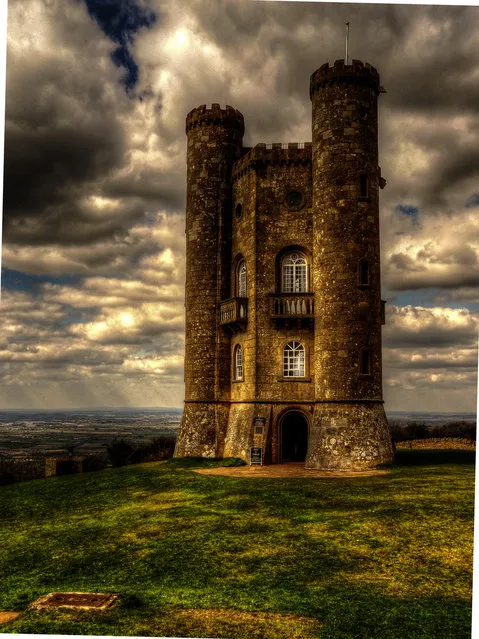
Broadway Tower In English

Broadway Tower is a folly located on Broadway Hill, near the village of Broadway, in the English county of Worcestershire, at the second highest point of the Cotswolds after Cleeve Hill. Broadway Tower's base is 1,024 feet (312 metres) above sea level. The tower itself stands 55 feet (17 metres) high. The “Saxon” tower was designed by James Wyatt in 1794 in the form of a castle, and built for Lady Coventry in 1799. The tower was built on a “beacon” hill, where beacons were lit on special occasions. Lady Coventry wondered if a beacon on this hill could be seen from her house in Worcester – approximately 22 miles (35 km) away – and sponsored the construction of the folly to find out. The beacon could be seen clearly.
Details
19 Dec 2013 10:06:00
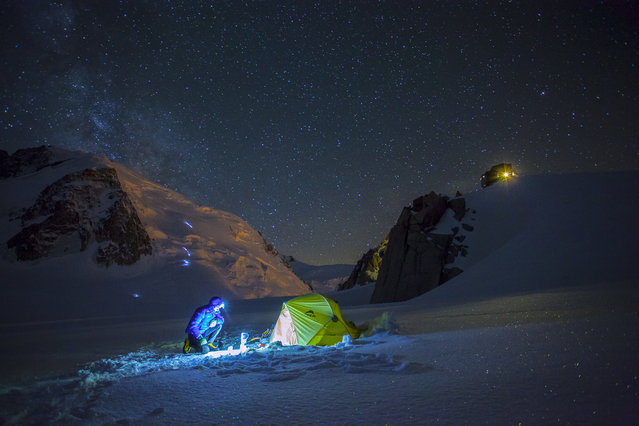
“A snapshot from mountaineer's life”. Have you ever wondered how does a mountaineer's day start? (Photo and caption by Kamil Tamiola/National Geographic Traveler Photo Contest)

“A snapshot from mountaineer's life”. Have you ever wondered how does a mountaineer's day start? I will give you a hint: you wake up at 3 am, set the stove, wake up your partner, pretend it is warm, quickly consume a high-calorie breakfast, watch your friends slowly ascending the icy slopes of your dream summit with their tiny head torches glimmering against perfectly blue ice, and hope for the good weather. One would ask: why all this trouble? The answer is easy: for the love of the adventure and the unknown. Location: Chamonix, Haute Savoye, France. (Photo and caption by Kamil Tamiola/National Geographic Traveler Photo Contest)

ATTENTION! All pictures are presented in high resolution. To see Hi-Res images – just TWICE click on any picture. In other words, click small picture – opens the BIG picture. Click BIG picture – opens VERY BIG picture.
Details
27 Jun 2013 12:47:00
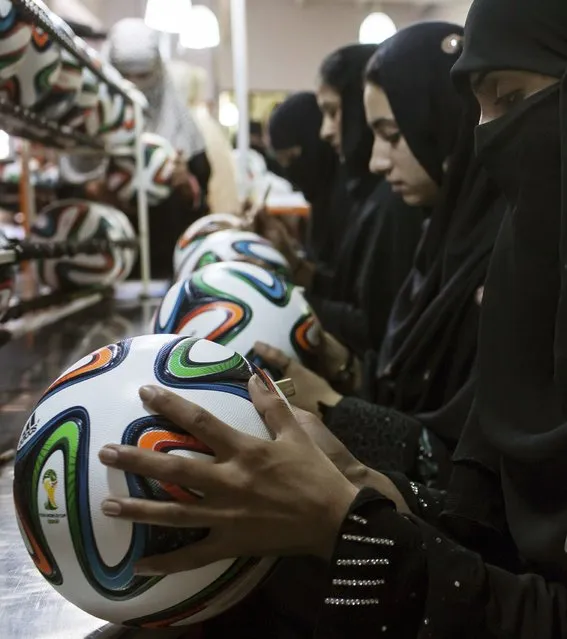
Employees conduct a final check to fix any cavities in the seams of balls inside the soccer ball factory that produces official match balls for the 2014 World Cup in Brazil, in Sialkot, Punjab province May 16, 2014. (Photo by Sara Farid/Reuters)

Employees conduct a final check to fix any cavities in the seams of balls inside the soccer ball factory that produces official match balls for the 2014 World Cup in Brazil, in Sialkot, Punjab province May 16, 2014. It was when he felt the roar of the crowd at the 2006 World Cup in Germany that Pakistani factory owner Khawaja Akhtar first dreamt up a goal of his own: to manufacture the ball for the biggest soccer tournament on the planet. Last year he finally got his chance – but only 33 days to make it happen. (Photo by Sara Farid/Reuters)
Details
26 May 2014 13:59:00
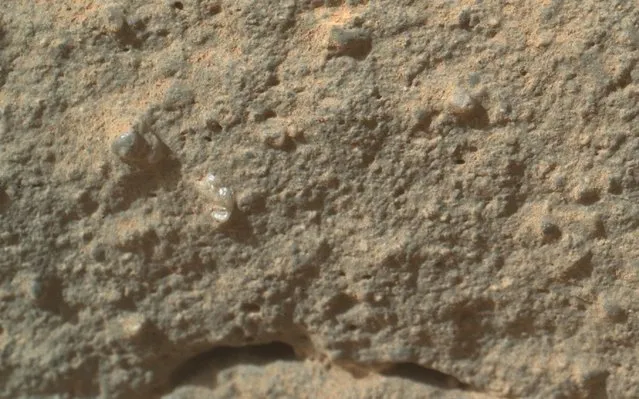
Scientists say that a “Martian flower”, seen here in an image from the Curiosity rover's Mars Hand Lens Imager, is a 2-millimeter-wide grain or pebble that's embedded in the surrounding rock. Another, darker-colored mineral grain can be seen above and to the left. (Photo by NASA)

“The scientists behind NASA's $2.5 billion Curiosity rover mission on Mars on Tuesday explained the nature of a tiny, gleaming "flower" embedded in Red Planet rock, and revealed where they'll be using the SUV-sized robot's drill for the first time”. – Alan Boyle via NBCNews.com

Photo: Scientists say that a “Martian flower”, seen here in an image from the Curiosity rover's Mars Hand Lens Imager, is a 2-millimeter-wide grain or pebble that's embedded in the surrounding rock. Another, darker-colored mineral grain can be seen above and to the left. (Photo by NASA)
Details
16 Jan 2013 11:12:00
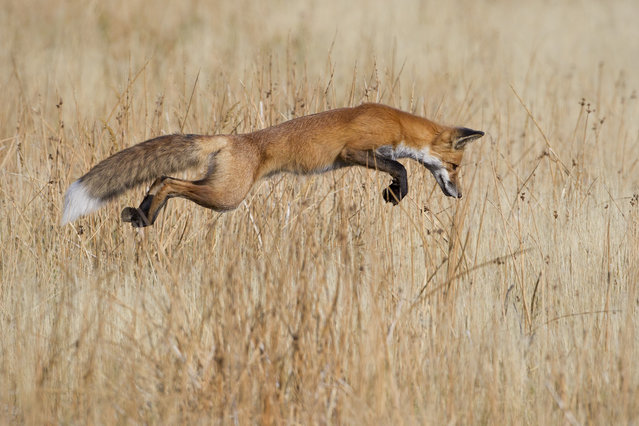
Canada: “Lucky pounce”. (Photo by Connor Stefanison/Wildlife Photographer of the Year 2013)

The winners of The London’s Natural History Museum's prestigious Wildlife Photographer of the Year for 2013 have finally been unveiled. Selected from almost 43,000 entries from 96 countries, the winners offer a glimpse of the stunning array of natural beauty on our planet. Photo: Canada: “Lucky pounce”. “Anticipating the pounce – that was the hardest part”, says Connor, who had come to Yellowstone National Park, Wyoming, USA, in search of wildlife as much as the spectacular landscape. He had found this fox, his first ever, on his last day in the park. It was so absorbed in hunting that Connor had plenty of time to get out of the car and settle behind a rock. It quartered the grassland, back and forth, and then started staring intently at a patch of ground, giving Connor just enough warning of the action to come. When it sprung up, Connor got his shot. And when it landed, the fox got his mouse. (Photo by Connor Stefanison/Wildlife Photographer of the Year 2013)
Details
17 Oct 2013 08:12:00
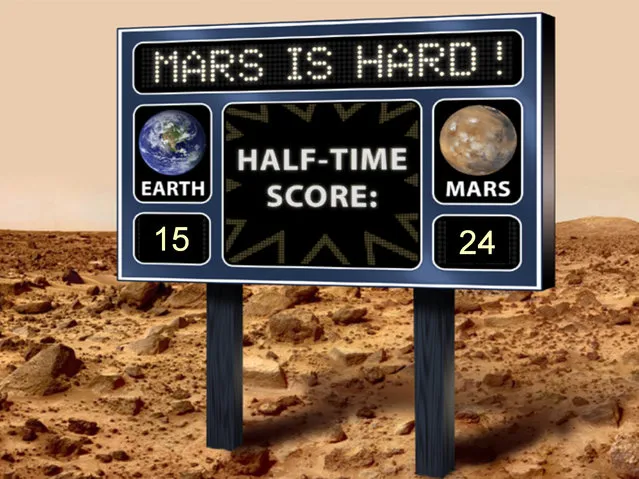
This artist's scoreboard displays a fictional game between Mars and Earth, with Mars in the lead. (Image by NASA/JPL-Caltech)

This artist's scoreboard displays a fictional game between Mars and Earth, with Mars in the lead. It refers to the success rate of sending missions to Mars, both as orbiters and landers. Of the previous 39 missions targeted for Mars from around the world, 15 have been successes and 24 failures. For baseball fans, that's a batting average of .385. The United States has had 13 successes out of 18 attempts, or a “batting average” of .722. NASA's Curiosity rover, set to land on the Red Planet the evening of Aug. 5, 2012 PDT (morning of Aug. 6 EDT), will mark the United States' 19th attempt to tackle the challenge of Mars, and the world's 40th attempt. (Image by NASA/JPL-Caltech)
Details
06 Aug 2012 09:47:00
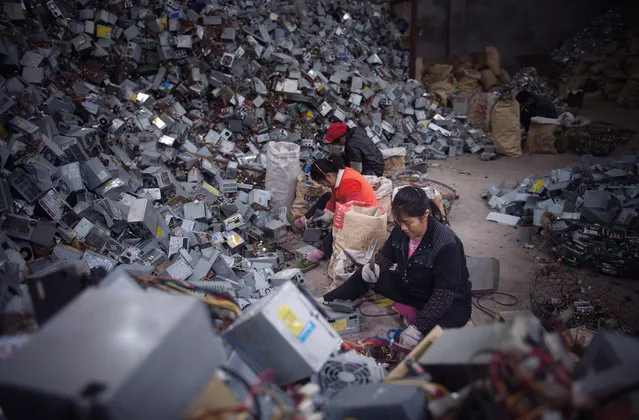
“The sustainable development goals cannot be met unless waste management is addressed as a priority”, says UK waste management charity Waste Aid. “E-waste is one of the fastest growing categories of the 7-10bn tonnes of waste produced globally every year”, adds director Mike Webster. “In our view, decent waste management is a basic right and we want governments around the world take this issue much more seriously – in 2012 only 0.2% of international aid went on improving solid waste management – it’s just not enough”. (Photo by Kai Loeffelbein/laif Agentur)

Sustainable development goal target 12.5 is to reduce waste. But with a planet increasingly dependent on technology, is that even possible? As of today, over 30m tonnes of electronic waste has been thrown out so far this year, according to the World Counts. Most e-waste is sent to landfills in Asia and Africa where it is recycled by hand, exposing the people who do it to environmental hazards. Kai Loeffelbein’s photographs of e-waste recycling in Guiyu, southern China show what happens to discarded computers. (Photo by Kai Loeffelbein/laif Agentur)
Details
19 Oct 2016 12:14:00
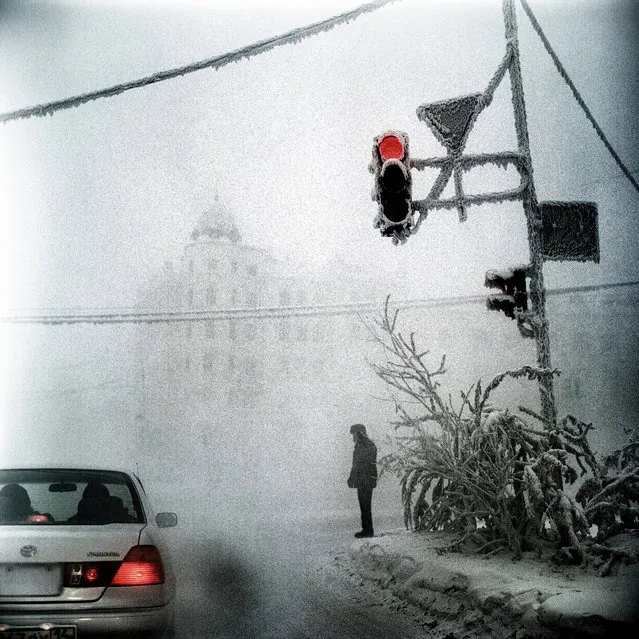
January 2013. A scene in Yakutsk, Siberia, the coldest city in the world. (Photo by Steeve Iuncker/Agence VU)

Yakutsk, a remote city in Eastern Siberia along the Lena River, is the coldest city in the world. Located 1840 km away from Irkoustk and 5000 km away from Moscow, this city founded in 1632 by the Cossacks imposes upon its inhabitants an extreme way of life. And yet, despite particularly harsh conditions, Yakutsk boasts a population of 270,000, or a quarter of the entire population of Siberia. No other place on the planet experiences the temperature extreme found here: in winter, the temperatures regularly fall to minus 40° (the coldest temperature recorded was –64°C) and in summer often reaches temperatures above 30°C. Photo: January 2013. A scene in Yakutsk, Siberia, the coldest city in the world. (Photo by Steeve Iuncker/Agence VU)
Details
29 Apr 2013 10:30:00